GS 1: Modern HistoryGS 3: Science & TechnologyEthicsPrelims
The Darwin of Botany, Pg9
"Darwin of Botany" Sir J.C. Bose lauded in London, championing science for India's industrial and agricultural prosperity.
Practice MCQs
847 Students attempted
Key Highlights:
- Sir Jagadish Chandra Bose was honored at a luncheon in London on June 11, 1926, hosted by the British Indian Union.
- Lord Lee of Fareham presided, praising Bose's contributions to science and humanity.
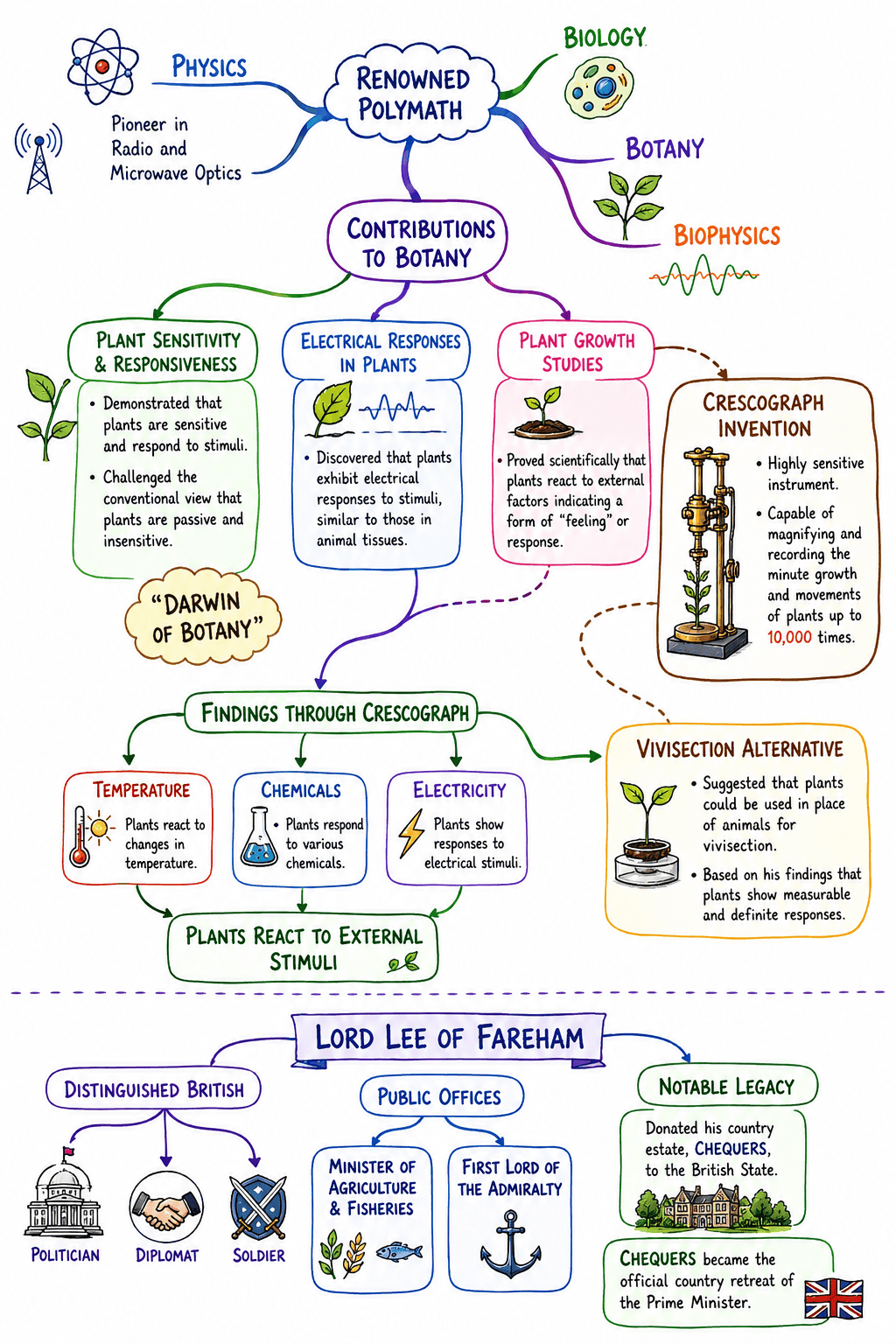
- Bose was referred to as the "Darwin of Botany" for his pioneering work in plant physiology.
- He proposed substituting plants for animals in vivisection experiments, suggesting an ethical alternative.
- Sir Jagadish emphasized the critical role of science in developing both industry and agriculture for India's economic welfare.
JC Bose.png
Detailed Insights:
- Sir Jagadish Chandra Bose was a renowned polymath, making significant contributions across physics, biology, botany, and biophysics, and is considered a pioneer in radio and microwave optics.
- His epithet, "Darwin of Botany," acknowledged his groundbreaking research that demonstrated the sensitivity and responsiveness of plants to various stimuli, challenging conventional views.
- Bose's suggestion to use plants in place of animals for vivisection stemmed from his findings that plants exhibit electrical responses to stimuli, akin to those observed in animal tissues.
- He invented the crescograph, a highly sensitive instrument capable of magnifying and recording the minute growth and movements of plants up to 10,000 times.
- This instrument allowed him to prove that plants react to external factors like temperature, chemicals, and electricity, indicating a form of "feeling" or response.
- Lord Lee of Fareham, a distinguished British politician, diplomat, and soldier, served as Minister of Agriculture and Fisheries and First Lord of the Admiralty, and was known for donating his country estate, Chequers, as a retreat for the Prime Minister.
Scientific/Technical Concepts Involved:
- Plant Physiology: The scientific study of the functions and vital processes of plants, including their growth, development, and responses to environmental factors.
- Vivisection: The practice of conducting surgical operations or other experiments on living animals for the purpose of physiological or pathological research.
- Crescograph: An instrument invented by Sir Jagadish Chandra Bose designed to measure and record the extremely slow growth and subtle movements of plants with high magnification.

SuperKalam is your personal mentor for UPSC preparation, guiding you at every step of the exam journey.
Download the App


STUDY RESOURCES
CONTACT US
ⓒ Snapstack Technologies Private Limited