GS 3: Environment & EcologyGS 2: International RelationsGS 3: EconomyPrelims
Green energy can't yet bend climate curve, Pg11
New IGCC report reveals global warming surged to 1.37°C, warns 1.5°C carbon budget depletes in three years despite record renewable energy installations.
Practice MCQs
847 Students attempted
Key Highlights:
- Global warming reached 1.37 degrees Celsius in 2025, as per the Indicators of Global Climate Change (IGCC) report.
- This increase occurred despite record global renewable energy installations, with India and China leading the expansion.
- The global carbon budget is projected to be fully depleted in approximately three years at current emission rates.
- The industrial sector's continued reliance on fossil fuels is a major challenge to curbing greenhouse gas emissions.
- The IGCC report findings were released during mid-year climate talks held in Bonn.
Clean Energy.png
Detailed Insights:
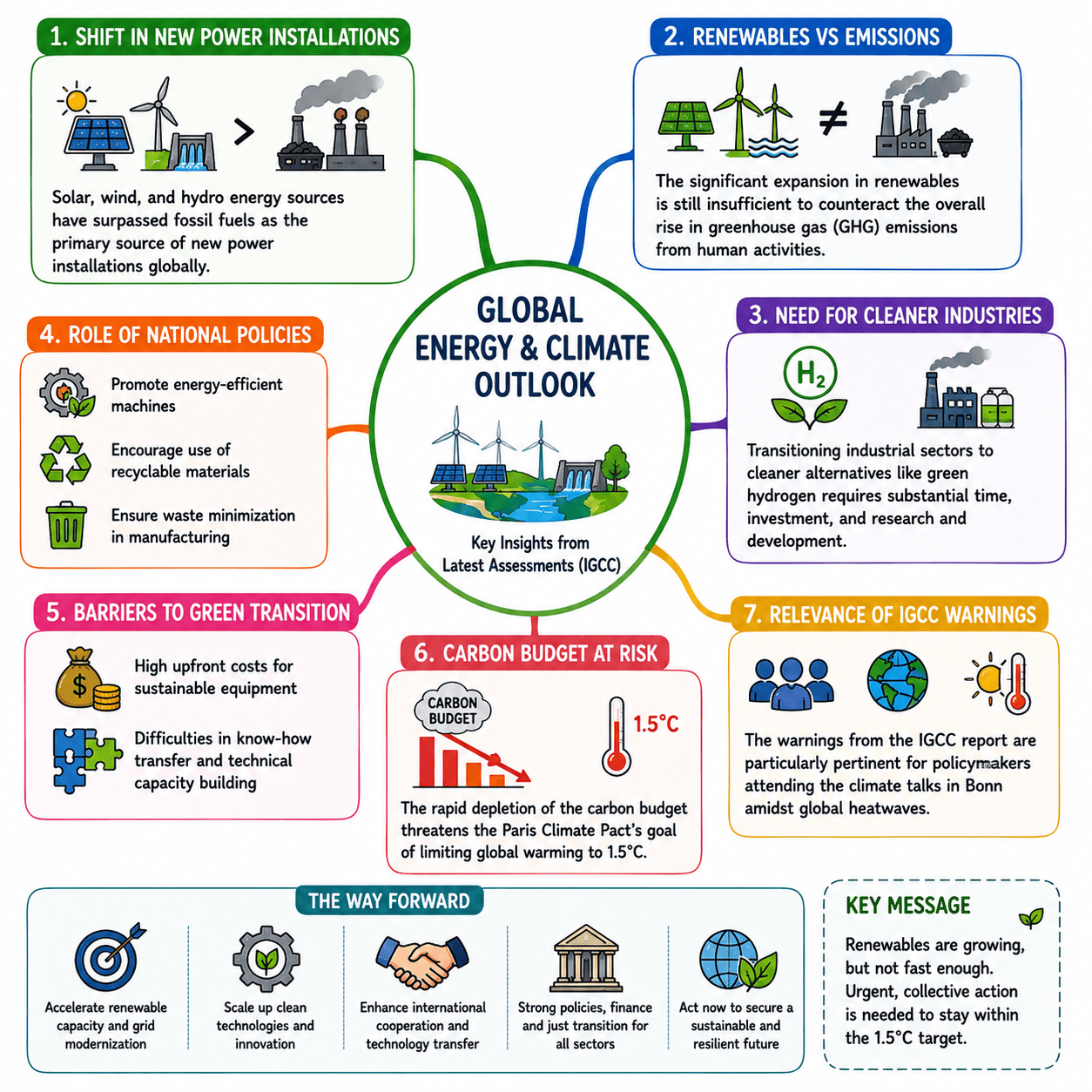
- Solar, wind, and hydro energy sources have surpassed fossil fuels as the primary source of new power installations globally.
- The significant expansion in renewables is still insufficient to counteract the overall rise in greenhouse gas (GHG) emissions from human activities.
- Transitioning industrial sectors to cleaner alternatives like green hydrogen requires substantial time, investment, and research and development.
- National policies can promote energy-efficient machines, the use of recyclable materials, and waste minimization in manufacturing.
- High upfront costs for sustainable equipment and difficulties in know-how transfer are significant barriers to green technology adoption.
- The rapid depletion of the carbon budget threatens the Paris Climate Pact's goal of limiting global warming to 1.5°C.
- The warnings from the IGCC report are particularly pertinent for policymakers attending the climate talks in Bonn amidst global heatwaves.
Key Concepts Involved:
- Greenhouse Gas (GHG) Emissions: Gases in the atmosphere that trap heat, contributing to the warming of the Earth's surface.
- Carbon Budget: The total amount of carbon dioxide that can be emitted globally while still having a chance to limit global warming to a specific temperature target.
- Paris Climate Pact: An international treaty adopted in 2015 aiming to limit global warming to well below 2°C, preferably to 1.5°C, compared to pre-industrial levels.
- Green Hydrogen: Hydrogen produced by splitting water using electrolysis powered by renewable energy, considered a clean energy carrier.

SuperKalam is your personal mentor for UPSC preparation, guiding you at every step of the exam journey.
Download the App


STUDY RESOURCES
CONTACT US
ⓒ Snapstack Technologies Private Limited