GS 3: EconomyGS 3: Environment & EcologyPrelims
Centre waives excise duty on ethanol-blended petrol, Pg16
Amidst soaring fuel costs, Centre slashes excise duty to nil on E22-E30 ethanol-blended petrol, boosting green fuel adoption.
Practice MCQs
847 Students attempted
Key Highlights:
- The Centre has waived excise duty on specific variants of ethanol-blended petrol.
- The waiver applies to E22, E25, E27, and E30 blends of petrol.
- This move, announced by the Finance Ministry, aims to encourage the adoption of higher ethanol blends.
- The decision comes amidst rising petrol and diesel prices, seeking to promote cleaner fuel and energy security.
EBP.png
Detailed Insights:
- The excise duty waiver makes higher ethanol-blended petrol more economically attractive for both producers and suppliers.
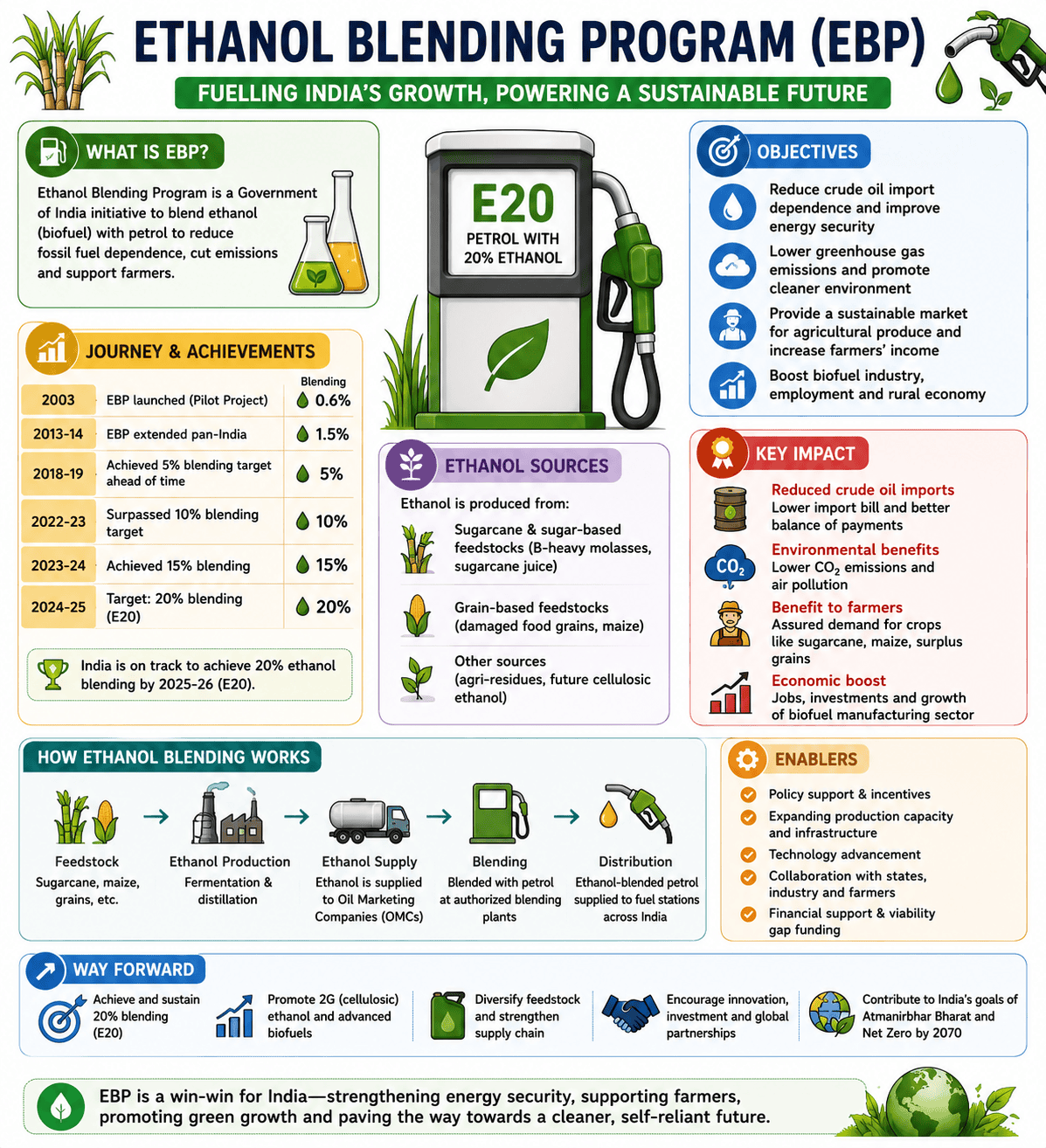
- India's Ethanol Blending Program (EBP) aims to achieve 20% ethanol blending (E20) in petrol by 2025-26, a target advanced from the original 2030 deadline.
- Ethanol blending significantly enhances India's energy security by reducing its heavy reliance on crude oil imports, which account for over 85% of its oil requirements.
- It offers environmental benefits through cleaner combustion, lower emissions, and a reduction in carbon dioxide output.
- Economically, the program is projected to save approximately US $4 billion annually (or Rs. 30,000 crore) with successful E20 implementation.
- The initiative also supports the agricultural sector by creating demand for crops like sugarcane, corn, and damaged food grains, thereby boosting rural incomes.
- The National Policy on Biofuels (2018), amended in 2022, provides the overarching framework for this program, expanding feedstock options for ethanol production.
- The waiver applies to fuel blends that conform to the Bureau of Indian Standards (BIS) specification IS 19850.
- As of April 1, 2026, E20 petrol has become the mandated standard across the country.
Key Concepts Involved:
- Ethanol Blending Program (EBP): A government initiative to mix ethanol with petrol to reduce crude oil imports and promote cleaner fuel.
- Excise Duty: An indirect tax levied by the central government on the manufacture or production of goods within the country.
- Biofuels: Fuels derived from biomass, such as agricultural crops, used as an alternative to fossil fuels.
- E20: A blend of petrol containing 20% ethanol and 80% petrol.

SuperKalam is your personal mentor for UPSC preparation, guiding you at every step of the exam journey.
Download the App


STUDY RESOURCES
CONTACT US
ⓒ Snapstack Technologies Private Limited