GS 3: EconomyGS 2: Governance
Second day, PM makes austerity push, invokes Covid-era habits, Pg1
PM urges austerity amidst West Asia conflict, promoting 'Covid-era' habits, local products, and reduced gold/fuel consumption to safeguard forex reserves.
Practice MCQs
840 Students attempted
Key Highlights:
- PM Narendra Modi urged government and private sectors to reinstate Covid-era practices like work-from-home to mitigate economic impacts of the West Asia conflict.
- India's forex reserves have decreased by $38 billion since the conflict began, causing the rupee to fall past 95 against the US dollar.
- The PM advocated for reduced fuel consumption, promotion of public transport, and preference for local products to decrease imports and foreign exchange outflow.
- Modi advised citizens to postpone gold purchases and reduce cooking oil consumption to ease pressure on foreign exchange reserves.
Detailed Insights:
- The West Asia conflict poses risks to India's economy through increased import prices, disrupted supply chains, and strain on foreign exchange reserves.
- In Q3 2025, India's current account deficit rose to $13.2 billion (1.3% of GDP), compared to $11.3 billion (1.1% of GDP) previously.
- A weaker rupee could diminish investor confidence and worsen the capital account, prompting the government to advocate for austerity measures.
- The PM emphasized domestic tourism and the use of electric vehicles to reduce dependence on foreign goods and services.
- Modi highlighted that a significant portion of India's imports is crude oil, and the conflict-affected regions are major oil suppliers.
Key Concepts Involved:
- Foreign Exchange Reserves: Assets held by a central bank in foreign currencies, used to back liabilities and influence monetary policy.
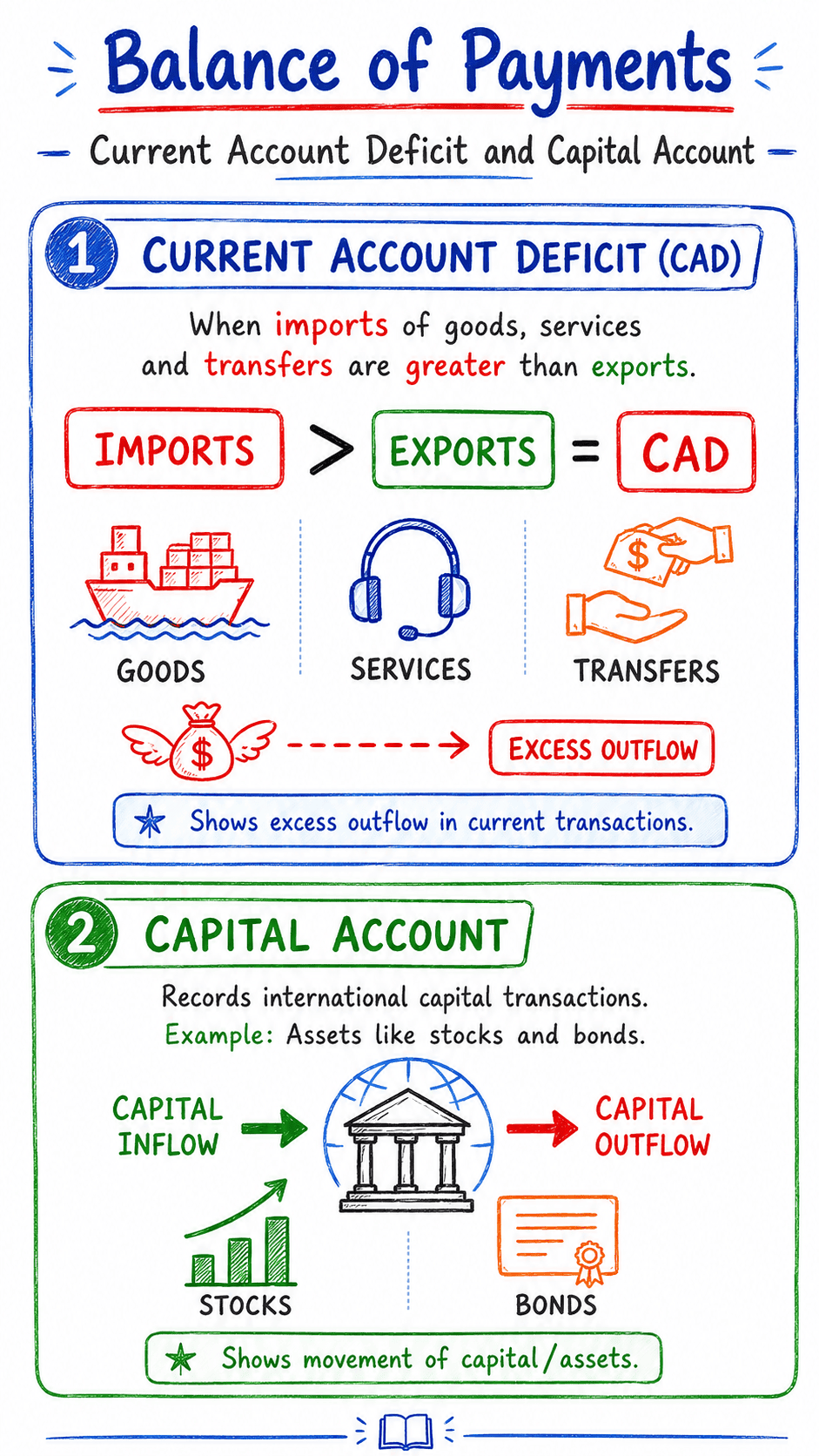
- Current Account Deficit: The shortfall when a country's total imports of goods, services, and transfers are greater than its exports.
- Capital Account: Records all international capital transactions, such as the purchase and sale of assets like stocks and bonds.
BoP

SuperKalam is your personal mentor for UPSC preparation, guiding you at every step of the exam journey.
Download the App


STUDY RESOURCES
CONTACT US
ⓒ Snapstack Technologies Private Limited