GS 3: Science & TechnologyGS 1: Indian GeographyGS 3: EconomyGS 3: Disaster ManagementPrelims
Zojila Tunnel: The challenge of digging through the Himalayas, Pg6
Zojila Tunnel breakthrough at 11,578 feet highlights India's engineering triumph over extreme Himalayan geological and climatic challenges.
Practice MCQs
840 Students attempted
Key Highlights:
- The Zojila Tunnel, a 13-km passage, achieved a significant breakthrough in its construction.
- Located at an altitude of 11,578 feet in the Himalayas, it is one of India's most challenging infrastructure projects.
- Tunnelling in the Himalayas faces unique geological and environmental risks, including highly variable rock strata and extreme temperatures as low as -30°C.
- The project incorporates safety measures such as three deep shafts, with the longest being 474.3m deep, for ventilation and rescue.
- The New Austrian Tunnelling Method (NATM) is being used for excavation, involving selective blasting and immediate structural reinforcement.
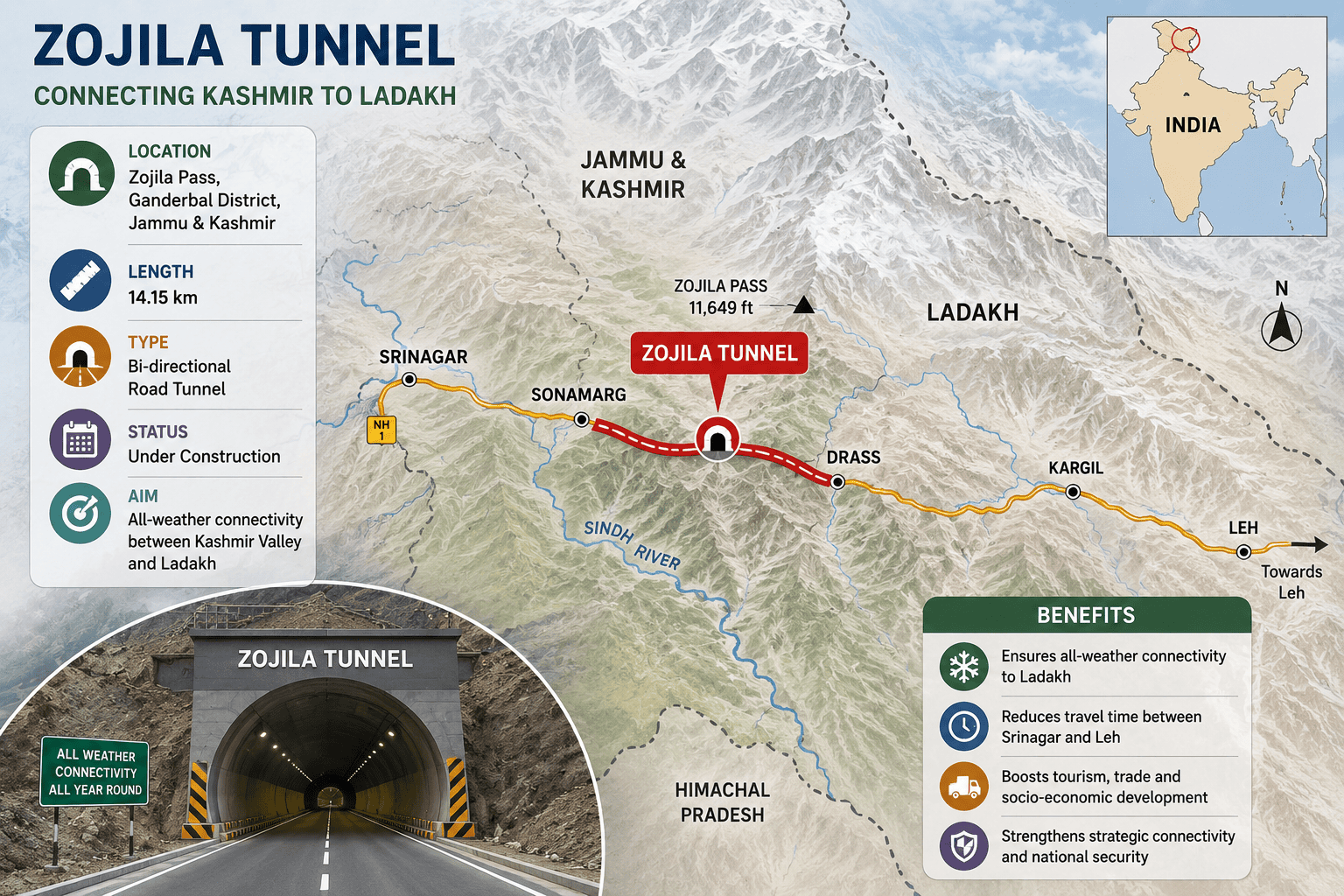
Zojila Tunnel.png
Detailed Insights:
- The Himalayas are a relatively new and tectonically active mountain range, making tunnelling inherently risky due to unstable rock formations.
- Geologists describe the Himalayan rock strata as highly variable, ranging from soft seabed rock to boulders, often differing significantly meter to meter.
- Extreme cold temperatures and high altitudes pose severe challenges for both human workers and machinery, impacting operational efficiency and safety.
- The mountains store significant amounts of water, and melting snow contributes to water ingress, which requires careful management to prevent pressure build-up and potential collapses.
- The NATM involves excavating the top half first, followed by the bottom, and immediately securing the walls with shotcrete and rock bolts to maintain structural integrity.
- Engineers can adjust the tunnel's alignment and the configuration of reinforcements like rock bolts based on real-time geological conditions encountered.
Scientific/Technical Concepts Involved:
- New Austrian Tunnelling Method (NATM): A modern tunnelling approach that uses the geological stress of the surrounding rock mass to stabilize the tunnel, employing shotcrete and rock bolts.
- Shotcrete: A type of concrete or mortar conveyed through a hose and pneumatically projected at high velocity onto a surface, used for structural support and lining.
- Rock bolts: Steel reinforcing bars or cables inserted into holes drilled in rock masses to stabilize rock excavations, preventing rock falls and improving overall stability.
- Tectonic activity: The movement and deformation of the Earth's crust, leading to phenomena like earthquakes, volcanic activity, and mountain building, prevalent in geologically young mountain ranges like the Himalayas.

SuperKalam is your personal mentor for UPSC preparation, guiding you at every step of the exam journey.
Download the App


STUDY RESOURCES
CONTACT US
ⓒ Snapstack Technologies Private Limited