GS 1: Physical GeographyGS 3: Science & TechnologyPrelims
Homogeneous accretion, PgII
Earth's homogeneous accretion confirmed: Study reveals planet formed almost exclusively from inner solar system materials, simplifying planet formation theories.
Practice MCQs
833 Students attempted
Key Highlights:
- A new study in Nature Astronomy suggests Earth formed almost exclusively from materials in the inner solar system.
- Researchers analyzed 10 sets of chemical 'fingerprints' from ancient stars on meteorites and rocky materials.
- The study used Bayesian latent factor analysis to examine the fingerprints across meteorite groups and planets.
- Earth's composition aligns with non-carbonaceous bodies in the inner solar system, indicating homogeneous accretion.
Detailed Insights:
- The debate around Earth's formation involved whether it was from local materials or included 'pebbles' from the outer solar system.
- Previous studies provided conflicting results, estimating outer solar system material in Earth's composition from 6% to 40%.
- Homogeneous accretion implies Earth's building blocks were consistent throughout its formation.
- The study predicts similar chemical trends for Mercury and Venus, with more extreme values due to their distance from the sun.
Scientific/Technical Concepts Involved:
- Isotopes: Variants of a chemical element which differ in neutron number.
- Meteorites: A rock that has fallen to the earth from space.
- Non-carbonaceous bodies: Rocky materials in the inner solar system with low carbon content.
- Homogeneous accretion: The process where a planet forms from consistent building blocks.
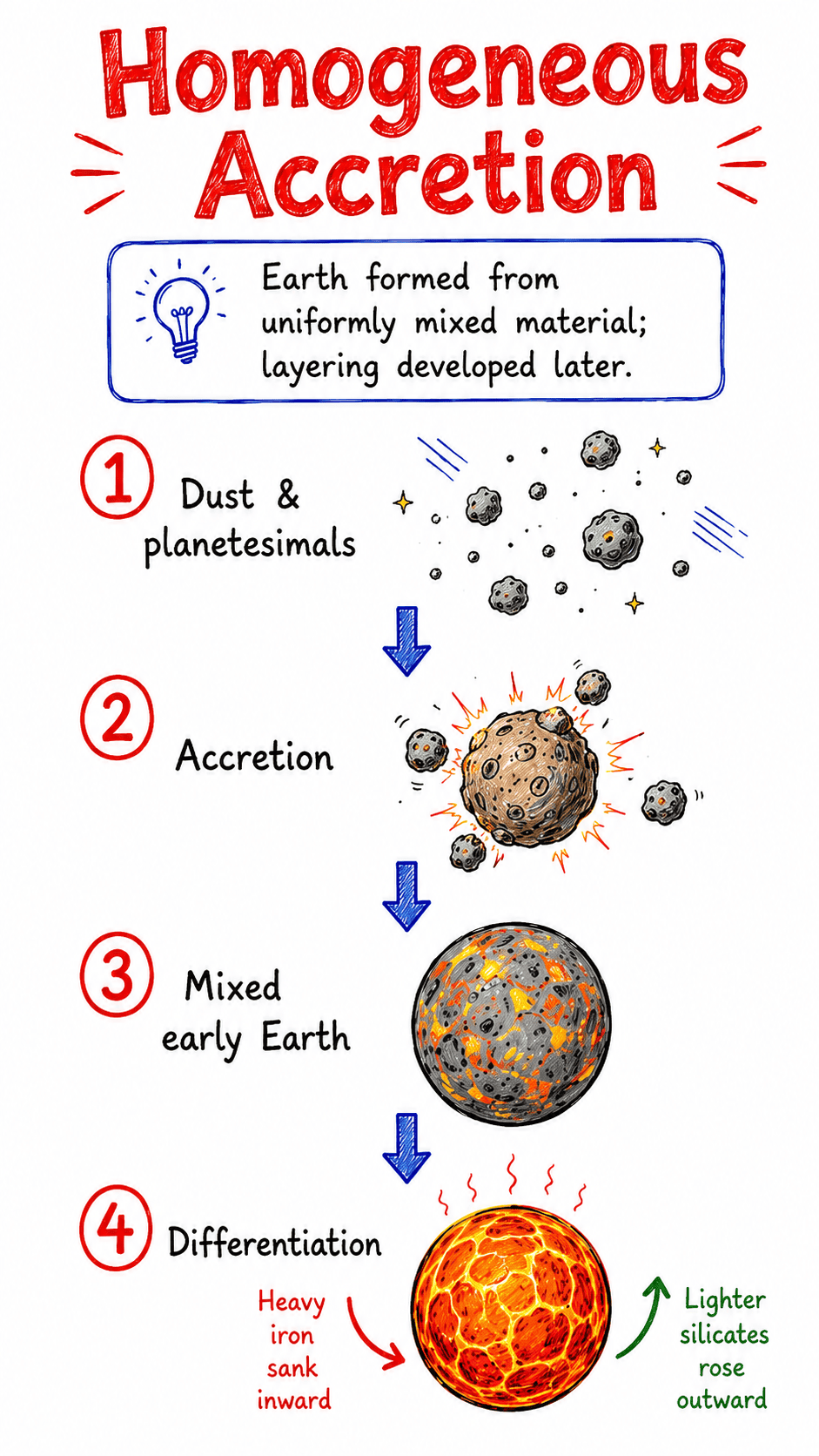
Homogeneous Accretion
Previous9/9

SuperKalam is your personal mentor for UPSC preparation, guiding you at every step of the exam journey.
Download the App


STUDY RESOURCES
CONTACT US
ⓒ Snapstack Technologies Private Limited