GS 2: International RelationsGS 3: EconomyPrelims
Syria welcomes U.S. announcement of removal from blacklist, Pg16
US removes Syria from terror blacklist after five decades, paving way for economic recovery and foreign investment.
Practice MCQs
840 Students attempted
Key Highlights:
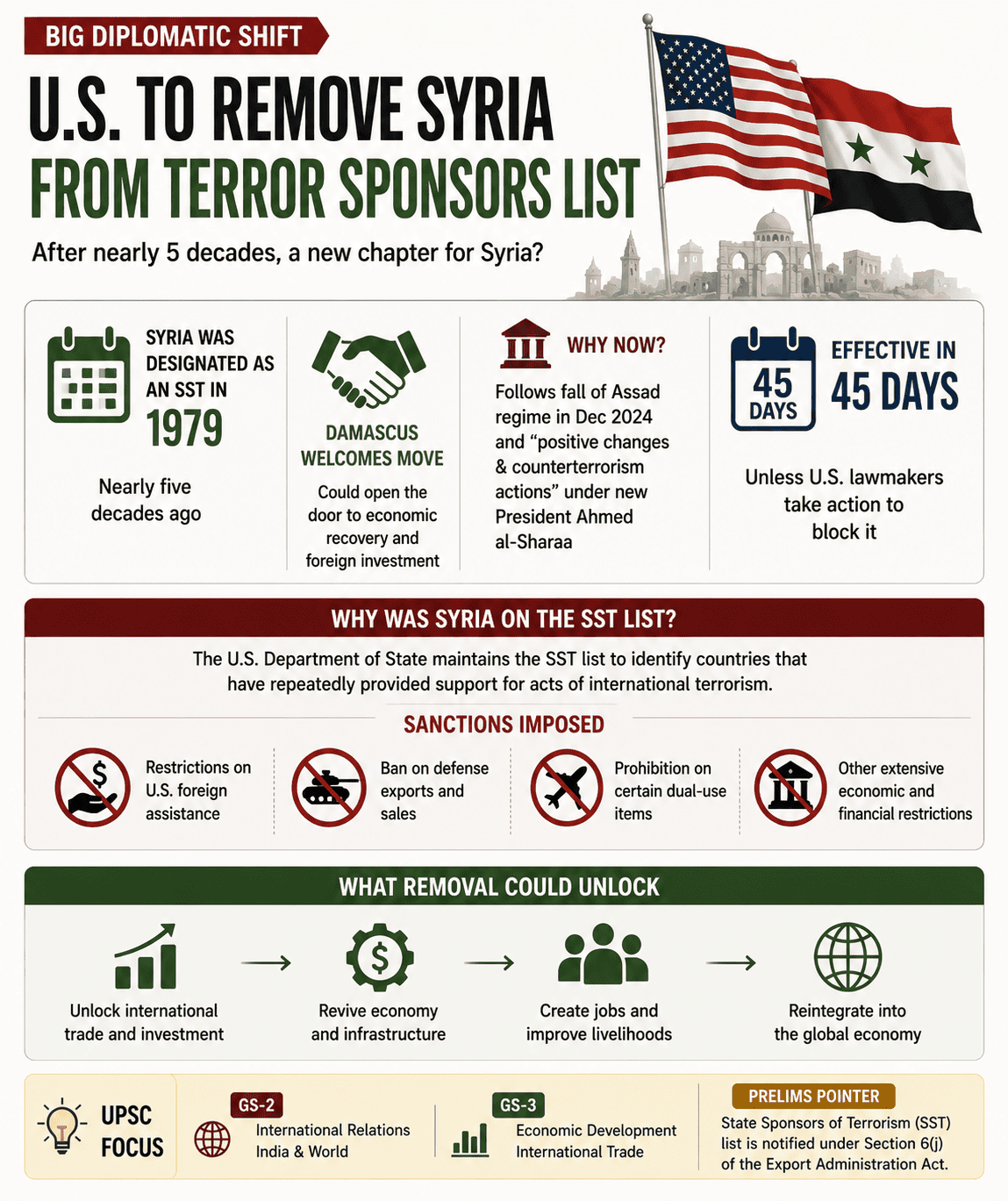
- The United States announced its intention to remove Syria from its State Sponsors of Terrorism (SST) list.
- Syria was initially designated as an SST in 1979, nearly five decades ago.
- Damascus welcomed the announcement, with an economist noting it could open the door to economic recovery and foreign investment.
- The decision follows the fall of the Assad regime in December 2024 and subsequent "positive changes and counterterrorism actions" under the new Syrian President Ahmed al-Sharaa.
- The removal will become effective in 45 days unless U.S. lawmakers take action to block it.
Syria.png
Detailed Insights:
- The U.S. Department of State maintains the SST list to identify countries that have repeatedly provided support for acts of international terrorism.
- Inclusion on the SST list imposes significant sanctions, including restrictions on U.S. foreign assistance, a ban on defense exports and sales, and controls over dual-use items.
- The removal is expected to unlock international trade and investment, allowing Syria to rebuild and reintegrate into the global economy.
- The U.S. decision is based on criteria such as a fundamental change in the country's leadership and policies, a cessation of support for international terrorism, and formal assurances against future support.
- This move is also seen as an effort to reduce Syria's dependence on other nations and foster regional stability.
Key Concepts Involved:
- State Sponsors of Terrorism (SST) list: A U.S. designation for countries determined by the Secretary of State to have repeatedly provided support for acts of international terrorism, leading to stringent sanctions.
- Sanctions: Penalties, often economic, imposed by one country on another to influence policy or behavior, including restrictions on trade, finance, and aid.
- Dual-use items: Goods, software, and technology that can be used for both civilian and military applications, subject to export controls in designated countries.
Previous12/12

SuperKalam is your personal mentor for UPSC preparation, guiding you at every step of the exam journey.
Download the App


STUDY RESOURCES
CONTACT US
ⓒ Snapstack Technologies Private Limited