GS 1: Indian SocietyGS 3: EconomyGS 2: Social JusticeGS 2: GovernancePrelims
Not till cities reduce time, safety, care costs, Pg11
Major Indian cities offer better salaried jobs, yet female labor force participation lags due to critical safety, childcare, and commuting barriers, demanding urgent urban policy reforms.
Practice MCQs
840 Students attempted
Key Highlights:
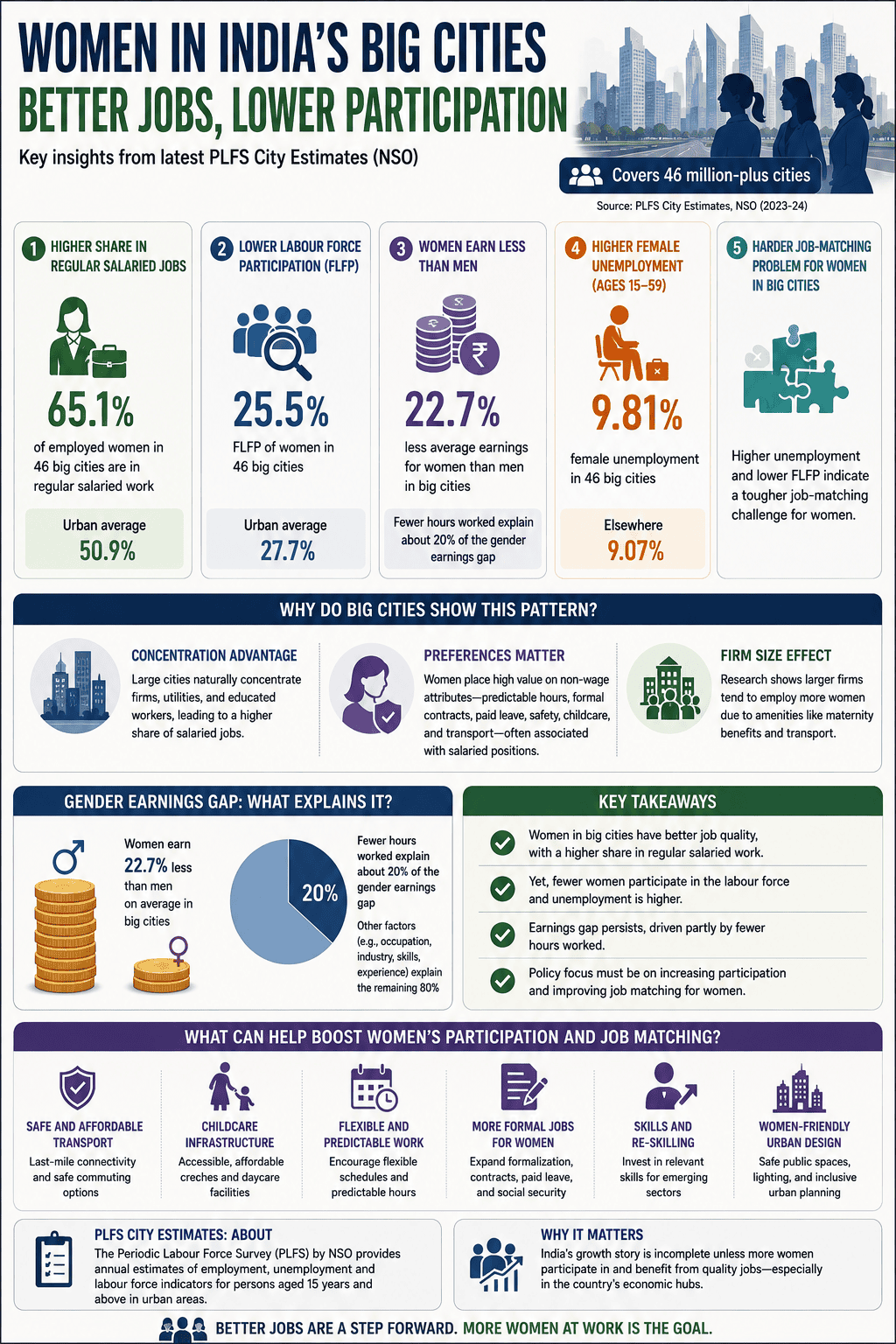
- The latest Periodic Labour Force Survey (PLFS) city estimates from the National Statistical Office (NSO) indicate that 65.1% of employed women in India's 46 million-plus cities are in regular salaried work, higher than the 50.9% urban average.
- Despite better job quality, female labour force participation (FLFP) in these large cities is only 25.5%, which is lower than the overall urban average of 27.7%.
- Women in big cities earn 22.7% less than men on average, with fewer hours worked explaining about 20% of this gender earnings gap.
- Female unemployment (ages 15-59) is higher in the 46 big cities (9.81%) compared to elsewhere (9.07%), indicating a harder job-matching problem for women.
Women in big cities.png
Detailed Insights:
- Large cities naturally concentrate firms, utilities, and educated workers, leading to a higher share of salaried jobs.
- Women prioritize non-wage attributes like predictable hours, formal contracts, paid leave, safety, childcare, and transport, which are often found in salaried positions.
- Research suggests that larger firms tend to employ more women due to amenities like maternity benefits and transport.
- The lower FLFP in large cities is attributed to factors such as safety concerns, household responsibilities, social norms, and inadequate transport systems.
- Women often search for jobs closer to home and are willing to trade off wages for shorter commutes, a constraint more pronounced in urban settings.
- Rural India historically shows higher FLFP, as agricultural and allied work is often closer to home and easier to combine with domestic duties.
- The article emphasizes that urban development policies must actively address women's employment challenges rather than assuming it will be an automatic outcome of economic growth.
- Suggested urban interventions include frequent and safe public transport, last-mile connectivity, streetlighting, mixed-use neighborhoods, and accessible childcare facilities.
Key Concepts Involved:
- Periodic Labour Force Survey (PLFS): An annual survey conducted by the National Statistical Office (NSO) to estimate key labour force indicators like employment, unemployment, and labour force participation rates.
- Female Labour Force Participation Rate (FLFPR): The proportion of women in the working-age population (15 years and above) who are either employed or actively seeking employment.
- National Statistical Office (NSO): The central agency under the Ministry of Statistics and Programme Implementation (MoSPI) responsible for collecting, compiling, analyzing, and disseminating official statistics in India.
- Gender Earnings Gap: The average difference between the earnings of men and women, often reflecting disparities in wages, hours worked, and occupational choices.

SuperKalam is your personal mentor for UPSC preparation, guiding you at every step of the exam journey.
Download the App


STUDY RESOURCES
CONTACT US
ⓒ Snapstack Technologies Private Limited