GS 3: Science & TechnologyGS 3: EconomyGS 2: International RelationsGS 2: GovernancePrelims
Lessons from a Chinese supercomputer, Pg10
China's LineShine supercomputer, built with domestic tech, surpasses US rivals despite sanctions, offering India crucial lessons for semiconductor sovereignty.
Practice MCQs
840 Students attempted
Key Highlights:
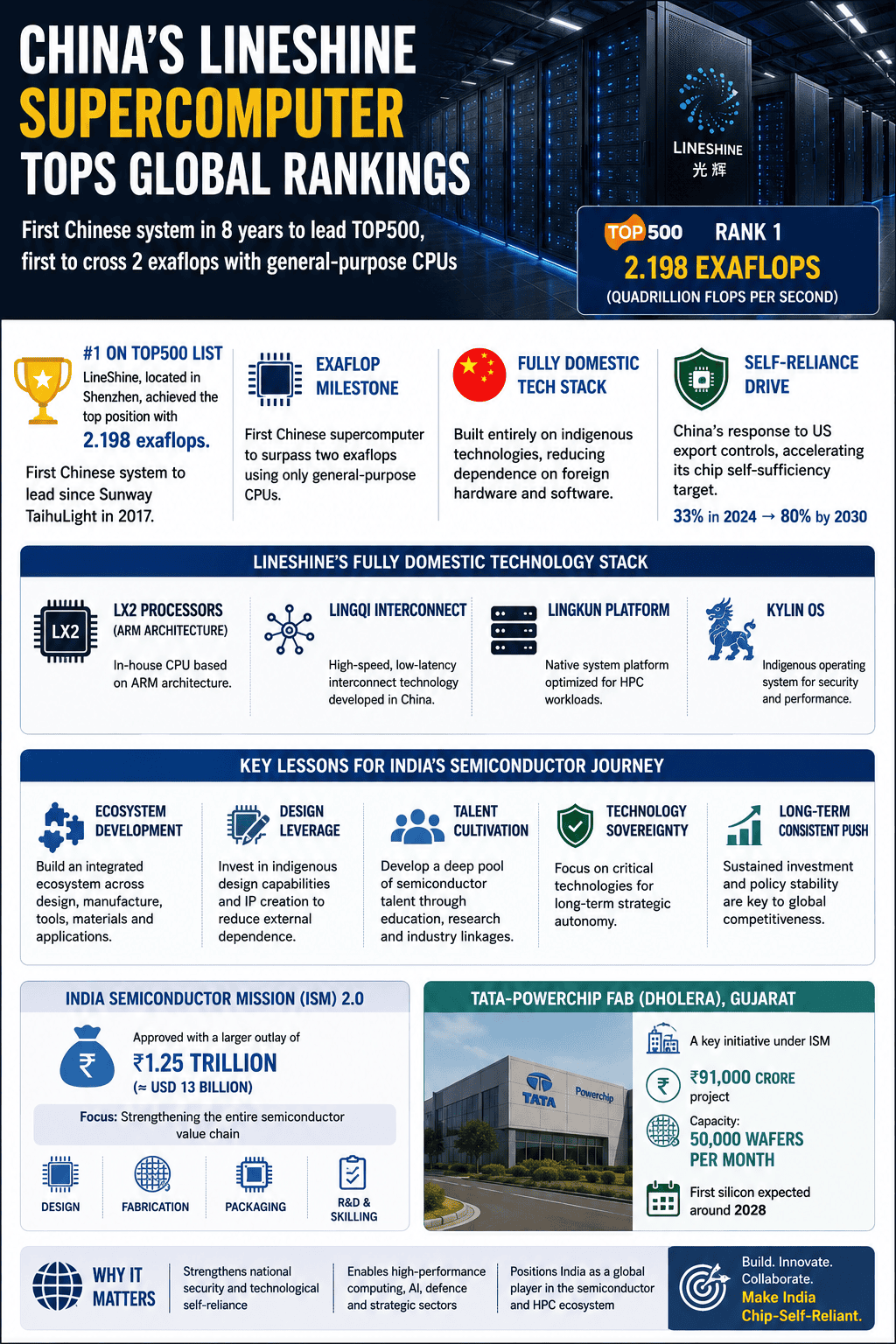
- China's LineShine supercomputer, located in Shenzhen, achieved the top position on the TOP500 list with 2.198 exaflops.
- It is the first Chinese system to lead the TOP500 since Sunway TaihuLight in 2017 and the first to surpass two exaflops using only general-purpose CPUs.
- LineShine operates on a fully domestic technology stack, including LX2 processors (ARM architecture), LingQi interconnect, LingKun platform, and Kylin OS.
- This advancement signals China's response to US export controls, accelerating its drive for chip self-sufficiency, targeting 80% by 2030 from 33% in 2024.
- The development offers crucial lessons for India's India Semiconductor Mission (ISM), emphasizing ecosystem development, design leverage, and talent cultivation.
Supercomputer.png
Detailed Insights:
- LineShine displaced the US's El Capitan (1.809 exaflops) from the top position, showcasing a significant leap in China's supercomputing capabilities.
- The supercomputer's reliance on domestic components, including its 304-core LX2 processors and LingQi interconnect, demonstrates China's success in overcoming technology restrictions.
- China's self-sufficiency drive aims to build and validate a complete 7nm production line using entirely domestically produced equipment by 2030.
- The India Semiconductor Mission (ISM), launched in 2021 with an initial outlay of ₹76,000 crore, has approved 13 projects across seven states.
- ISM 2.0 has been approved with a larger outlay of ₹1.25 trillion (approximately USD 13 billion), focusing on strengthening the entire semiconductor value chain, including design, fabrication, and packaging.
- The Tata-Powerchip fab in Dholera, a ₹91,000-crore project, is a key initiative under ISM, aiming for 50,000 wafers per month with first silicon expected around 2028.
- India's existing strength in design, hosting R&D centers for companies like Nvidia and Intel, provides a strategic advantage that could yield faster results than solely pursuing leading-edge fabs.
- The geopolitical implication highlights that technology denial strategies can inadvertently accelerate a rival's industrial self-sufficiency, fragmenting global technology ecosystems.
Key Concepts Involved:
- Exaflops: A measure of a computer's processing speed, representing one quintillion (10^18) floating-point operations per second.
- TOP500: A project that ranks the 500 most powerful non-distributed computer systems in the world based on their LINPACK Benchmark performance.
- General-purpose CPUs: Central Processing Units designed to handle a wide range of tasks, as opposed to specialized processors like GPUs.
- Fabless strength: A business model in the semiconductor industry where a company designs and sells hardware devices and semiconductor chips but does not manufacture them.
- India Semiconductor Mission (ISM): A government initiative aimed at building a robust semiconductor and display manufacturing ecosystem in India.

SuperKalam is your personal mentor for UPSC preparation, guiding you at every step of the exam journey.
Download the App


STUDY RESOURCES
CONTACT US
ⓒ Snapstack Technologies Private Limited