GS 3: EconomyGS 3: Science & TechnologyGS 3: Environment & EcologyGS 2: GovernancePrelims
Lessons for India from Brazil's ethanol pathway, Pg13
Brazil's 50-year ethanol masterclass, featuring phased blending and flex-fuel vehicles, offers crucial lessons for India's rushed E20 adoption and energy security goals.
Practice MCQs
840 Students attempted
Key Highlights:
- Brazil's National Alcohol Program (Proálcool), launched in 1975, successfully integrated ethanol into its auto fuel mix over decades.
- Brazil's approach involved a graded blending strategy, early adaptation of the vehicular ecosystem with Flex-Fuel Vehicles (FFVs), and consumer choice with price incentives.
- India aims to achieve E20 blending nationwide and is pushing for E25 and E85-100 fuels for FFVs to reduce crude oil import dependence.
- Unlike Brazil's phased approach, India's ethanol blending efforts are criticized for being rushed, with inadequate preparation for the vehicular ecosystem and potential consumer issues like reduced mileage.
- Brazil's Fuel of the Future and Mover Program legislation (2024) further boost low-carbon vehicle technology and biofuel adoption, mandating E30 petrol blend by 2025.
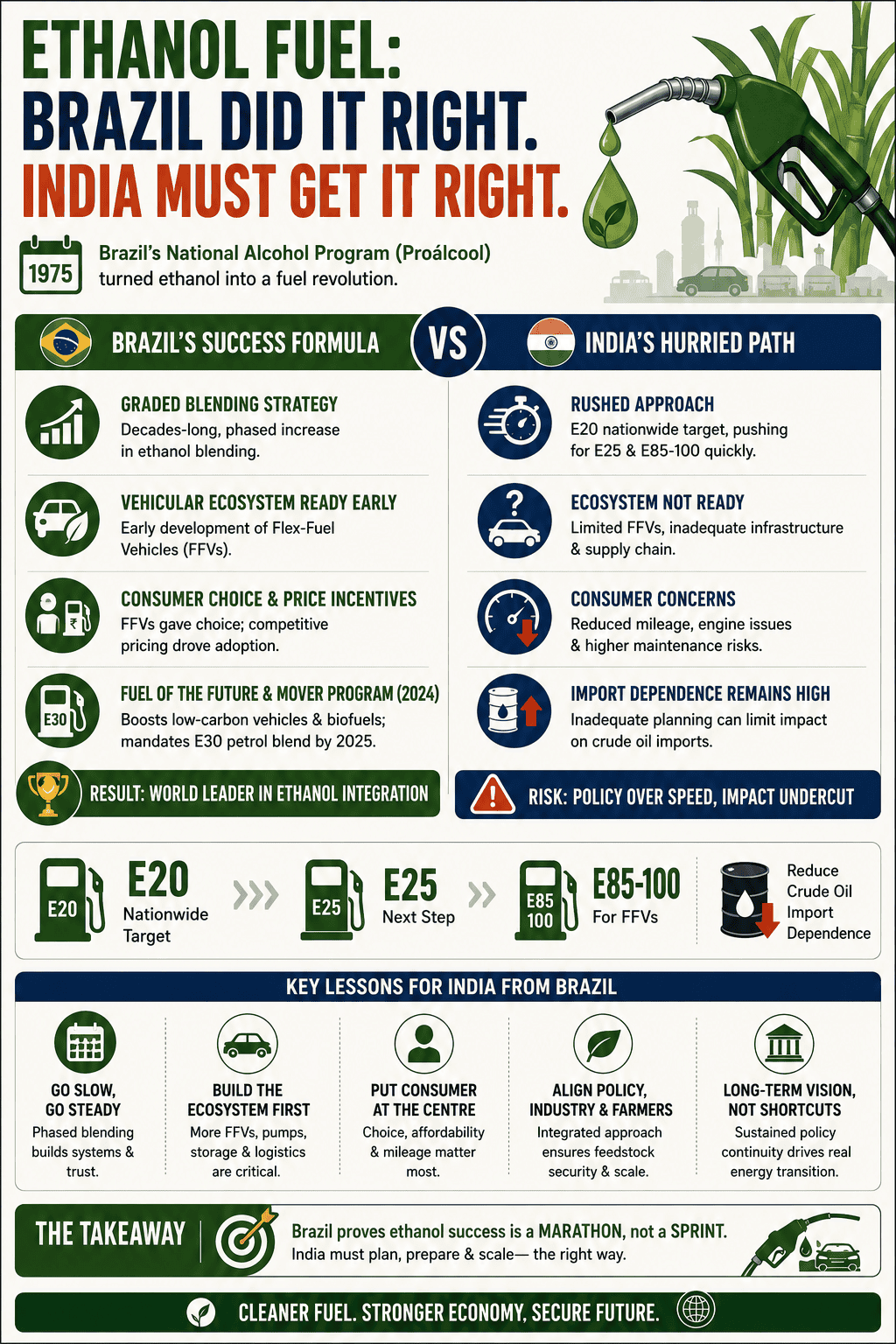
Brazil vs India.png
Detailed Insights:
- Brazil's first ethanol blending law dates back to 1931, culminating in the 2024 Fuel of the Future and Mover Program legislation.
- The Proálcool program was initiated in 1975 in response to the 1973 global oil crisis to reduce petroleum dependence.
- Brazil's auto industry began producing FFVs at scale from 2003, with these vehicles now comprising nearly 90% of its car fleet.
- In India, 10% ethanol blending was achieved in 2022, with a rapid increase to E20 as the nationwide standard.
- India's current strategy involves transitioning from E20 to E25, and then towards FFVs using E85-E100 fuels.
- India imports approximately 88.5% of its crude oil, making energy security a critical driver for biofuel adoption.
- Brazilian motorists can choose between E27 blended petrol and E100 pure hydrous ethanol, with E100 often being cheaper.
- India faces challenges with consumer acceptance due to reported dips in vehicle mileage and concerns about potential damage to older vehicles.
Key Concepts Involved:
- Ethanol Blending: The process of mixing ethanol, an alcohol, with petrol to create a blended fuel.
- Flex-Fuel Vehicles (FFVs): Internal combustion engine vehicles designed to run on varying proportions of petrol and ethanol or methanol.
- E20/E25/E85/E100: Designations indicating the percentage of ethanol in a fuel blend (e.g., E20 means 20% ethanol, 80% petrol).
- National Alcohol Program (Proálcool): Brazil's government program launched in 1975 to promote ethanol as an alternative fuel.

SuperKalam is your personal mentor for UPSC preparation, guiding you at every step of the exam journey.
Download the App


STUDY RESOURCES
CONTACT US
ⓒ Snapstack Technologies Private Limited