GS 3: Science & TechnologyPrelims
Shiv Shakti Point soil chemically close to lunar meteorite that hit Antarctica, Pg9
Chandrayaan-3 data reveals Shiv Shakti Point soil chemically matches Antarctic lunar meteorite ALHA 81005, offering new insights into Moon's evolution.
Practice MCQs
833 Students attempted
Key Highlights:
- Data from India's Chandrayaan-3 mission has revealed a close chemical resemblance between the soil at Shiv Shakti Point on the Moon's South Pole and the lunar meteorite ALHA 81005.
- The Physical Research Laboratory (PRL)-led study found the soil to be rich in iron and magnesium and deficient in aluminum.
- The ALHA 81005 meteorite was discovered in 1982 in the Allan Hills region of Antarctica.
- This chemical similarity suggests the Chandrayaan-3 landing site occupies a compositional space between ferroan anorthosite and Mg-suite lithologies.
- The findings, published in the journal Nature, were derived from data collected by the Alpha Particle X-ray Spectrometer (APXS) on the Pragyan rover.
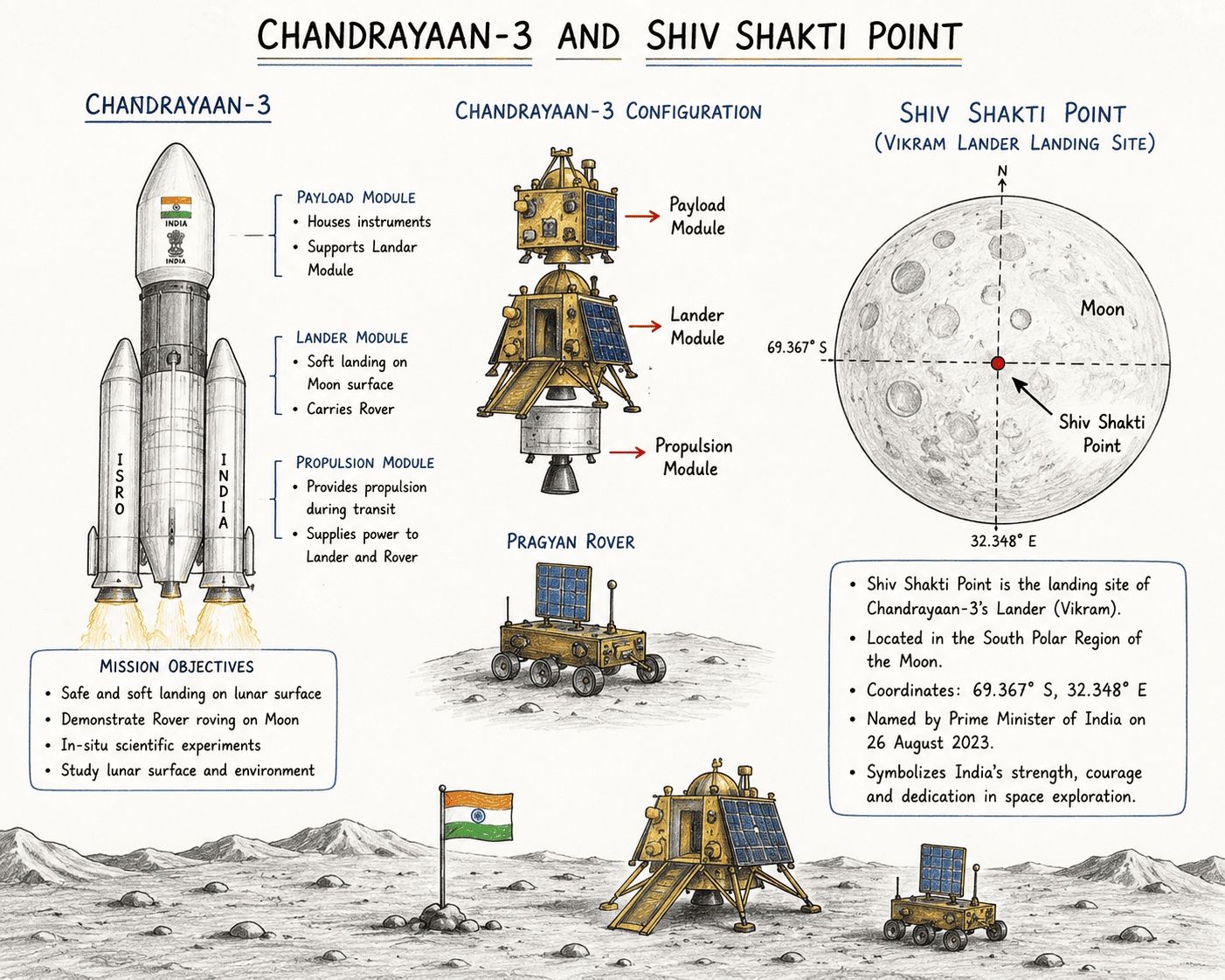
Chandrayaan3.png
Detailed Insights:
- Chandrayaan-3 successfully soft-landed near the lunar south pole on August 23, 2023, making India the first nation to achieve this feat.
- The Pragyan rover explored the area around Shiv Shakti Point, collecting crucial data on the elemental composition of the lunar surface.
- The ALHA 81005 meteorite was the first to be definitively recognized as originating from the Moon.
- The soil at Shiv Shakti Point exhibits an elevated magnesium number (Mg# 70), indicating a distinctive geochemical signature.
- This suggests contributions from deeper lunar layers, possibly brought to the surface by impacts such as the formation of the South Pole-Aitken (SPA) basin.
- Understanding this compositional diversity and impact history is crucial for guiding future lunar missions and unraveling the Moon's early evolution.
Scientific/Technical Concepts Involved:
- Shiv Shakti Point: The landing site of India's Chandrayaan-3 mission near the Moon's South Pole.
- ALHA 81005: A lunar meteorite found in Antarctica, chemically similar to the soil at Shiv Shakti Point.
- Alpha Particle X-ray Spectrometer (APXS): An instrument on the Pragyan rover used to determine the elemental composition of lunar surface materials.
- Ferroan Anorthosite (FAN): A type of igneous rock rich in plagioclase feldspar, believed to form part of the Moon's primordial crust.
- Mg-suite Lithologies: A group of magnesium-rich igneous rocks found in lunar highlands, formed after the initial lunar crust.

SuperKalam is your personal mentor for UPSC preparation, guiding you at every step of the exam journey.
Download the App


STUDY RESOURCES
CONTACT US
ⓒ Snapstack Technologies Private Limited