GS 1: Indian SocietyGS 2: GovernanceGS 2: Social JusticeGS 3: EconomyPrelims
Across world, why fewer people are having children, Pg13
World faces demographic crisis as fertility rates plunge below replacement levels, forcing governments to implement costly incentives to encourage child-bearing.
Practice MCQs
833 Students attempted
Key Highlights:
- The global Total Fertility Rate (TFR) declined from 5.3 in the early 1960s to 2.2 in 2024, nearing the replacement rate of 2.1.
- India's TFR has fallen from 5.9 to 2, dropping below the replacement rate around 2020, much faster than UN projections.
- Governments worldwide, including Andhra Pradesh, are introducing policies like financial incentives for more children and state-funded IVF to counter demographic decline.
- The decline is attributed to factors such as improved health, education, economic indicators, urbanisation, and women's empowerment.
- Consequences include an aging population, with India's elderly proportion projected to reach 20.8% (34.7 crore) by 2050, straining healthcare and pension systems.
TFR.png
Detailed Insights:
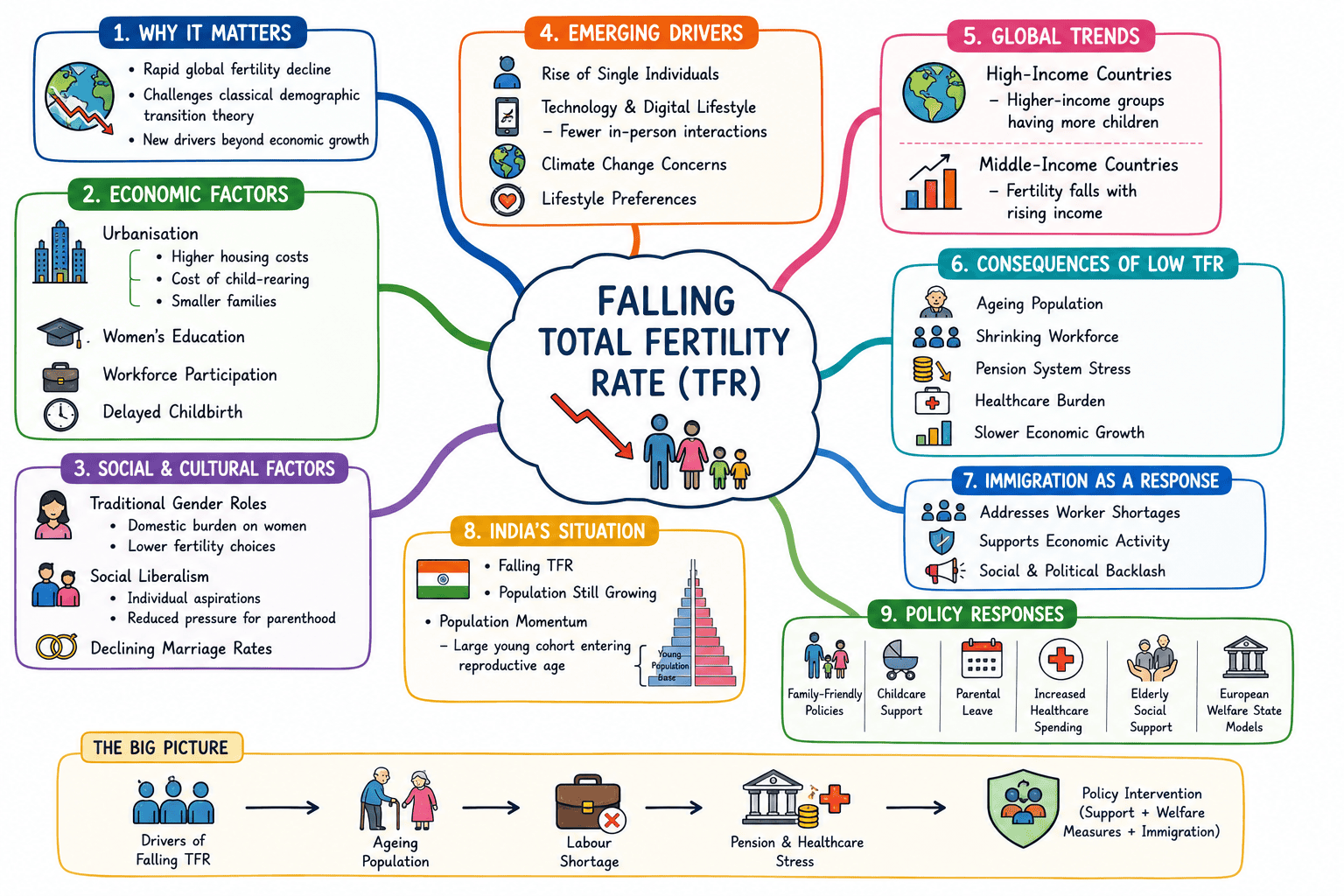
- The rapid decline in TFR challenges previous demographic transition theories, prompting a search for additional influencing factors beyond economic growth.
- In many high-income countries, higher-income individuals are now having more children, a reversal of historical patterns, while middle-income countries often show the opposite trend.
- Urbanisation has increased living costs, contributing to smaller family sizes, alongside women's increased educational attainment and workforce participation.
- The persistence of traditional gender roles, where women shoulder disproportionate domestic responsibilities, also influences decisions to have fewer or no children.
- Social liberalism, focusing on individual aspirations, and the withdrawal of the welfare state in some Western economies have reduced the societal mandate for childbearing.
- Emerging factors like the rise of single individuals, declining marriage rates, increased technology use leading to fewer in-person interactions, and climate change concerns are also impacting fertility decisions.
- Low TFRs lead to challenges in maintaining pension systems and public healthcare for the elderly due to a shrinking working-age population.
- Immigration is considered a solution for worker shortages but can lead to social and political backlash.
- India's continued population increase despite falling TFR is due to population momentum, a large young population entering reproductive age.
- Preparing for the demographic shift requires increased public spending on healthcare and social support, and family-friendly policies similar to European welfare states.
Key Concepts Involved:
- Total Fertility Rate (TFR): The average number of children a woman is expected to bear in her lifetime.
- Replacement Rate: The TFR (approximately 2.1) required for a population to replace itself from one generation to the next, without migration.
- Demographic Transition Theory: A model explaining population changes from high birth and death rates to low rates as societies develop economically.
- Population Momentum: The tendency for a population to continue growing (or declining) even after fertility rates have reached replacement level, due to the existing age structure.

SuperKalam is your personal mentor for UPSC preparation, guiding you at every step of the exam journey.
Download the App


STUDY RESOURCES
CONTACT US
ⓒ Snapstack Technologies Private Limited