GS 3: Science & TechnologyPrelims
How will Gaganyaan astronauts return safely to earth?, Pg10
Gaganyaan mission: ISRO details complex re-entry, aerobraking, parachute deployment, and recovery procedures ensuring safe astronaut return from space.
Practice MCQs
819 Students attempted
Key Highlights:
- The Gaganyaan crew module will orbit Earth at approximately 7,800 m/s and use aerobraking to reduce speed during re-entry.
- A multi-stage parachute system will deploy when the module is within 12 km of the ground for a soft landing.
- Landing on land requires a touchdown speed of 1-2 m/s, while sea landings can tolerate 7-9 m/s due to water's energy absorption.
- The Indian Navy will lead the Gaganyaan recovery operation in the Bay of Bengal, using flotation bags and specialized gear.
Detailed Insights:
- Aerobraking is the primary method for shedding kinetic energy during re-entry, with parachutes and braking motors used for a soft landing.
- Sea landings are preferred when large, empty land territories are unavailable, despite requiring specialized recovery ships and crew safety measures.
- Using parachutes alone to reduce velocity to less than 2 m/s is impractical due to the exponential increase in parachute size and deployment challenges.
- The landing zone is elliptical due to the concentration of kinetic energy along the flight track and minimal lateral deviation capabilities.
- Recovery teams use predictive tracking, electronic signaling, and visual aids like GPS coordinates, homing signals, fluorescent dye, and strobe lights to locate the module.
- After splashdown, flotation bags will inflate, and naval divers will secure the module before it is winched onto a ship for crew extraction.
Scientific/Technical Concepts Involved:
- Aerobraking: Using atmospheric drag to decelerate a spacecraft during re-entry.
- Kinetic Energy: The energy an object possesses due to its motion.
- Multi-Stage Parachute System: A sequence of parachutes deployed to gradually reduce speed.
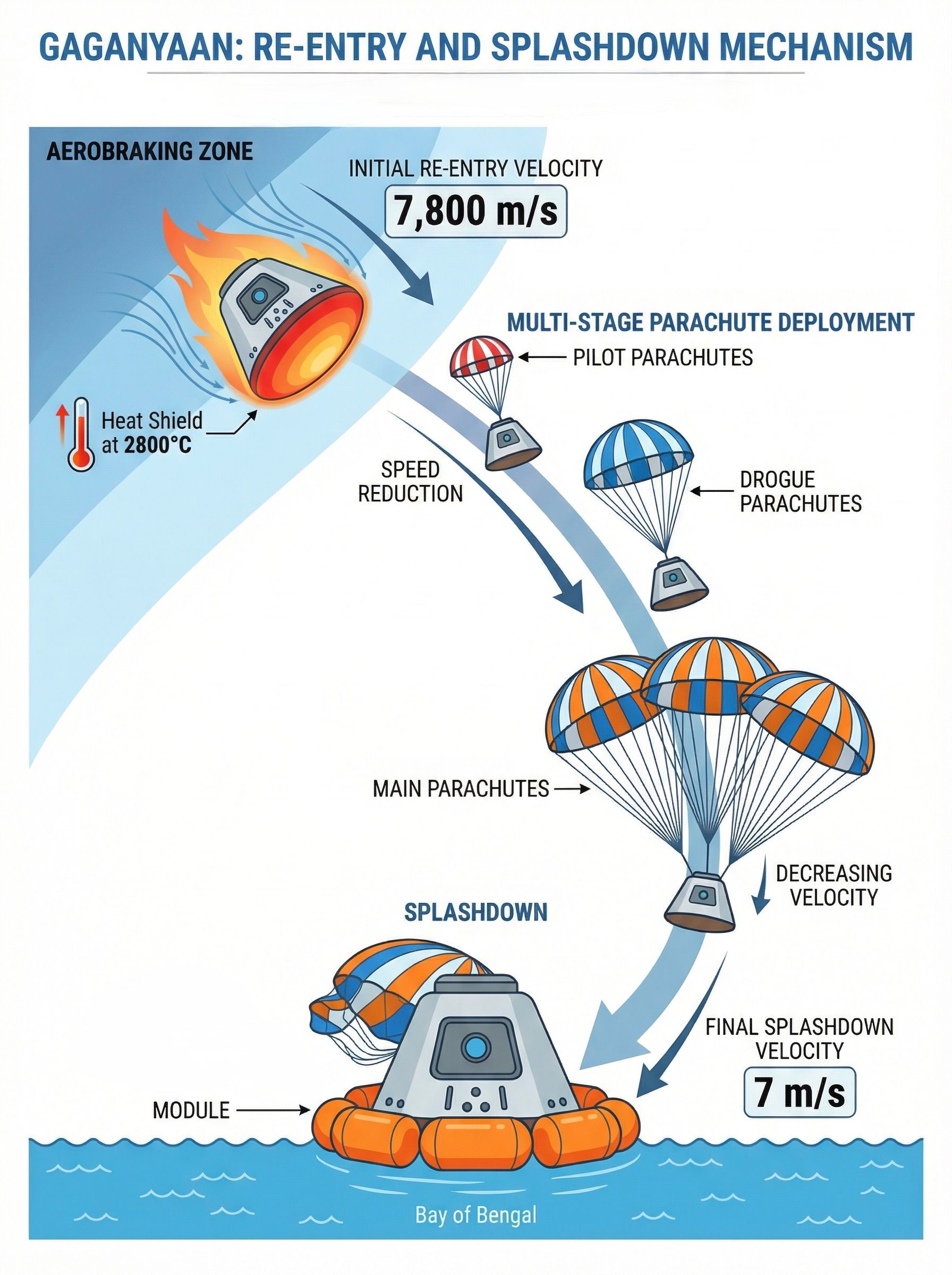
Gaganyaan: Parachute

SuperKalam is your personal mentor for UPSC preparation, guiding you at every step of the exam journey.
Download the App


STUDY RESOURCES
CONTACT US
ⓒ Snapstack Technologies Private Limited