GS 3: Environment & EcologyGS 1: Indian GeographyPrelims
If summer comes, can pollution be far behind?, Pg11
Delhi faces rising ozone pollution due to heat, sunlight, and biogenic volatile organic compounds from specific trees.
Practice MCQs
811 Students attempted
Key Highlights:
- Surface ozone pollution, a hazardous air pollutant and potent greenhouse gas, is emerging as a significant summer challenge, especially in rural India and some urban centers.
- Lutyens' Delhi is a hotspot for ozone pollution due to the presence of plants emitting biogenic volatile organic compounds (BVOCs), which react with nitrogen oxides under sunlight.
- A decadal analysis by the National Institute of Advanced Studies (NIAS) indicates a growing influence of BVOC indices on surface ozone levels, with high temperatures leading to greater BVOC emissions.
- The transition from La Niña to neutral conditions and the possibility of Super El Niño could lead to more heat, sunlight, and less ventilation, increasing the risk of severe summer ozone episodes.
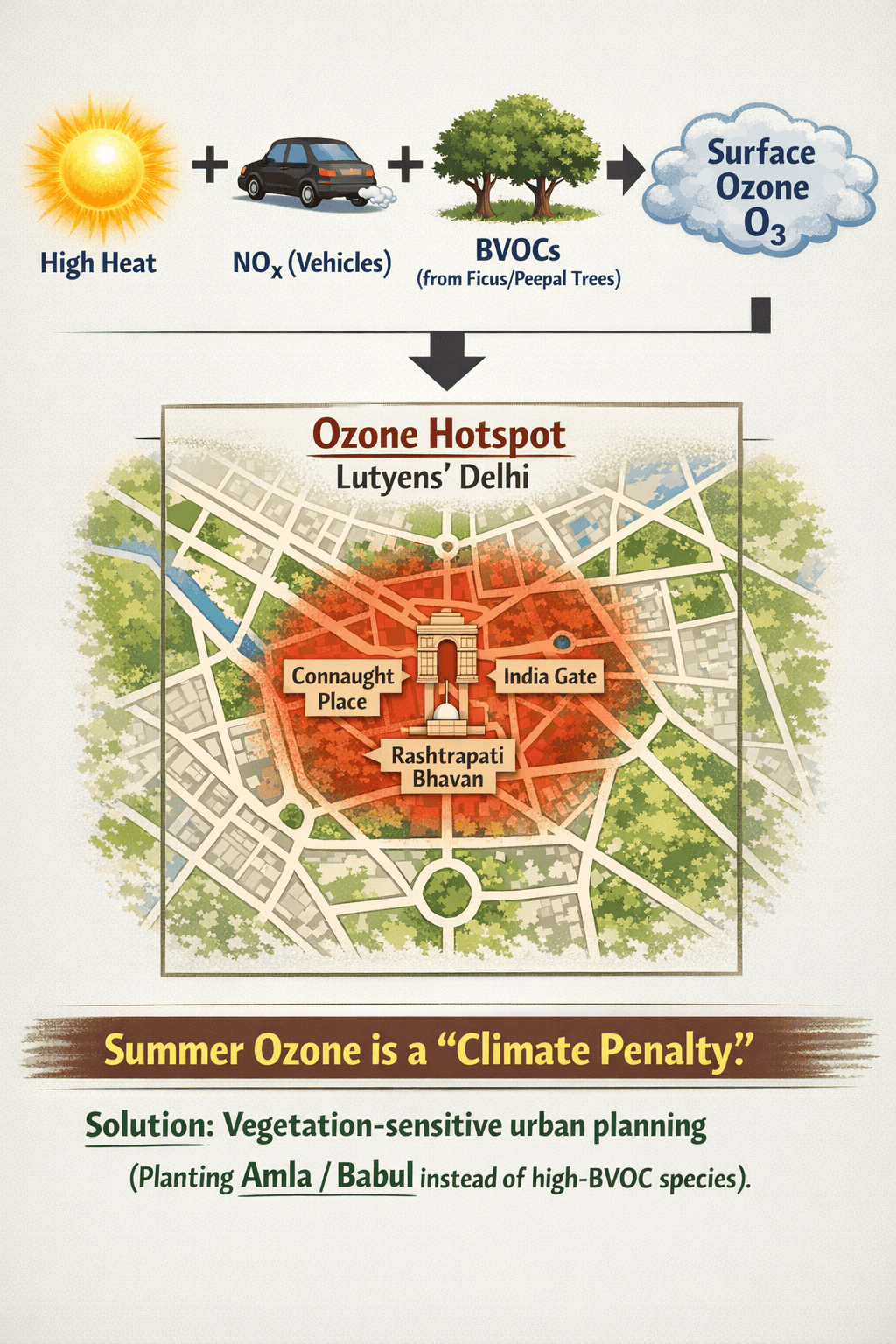
BVOCs
Detailed Insights:
- Ozone pollution results from the reaction of nitrogen oxides with volatile organic compounds (VOCs) under sunlight; traditionally, VOCs come from human activities, but scientific evidence shows that certain trees also emit BVOCs.
- Some plants, like various ficus species, emit high levels of BVOCs, while others, like amla and babul, emit negligible amounts, impacting ozone formation in areas like Lutyens' Delhi.
- During severe summers, high temperatures lead to greater BVOC emissions, amplifying ozone formation and creating local hotspots; in 2019, ozone levels in Lutyens' Delhi exceeded permissible standards on nearly 91% of summer days.
- Climate change is projected to intensify the frequency and severity of high-ozone days, known as the "climate penalty" on air quality, necessitating vegetation-sensitive urban planning and integrated climate mitigation strategies.
- Addressing ozone pollution requires science-based policymaking, an airshed approach, decisive emission reductions, and sustained public awareness, recognizing the interconnectedness of climate mitigation and air pollution control.
Scientific/Technical Concepts Involved:
- Ozone: A molecule made of three oxygen atoms that can be both a pollutant in the lower atmosphere and a protective layer in the upper atmosphere.
- Volatile Organic Compounds (VOCs): Organic chemicals that easily evaporate at room temperature, contributing to air pollution and ozone formation.
- Biogenic Volatile Organic Compounds (BVOCs): VOCs emitted by living organisms, especially plants, influenced by temperature and sunlight.
- La Niña/El Niño: Climate patterns in the Pacific Ocean that can affect global weather conditions, including temperature and atmospheric circulation.

SuperKalam is your personal mentor for UPSC preparation, guiding you at every step of the exam journey.
Download the App


STUDY RESOURCES
CONTACT US
ⓒ Snapstack Technologies Private Limited