GS 2: PolityGS 2: GovernancePrelims
What is the right to be forgotten?, Pg8
Delhi High Court defines 'right to be forgotten' under Article 21, balancing privacy with public interest and open justice, impacting digital footprints.
Practice MCQs
833 Students attempted
Key Highlights:
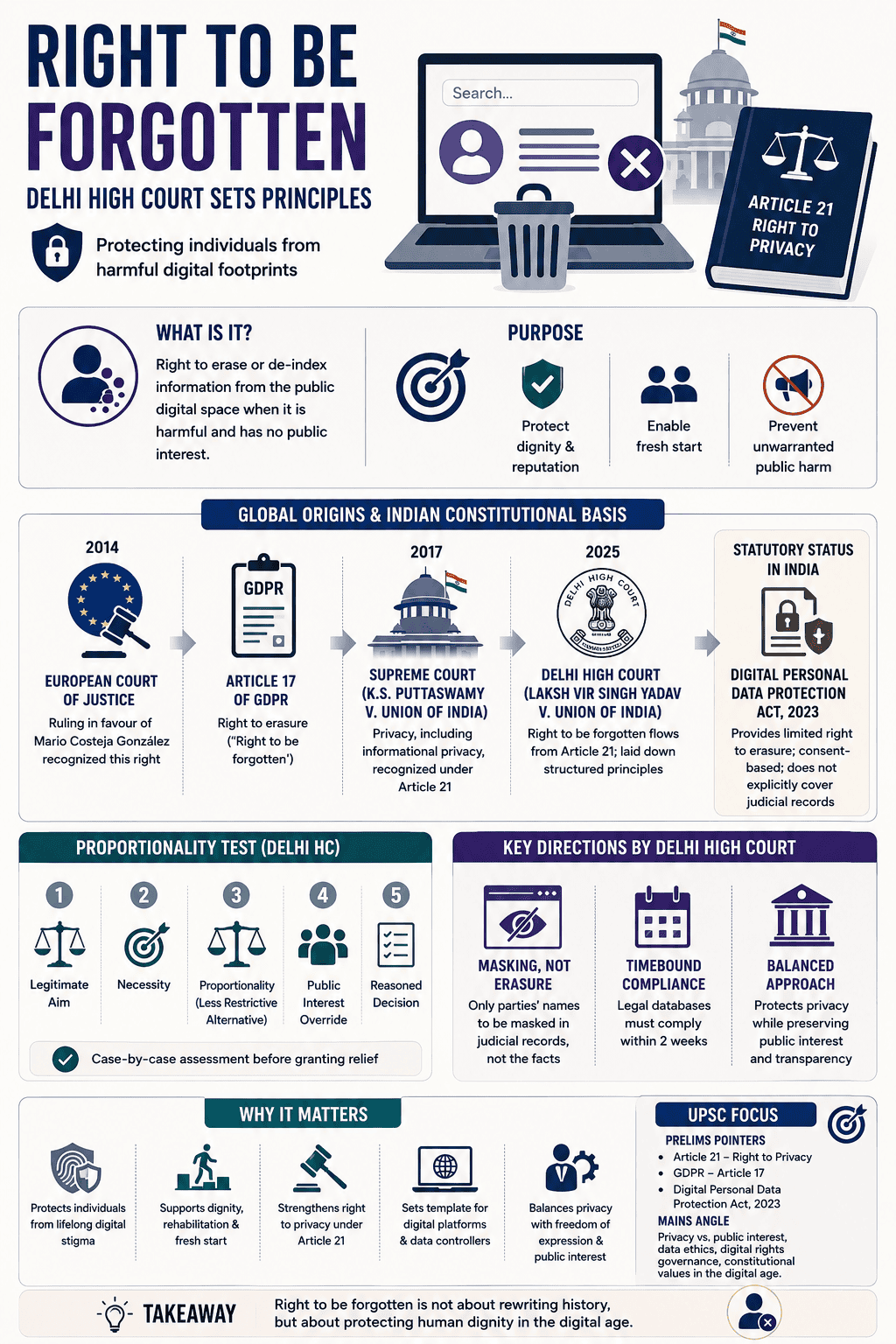
- The Delhi High Court recently established principles for the right to be forgotten, aiming to protect individuals from harmful digital footprints.
- This right allows for information to be erased or de-indexed from the public digital environment when its continued accessibility is harmful and serves no public interest.
- The concept gained prominence with the 2014 European Court of Justice ruling in favor of Mario Costeja González, leading to its inclusion in Article 17 of the European Union’s General Data Protection Regulation (GDPR).
- In India, the Supreme Court’s K.S. Puttaswamy v. Union of India (2017) judgment recognized privacy, including informational privacy, as a fundamental right under Article 21.
- The Delhi High Court, in Laksh Vir Singh Yadav v. Union of India, ruled that the right to be forgotten flows from Article 21 and prescribed a structured proportionality test for its application.
- The ruling mandates masking only parties' names in judicial records, not the facts, and sets a two-week deadline for compliance by legal databases.
- The Digital Personal Data Protection Act, 2023, currently offers a limited statutory right to erasure, primarily consent-based, and does not explicitly cover judicial records.
RIght to be forgotten.png
Detailed Insights:
- The Delhi High Court's ruling addresses the lack of a coherent framework to balance privacy with open justice in India.
- The structured proportionality test requires that retention of information must have a legitimate purpose, harm to privacy must be balanced against public interest, and the least intrusive means (like masking names) should be preferred.
- The right to be forgotten often conflicts with freedom of speech and press under Article 19(1)(a) and the principle of open justice.
- Public interest, especially in serious crime cases, can override the right to privacy, but digital presence should not permanently victimize individuals after trials conclude.
- Practical challenges include enforcement, as de-indexing at the search level does not prevent information from appearing on mirrors, archives, or social media.
- The Digital Personal Data Protection Act, 2023, is considered deficient as its rules have not been notified and the data protection board is not fully effective.
- A proposed tiered system for deciding erasure requests suggests involvement of platforms, the data protection board, and courts to balance efficiency and accountability.
- The Delhi High Court's framework is significant, but its full implementation awaits a Supreme Court ruling, establishment of a data protection board, and compliance from platforms.
Key Concepts Involved:
- Right to be forgotten: The right to have personal information de-indexed or erased from public digital platforms under certain conditions.
- Informational privacy: The right of individuals to control the collection, use, and dissemination of their personal data.
- Open justice: The principle that judicial proceedings and records should be accessible to the public.
- Structured proportionality test: A legal framework used to balance competing rights by assessing the legitimacy of purpose, necessity, and proportionality of a measure.

SuperKalam is your personal mentor for UPSC preparation, guiding you at every step of the exam journey.
Download the App


STUDY RESOURCES
CONTACT US
ⓒ Snapstack Technologies Private Limited