GS 2: PolityGS 2: GovernanceGS 2: Social JusticeGS 3: EconomyPrelims
States contribute disproportionately more to welfare schemes, Pg7
New analysis reveals states bear disproportionate welfare scheme burden, contributing 6.77% of GDP combined, as Union's fiscal commitment stagnates.
Practice MCQs
833 Students attempted
Key Highlights:
- States bear a disproportionately higher financial burden for welfare schemes compared to the Union government.
- Combined expenditure on selected welfare schemes for FY 2025-26 is projected at ₹24.20 lakh crore, constituting 6.77% of GDP.
- The Union government's contribution to this welfare spending is only 1.89% of GDP, with its share remaining largely stagnant.
- The 16th Finance Commission reported that states collectively spent ₹4.14 lakh crore on unconditional cash transfers.
- Centrally sponsored schemes like Maternity Entitlements scheme (PMMVY) and Integrated Child Development Services (ICDS) follow a 60:40 Centre-State funding ratio.
- The proposed VB-GRAM G Act, replacing the Mahatma Gandhi National Rural Employment Guarantee Act (MGNREGA), is expected to further increase states' financial contribution.
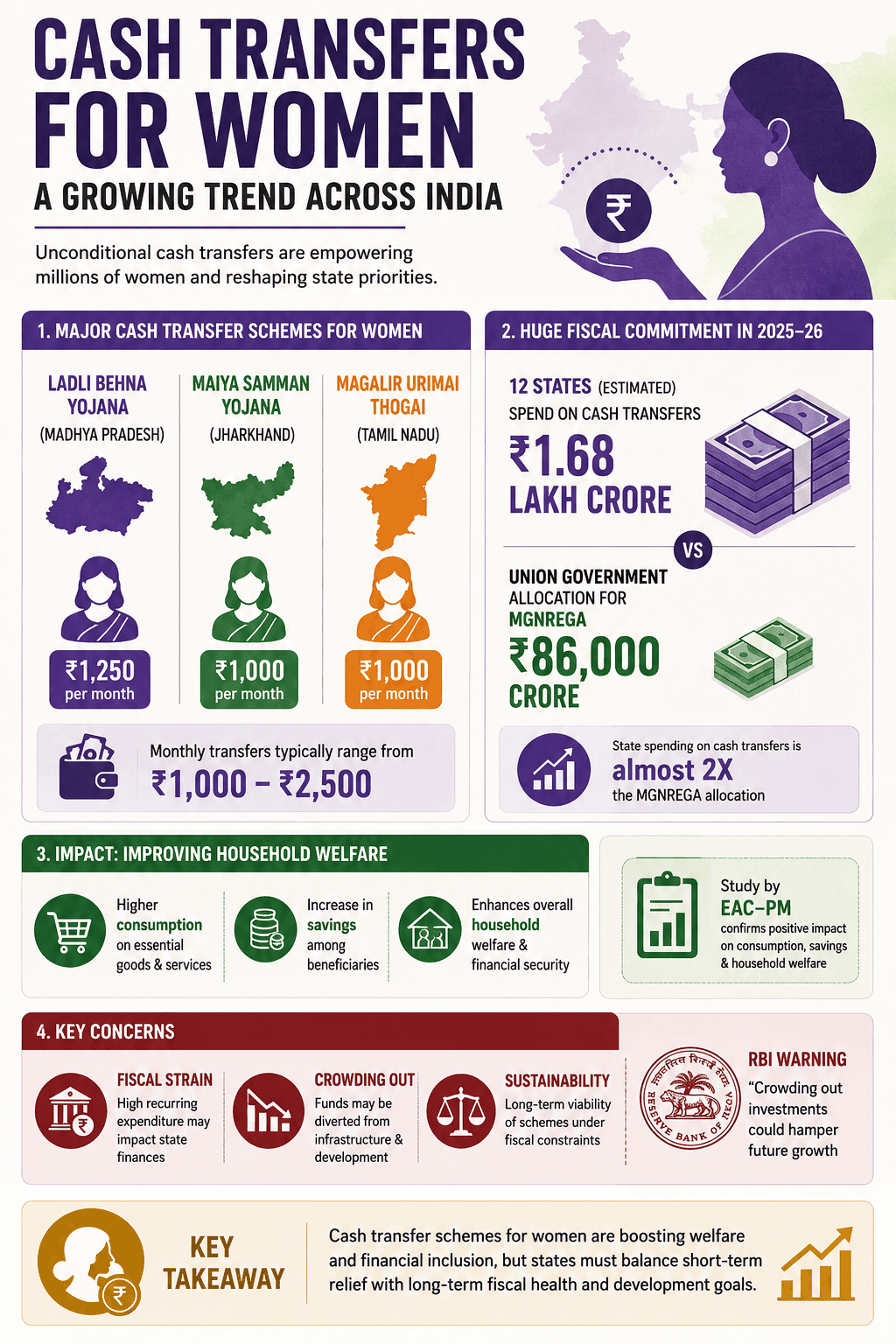
Cash Transfers.png
Detailed Insights:
- India's welfare regime has seen a shift from a rights-based approach to one increasingly focused on cash transfers.
- Despite a comparable tax-to-GDP ratio with middle-income countries, India lags in social security spending as a share of its GDP.
- The Union government, with higher tax revenues, places a significant financial onus on states, leading to their budget constraints.
- States are estimated to cover 75.2% of school education spending and a substantial portion of health expenditure.
- Economic research suggests that human development and growth are mutually reinforcing, advocating for increased Union fiscal commitment to the social sector.
- The current funding imbalance challenges the constitutional vision of a robust and equitable welfare state.
Key Concepts Involved:
- Fiscal Burden: The financial strain or cost imposed on a government or economy by certain expenditures.
- Rights-based Welfare Regime: A system where welfare provisions are legally guaranteed entitlements rather than discretionary benefits.
- Centrally Sponsored Schemes: Schemes implemented by state governments but largely funded by the central government, often with a defined sharing pattern.
- Cash Transfers: Direct payments of money from the government to individuals or households, often replacing in-kind benefits.
- Tax-to-GDP Ratio: The ratio of a country's total tax revenue to its Gross Domestic Product, indicating the government's tax collection efficiency.

SuperKalam is your personal mentor for UPSC preparation, guiding you at every step of the exam journey.
Download the App


STUDY RESOURCES
CONTACT US
ⓒ Snapstack Technologies Private Limited