GS 3: Science & TechnologyGS 2: GovernancePrelims
Quantum computing age will only begin when we silence the noise, Pg2
India's National Quantum Mission, backed by ₹6,000 crore, races to overcome 'noise' and error correction for practical quantum computing by 2031.
Practice MCQs
833 Students attempted
Key Highlights:
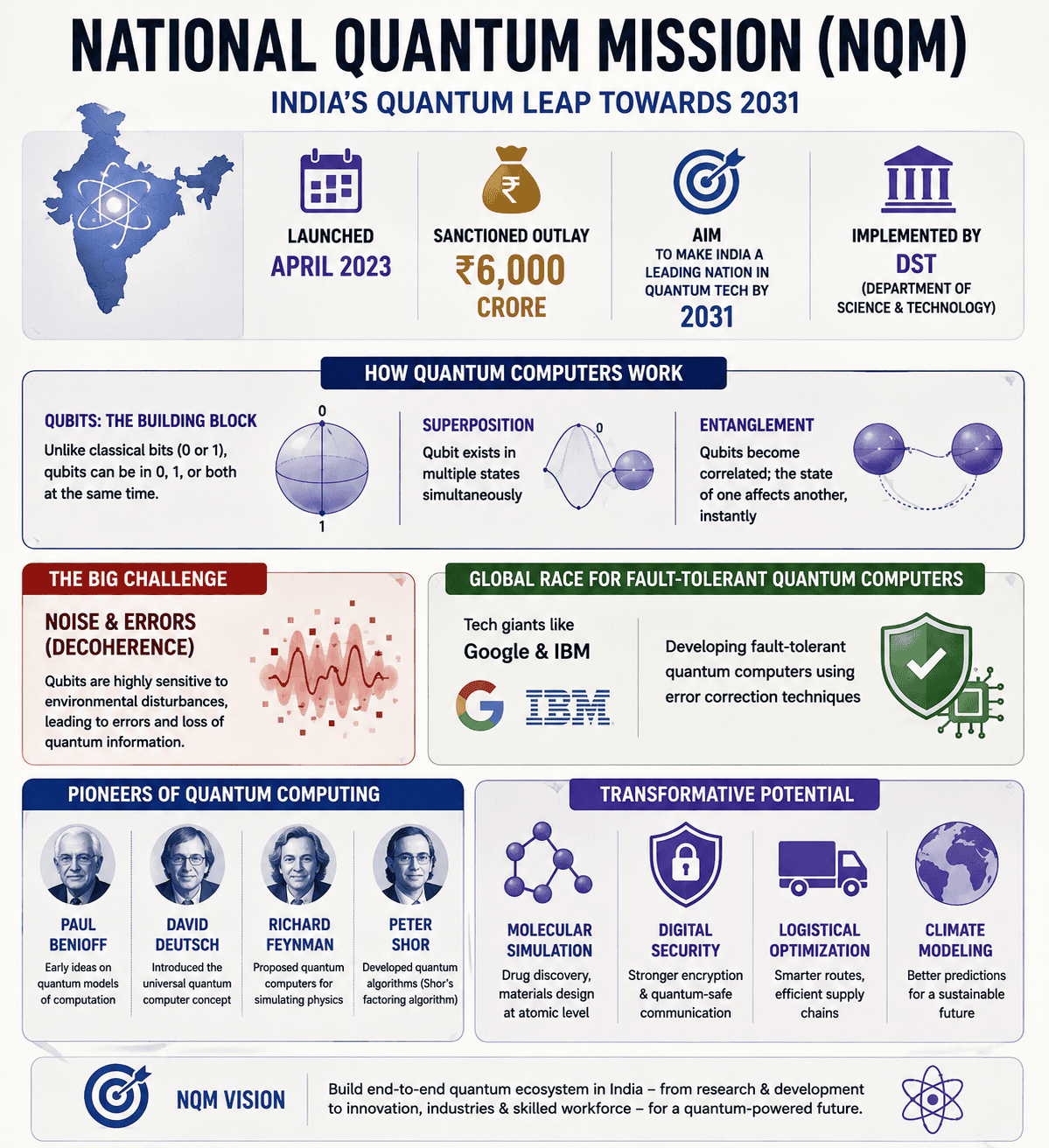
- India launched the National Quantum Mission (NQM) in April 2023 with a sanctioned outlay of ₹6,000 crore.
- The NQM aims to establish India as a leading nation in Quantum Technologies & Applications by 2031.
- Quantum computers utilize qubits, which leverage superposition and entanglement for processing information.
- A primary challenge in quantum computing is overcoming "noise and errors," a phenomenon known as decoherence.
- Major tech companies like Google and IBM are actively developing "fault-tolerant quantum computers" through error correction techniques.
NQM.png
Detailed Insights:
- The theoretical foundations of quantum computing were laid by physicists such as Paul Benioff, David Deutsch, Richard Feynman, and computer scientist Peter Shor.
- Quantum computers hold immense potential for revolutionizing molecular simulation, digital security, logistical optimization, and climate modeling.
- Despite advancements, current quantum computers have not yet demonstrated a commercially relevant problem that cannot be solved by classical supercomputers.
- Superposition allows a qubit to exist in multiple states simultaneously, significantly increasing information density compared to classical bits.
- Entanglement links the states of multiple qubits regardless of physical distance, enabling massive parallel processing capabilities.
- Various types of qubits are being developed, including superconducting, quantum dot, trapped ion, photonic, and NMR qubits.
- Decoherence occurs when qubits lose their delicate quantum states due to interaction with their environment, necessitating extreme isolation and cooling.
- Contemporary quantum processors exhibit high error rates (0.1% to 1%) compared to the near-perfect operations of classical computers.
- Error correction techniques aim to combine several physical qubits to form a more stable "logical qubit," reducing overall error rates.
- Google's Willow processor demonstrated the suppression of error rates by increasing the number of physical qubits in its system.
- Useful quantum computing applications are projected to emerge within the next five years by Google and by 2029 by IBM.
Scientific/Technical Concepts Involved:
- Quantum Mechanics: The branch of physics that describes the behavior of matter and light at the atomic and subatomic levels.
- Qubit: The basic unit of quantum information, capable of representing 0, 1, or a superposition of both states simultaneously.
- Superposition: A principle allowing a quantum system, like a qubit, to exist in multiple states at the same time until measured.
- Entanglement: A quantum phenomenon where two or more qubits become linked, such that the state of one instantly influences the others.
- Decoherence: The loss of quantum properties like superposition and entanglement in a qubit due to interaction with its environment.
- Fault-tolerant Quantum Computer: A quantum computer designed to perform reliable computations by actively correcting errors that occur in its qubits.

SuperKalam is your personal mentor for UPSC preparation, guiding you at every step of the exam journey.
Download the App


STUDY RESOURCES
CONTACT US
ⓒ Snapstack Technologies Private Limited