GS 3: EconomyGS 2: GovernanceGS 2: Social Justice
MGNREGS scale, workdays fell in 2025-26, finds study, Pg12
MGNREGS faces sharp contraction in scale and reach in 2025-26, with fewer workdays and income loss.
Practice MCQs
819 Students attempted
Key Highlights:
- MGNREGS experienced a contraction in scale and reach in 2025-26, despite a marginal increase in registered households.
- Fewer households and workers were employed, with total workdays declining by 21.5%.
- The number of households completing 100 days of guaranteed work fell by 40.5%.
- The upcoming Viksit Bharat - Guarantee for Rozgar and Ajeevika Mission (Gramin) Act, 2025 is set to replace MGNREGS.
- Average income loss per MGNREGS household during the financial year is estimated at ₹1,221.
Detailed Insights:
- The number of registered households under MGNREGS increased by 3.2%, from 14.98 crore in 2024-25 to 15.46 crore in 2025-26, but employment decreased.
- 44 lakh fewer households and 67 lakh fewer workers were employed, representing declines of 8.2% and 9.1% respectively.
- The number of persondays of work generated fell sharply by 21.5%, from 268.44 crore to 210.73 crore.
- Average persondays per household dropped by 14.5%, from 50.18 to 42.92, and households completing 100 days declined by 40.5%.
- Fifteen out of 20 states recorded a fall in persondays, with Tamil Nadu recording the steepest decline at 42.8%, followed by Haryana at 41.7%.
- The NREGA Sangharsh Morcha expressed concern over the lack of public consultation regarding the new employment scheme replacing MGNREGS.
- The Union government has allocated only ₹30,000 crore for MGNREGS for the transitional period.
Key Concepts Involved:
- MGNREGS: Aims to enhance livelihood security of households in rural areas of the country by providing at least one hundred days of guaranteed wage employment in a financial year to every household whose adult members volunteer to do unskilled manual work.
- Viksit Bharat - Guarantee for Rozgar and Ajeevika Mission (Gramin) Act, 2025: The new act that is expected to replace MGNREGS.
- Persondays: Unit to measure employment generated; one personday means one person is employed for one day.
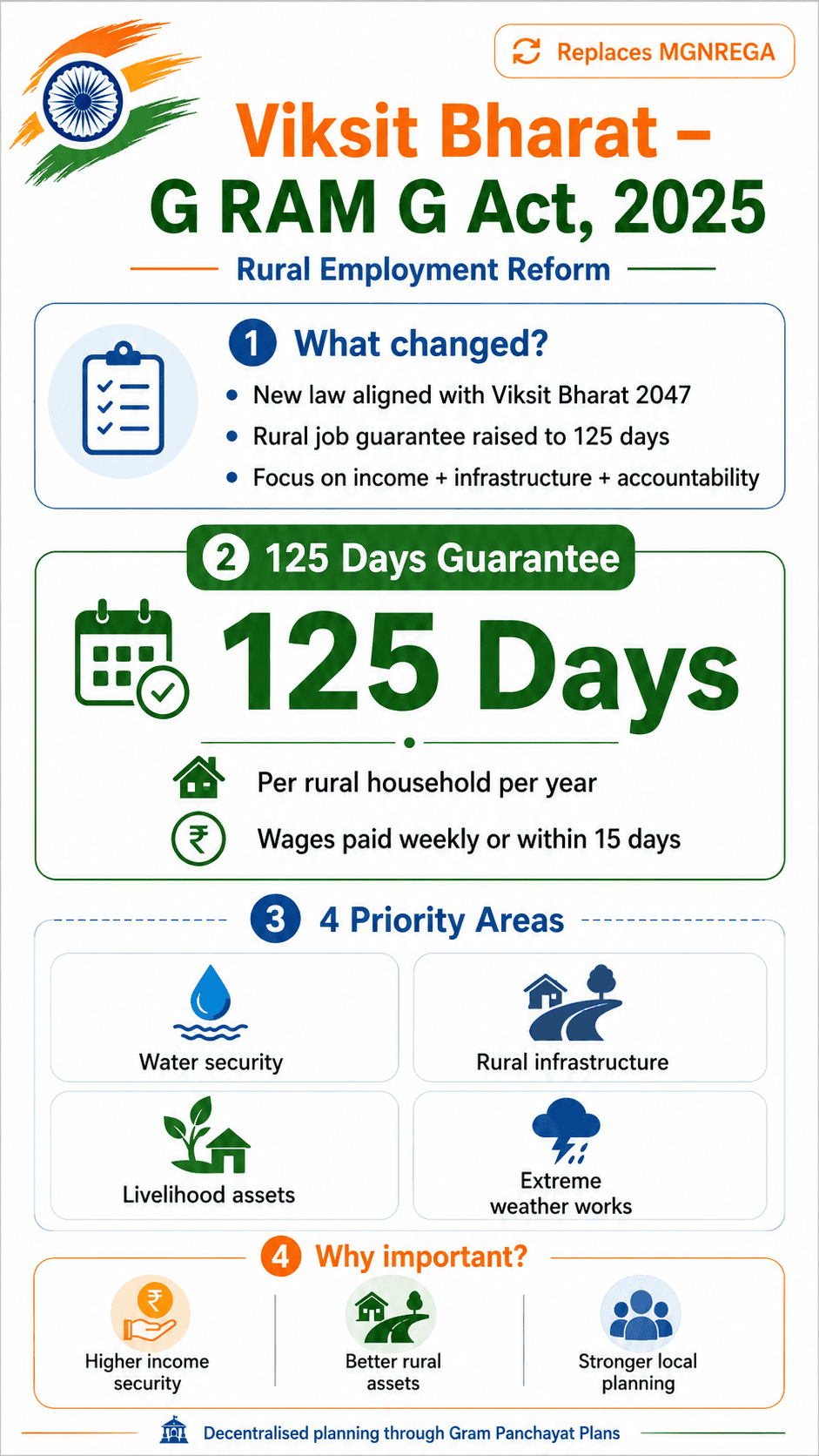
VB—G RAM G
Previous7/7

SuperKalam is your personal mentor for UPSC preparation, guiding you at every step of the exam journey.
Download the App


STUDY RESOURCES
CONTACT US
ⓒ Snapstack Technologies Private Limited