GS 2: Social JusticeGS 2: GovernanceGS 3: EconomyPrelims
The safety net and the trade-off, Pg12
States' burgeoning cash transfer schemes for women, totaling Rs 1.68 lakh crore, raise fiscal sustainability concerns amid rising debt and investment crowding out.
Practice MCQs
826 Students attempted
Key Highlights:
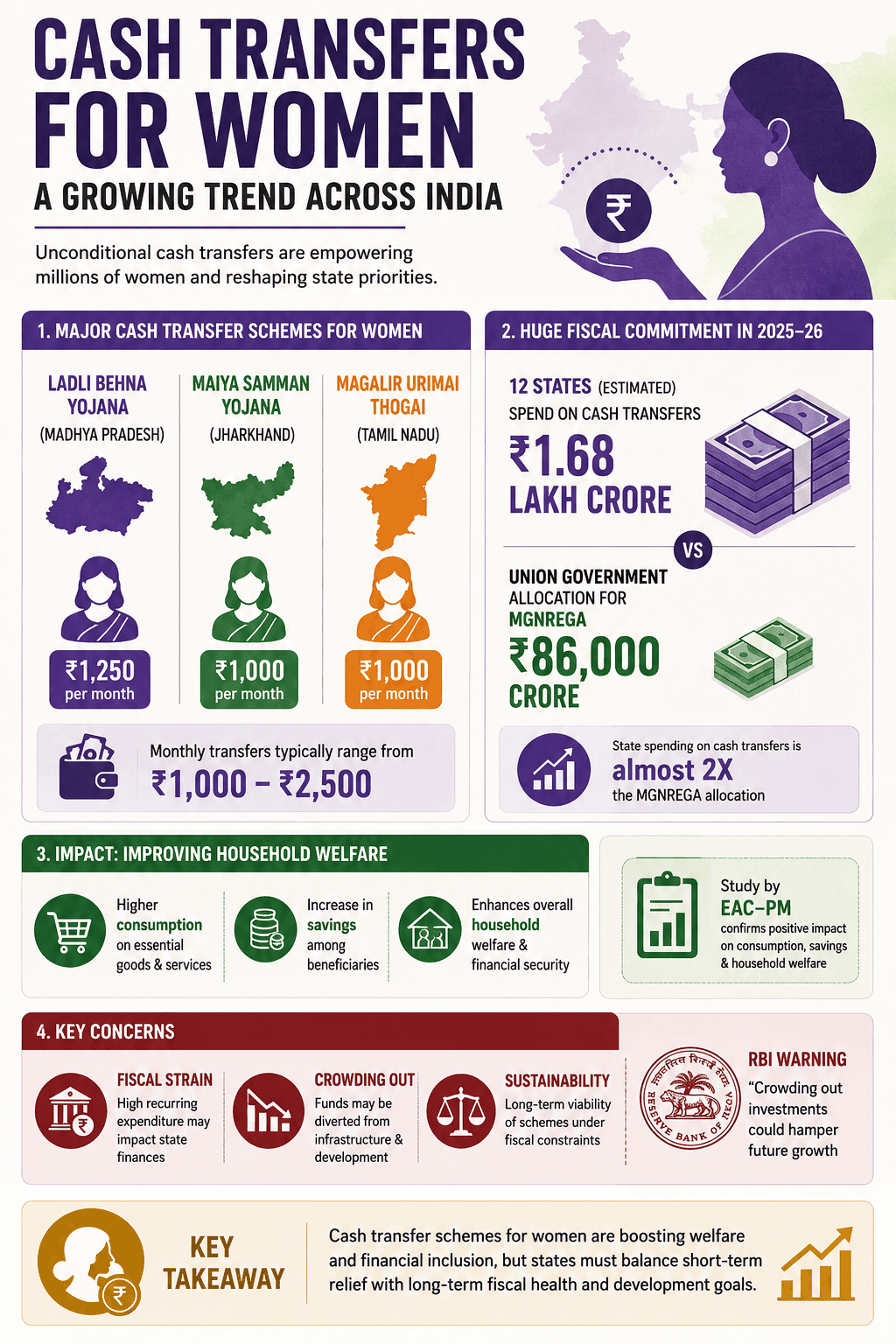
- Several Indian states have introduced unconditional cash transfer schemes for women, such as Ladli Behna Yojana (Madhya Pradesh), Maiya Samman Yojana (Jharkhand), and Magalir Urimai Thogai (Tamil Nadu).
- These schemes typically involve monthly transfers ranging from Rs 1,000 to Rs 2,500.
- In 2025-26, 12 states are estimated to spend Rs 1.68 lakh crore on these transfers, significantly more than the Union government's Rs 86,000 crore allocation for MGNREGA.
- A study by EAC-PM found that these schemes improved beneficiaries' consumption and savings, enhancing household welfare.
- Concerns exist regarding the impact of these schemes on state finances, with the Reserve Bank of India (RBI) warning of "crowding out" investments.
Cash Transfers.png
Detailed Insights:
- Unconditional cash transfers serve as instruments for social welfare, women's empowerment, and electoral strategies for political parties.
- The EAC-PM Working Paper Series study, examining schemes in Maharashtra and Odisha, highlighted increased spending on medical, educational, and lifestyle purposes by beneficiaries.
- The RBI has expressed concerns that increased state spending on such schemes and populist measures like free electricity could affect other developmental expenditures.
- According to an Axis Bank report, resources for these schemes are often garnered through expenditure switching and higher deficits.
- While the consolidated debt of states has decreased to 29.2% of GSDP in 2026 (budget estimates), significant variations exist, with Punjab at 46.4%, West Bengal at 38.9%, and Bihar at 36.8%.
- High debt levels, growing contingent liabilities from guarantees, and cash transfer schemes pose risks to state finances, as noted by the RBI.
Key Concepts Involved:
- Unconditional Cash Transfers: Direct financial aid provided to individuals or households without specific conditions on how the money is spent.
- Crowding Out: A phenomenon where increased government spending or public sector borrowing reduces private investment or consumption.
- Gross State Domestic Product (GSDP): The total value of goods and services produced within a state's geographical boundaries in a specific period.

SuperKalam is your personal mentor for UPSC preparation, guiding you at every step of the exam journey.
Download the App


STUDY RESOURCES
CONTACT US
ⓒ Snapstack Technologies Private Limited