GS 2: International RelationsGS 3: Internal SecurityGS 3: EconomyGS 1: Art & CulturePrelims
Missiles, minerals and port: Delhi, Jakarta seal key deals, Pg1
Delhi and Jakarta ink landmark BrahMos missile, critical minerals, and strategic Sabang Port deals, boosting Indo-Pacific ties.
Practice MCQs
826 Students attempted
Key Highlights:
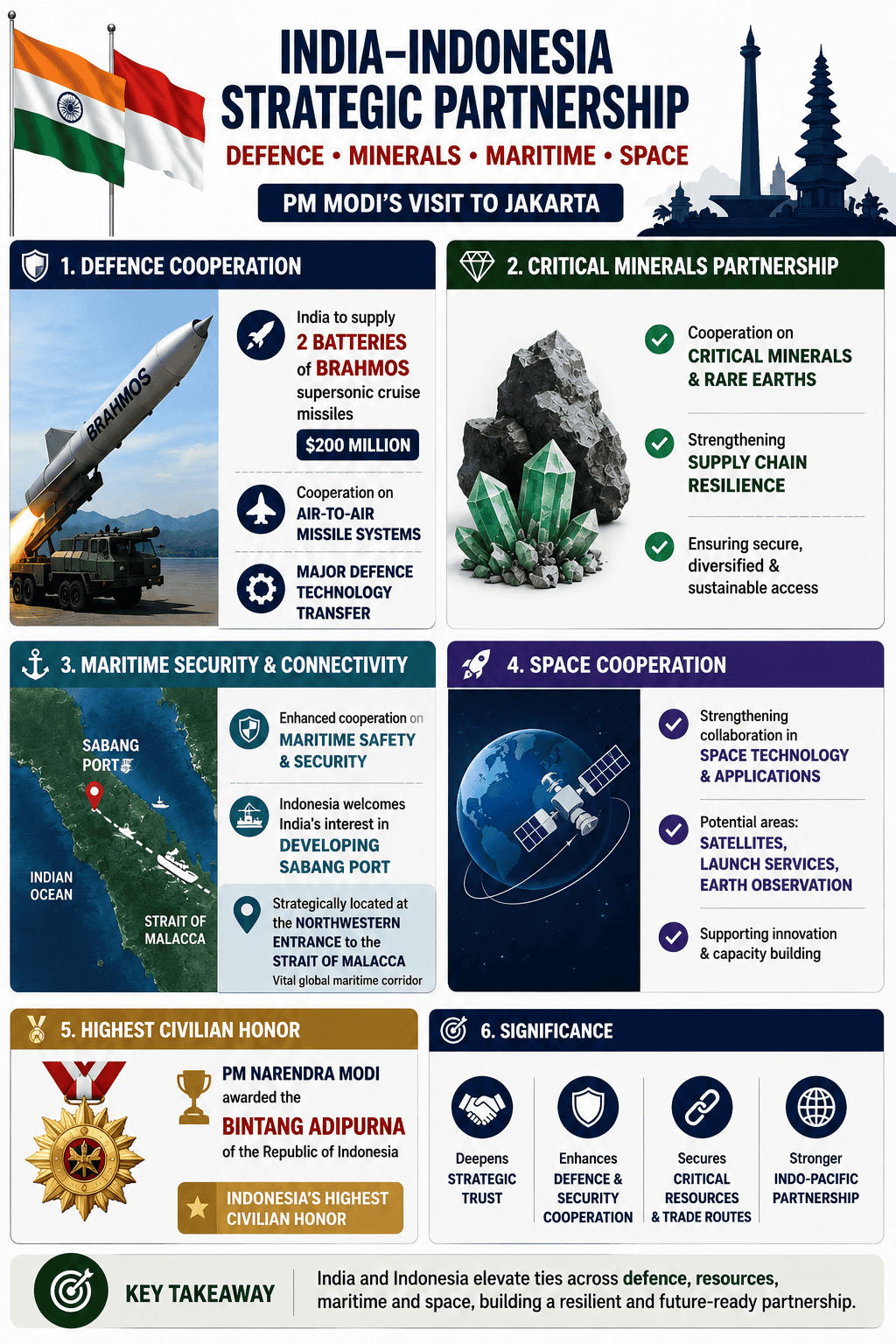
- India and Indonesia signed agreements on defense, critical minerals, maritime security, and space during Prime Minister Modi's visit to Jakarta.
- India is set to supply two batteries of BrahMos supersonic cruise missiles to Indonesia, valued at $200 million.
- The agreements include cooperation on critical minerals, rare earths, and strengthening supply chain resilience.
- Both nations agreed to enhance maritime safety and security, with Indonesia welcoming India's interest in developing Sabang Port.
- Prime Minister Modi was awarded the Bintang Adipurna of the Republic of Indonesia, the country's highest civilian honor.
India-Indonesia.png
Detailed Insights:
- The defense pacts also cover air-to-air missile systems and major defense technology transfer between the two countries.
- Sabang Port is strategically located at the northwestern entrance to the Strait of Malacca, a vital global maritime corridor.
- Its development aims to foster connectivity and trade between India's Andaman and Nicobar Islands and Sumatra.
- Indonesia is a major global player in critical minerals, holding approximately 21% of the world's nickel reserves.
- The leaders reaffirmed their commitment to a free, open, and inclusive Indo-Pacific region, emphasizing freedom of navigation.
- The visit marked the elevation of the Comprehensive Strategic Partnership, established in 2018, to new heights.
- Other agreements include establishing an IIM Bangalore campus in Indonesia and conserving the Prambanan Temple.
Key Concepts Involved:
- BrahMos Missile: A supersonic cruise missile developed jointly by India and Russia, capable of being launched from land, sea, and air platforms.
- Indo-Pacific: A geopolitical concept referring to the interconnected regions of the Indian and Pacific Oceans, crucial for global trade and security.
- Critical Minerals: Elements essential for modern technologies and economies, whose supply chains are vulnerable to disruption.
- ASEAN Centrality: The principle that the Association of Southeast Asian Nations (ASEAN) should be at the core of regional cooperation and architecture.

SuperKalam is your personal mentor for UPSC preparation, guiding you at every step of the exam journey.
Download the App


STUDY RESOURCES
CONTACT US
ⓒ Snapstack Technologies Private Limited