GS 2: International RelationsGS 3: EconomyPrelims
India flags flaws in US' Section 301 tariff probe, Pg15
India flags serious flaws in US's Section 301 forced-labor tariff probe, challenging proposed 12.8% duties and seeking bilateral dialogue.
Practice MCQs
826 Students attempted
Key Highlights:
- India has formally flagged several flaws in the United States' Section 301 investigation into alleged forced-labour content in Indian imports.
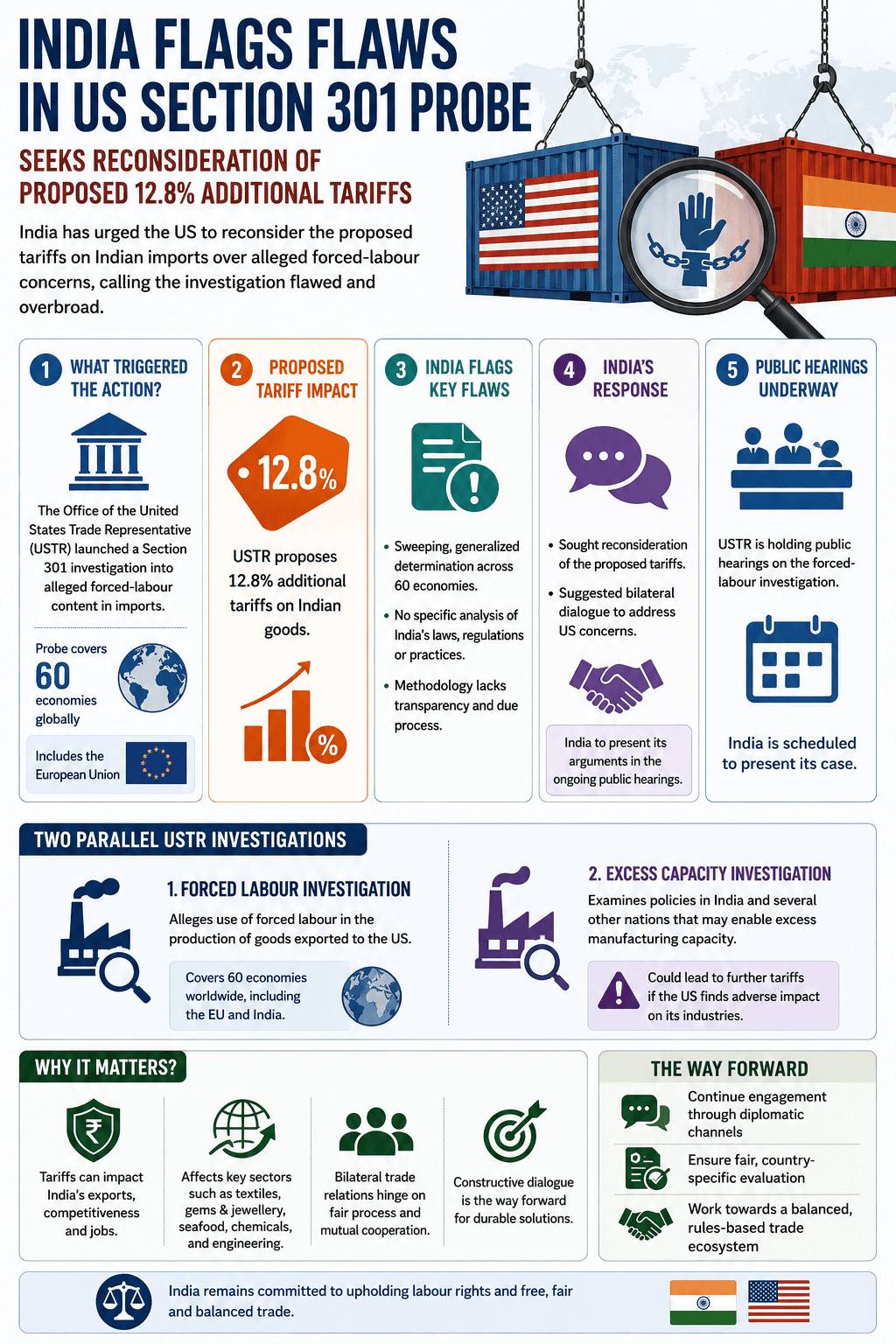
- The probe by the Office of the United States Trade Representative (USTR) proposes 12.8% additional tariffs on Indian goods.
- India's Ministry of Commerce and Industry stated that the USTR made a sweeping, generalized determination across 60 economies without specific analysis of India's laws and practices.
- India has sought reconsideration of the proposed tariffs and suggested bilateral dialogue to address US concerns.
- Public hearings on the forced-labour investigation are underway, with India scheduled to present its arguments.
USTR.png
Detailed Insights:
- The USTR investigation on forced labor covers 60 economies globally, including the European Union.
- Separately, the USTR is also investigating India and several other nations over policies allegedly enabling excess manufacturing capacity, which could lead to further tariffs.
- These investigations are seen as part of Washington's efforts to rebuild its tariff architecture following a US Supreme Court verdict on reciprocal tariffs.
- The probes are also linked to the ongoing India-US trade agreement negotiations, which are reportedly in their final stages.
- India argues that the USTR failed to meet the legal threshold under Section 301(d) of the Trade Act of 1974 by concluding that India's practices are unreasonable.
- India has a robust legal framework against forced labor, including Article 23 of its Constitution, the Bonded Labour System (Abolition) Act, 1976, and has ratified key International Labour Organization (ILO) Conventions such as the Forced Labour Convention, 1930 (No. 29) and the Abolition of Forced Labour Convention, 1957 (No. 105).
Key Concepts Involved:
- Section 301 of the Trade Act of 1974: A US trade law empowering the President to take action, including tariffs, against foreign governments engaging in unfair trade practices.
- Office of the United States Trade Representative (USTR): A US federal agency responsible for developing and executing international trade policy and negotiating trade agreements.
- Reciprocal Tariffs: Tariffs imposed by one country on another in response to similar tariffs or trade barriers imposed by the second country, aiming to balance trade.

SuperKalam is your personal mentor for UPSC preparation, guiding you at every step of the exam journey.
Download the App


STUDY RESOURCES
CONTACT US
ⓒ Snapstack Technologies Private Limited