GS 2: PolityGS 1: Indian GeographyPrelims
Four States reach a pact on Narmada project payments, Pg12
Maharashtra, Gujarat, Rajasthan, and MP sign historic Narmada project payment pact, resolving long-standing Sardar Sarovar cost-sharing dispute.
Practice MCQs
826 Students attempted
Key Highlights:
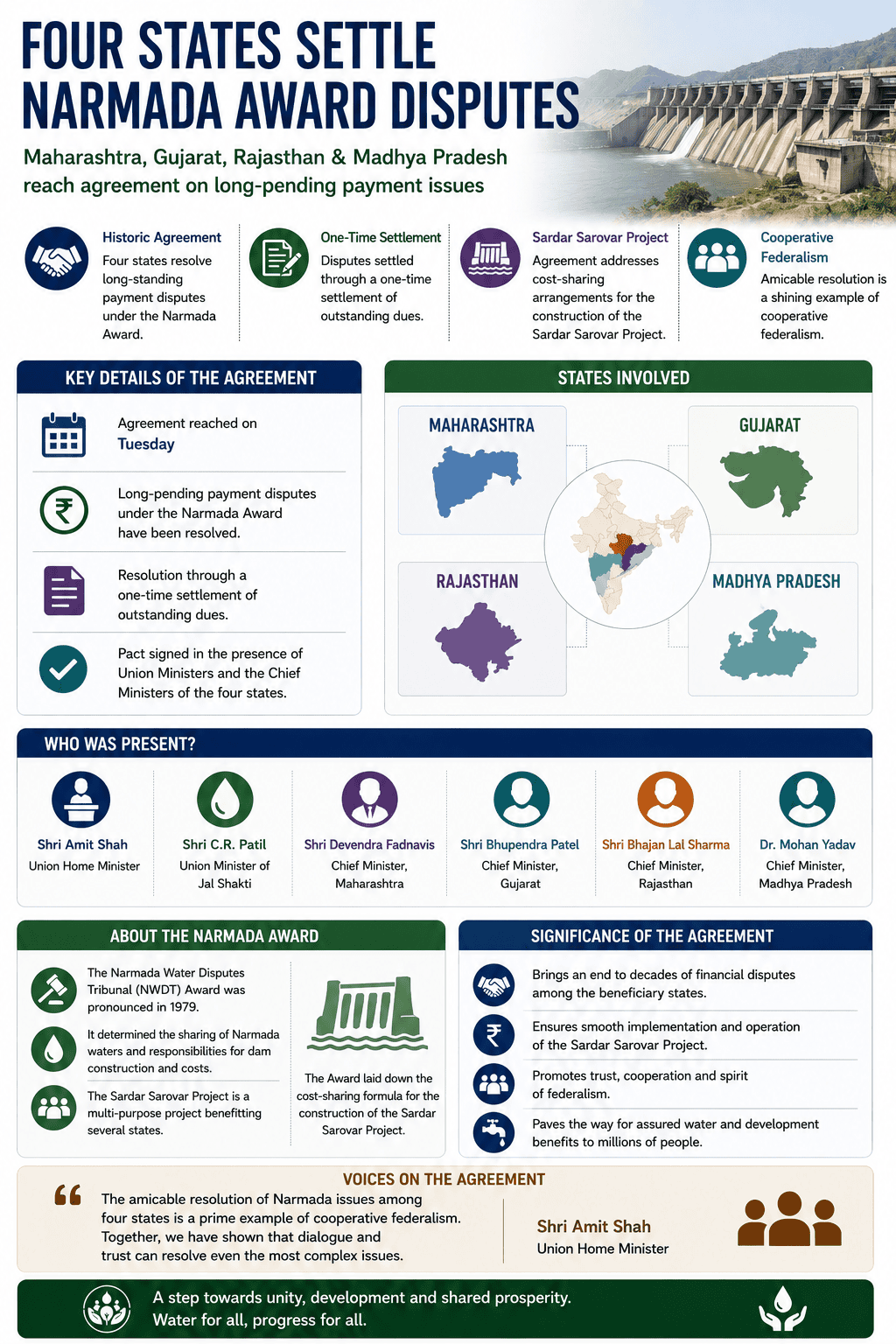
- Four states, Maharashtra, Gujarat, Rajasthan, and Madhya Pradesh, reached an agreement on Tuesday to settle long-pending payment disputes related to the Narmada Award.
- The agreement addresses cost-sharing arrangements for the construction of the Sardar Sarovar Project.
- The resolution was achieved through a one-time settlement of outstanding dues.
- The pact was signed in the presence of Union Home Minister Amit Shah and Union Minister of Jal Shakti C.R. Patil, along with the Chief Ministers of the four states.
Narmada Award.png
Detailed Insights:
- The issue of pending payments under the Narmada Award had remained unresolved among the four beneficiary states for a considerable period.
- Union Home Minister Amit Shah highlighted that the amicable resolution exemplifies cooperative federalism.
- The Sardar Sarovar Project has significantly benefited the participating states by providing water and electricity, transforming agricultural prospects and land values, particularly in Rajasthan.
- This agreement is part of broader efforts to resolve inter-state water disputes, including recent progress on the Kishau Dam project and the Yamuna Water Project between Rajasthan and Haryana.
- The Narmada Water Disputes Tribunal (NWDT), constituted in 1969, issued its award in 1979, which laid down the framework for sharing costs and benefits of the Sardar Sarovar Project.
Key Concepts Involved:
- Narmada Award: The final decision issued by the Narmada Water Disputes Tribunal (NWDT) in 1979, allocating Narmada waters and outlining cost-sharing for projects.
- Sardar Sarovar Project: A large multi-purpose dam project on the Narmada River, providing irrigation, drinking water, and hydroelectric power to several states.
- Inter-State Water Disputes Act, 1956: An Act of the Indian Parliament enacted to provide for the adjudication of disputes relating to waters of inter-state rivers and river valleys.

SuperKalam is your personal mentor for UPSC preparation, guiding you at every step of the exam journey.
Download the App


STUDY RESOURCES
CONTACT US
ⓒ Snapstack Technologies Private Limited