GS 3: Science & TechnologyPrelims
Contact lost with Drishti, world’s first OptoSAR satellite, Pg14
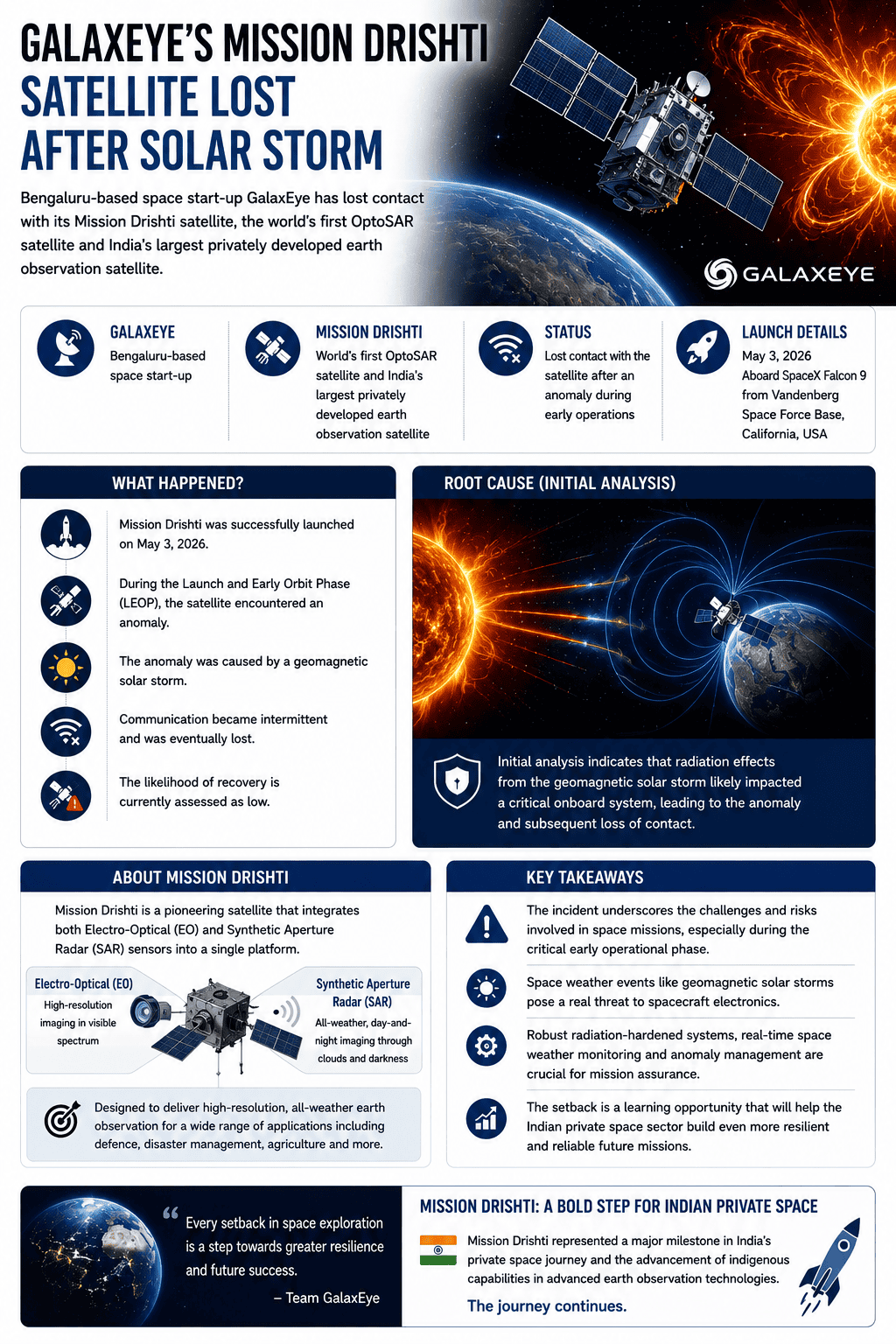
India's private space sector faces setback as GalaxEye's pioneering OptoSAR satellite, Mission Drishti, lost contact after geomagnetic storm.
Practice MCQs
826 Students attempted
Key Highlights:
- Bengaluru-based space start-up GalaxEye lost contact with its Mission Drishti satellite.
- Mission Drishti, launched in May, was the world’s first OptoSAR satellite and India’s largest privately developed earth observation satellite.
- The loss of contact occurred during the Launch and Early Orbit Phase (LEOP) following an anomaly caused by a geomagnetic solar storm.
- The satellite was launched on May 3 aboard a Falcon 9 rocket by SpaceX from Vandenberg, California.
Mission Dristi.png
Detailed Insights:
- Initial root cause analysis indicates that radiation effects from the geomagnetic solar storm likely impacted a critical onboard system.
- Communication with the spacecraft became intermittent and was eventually lost, with the likelihood of recovery currently appearing low.
- Mission Drishti was designed to integrate both Electro-Optical (EO) and Synthetic Aperture Radar (SAR) sensors into a single operational platform.
- This incident highlights the challenges and risks associated with space missions, particularly during critical early operational phases.
Scientific/Technical Concepts Involved:
- OptoSAR Satellite: A satellite that combines both electro-optical and synthetic aperture radar sensors for enhanced earth observation capabilities.
- Geomagnetic Solar Storm: A temporary disturbance of the Earth's magnetosphere caused by a solar wind shock wave or cloud of magnetic field.
- Launch and Early Orbit Phase (LEOP): The critical period immediately after a satellite's launch, involving maneuvers to reach its final orbit and initial system checks.
- Electro-Optical (EO) sensors: Passive sensors that detect and measure light in the visible and infrared spectrum, providing imagery similar to traditional cameras.
- Synthetic Aperture Radar (SAR) sensors: Active sensors that transmit radar signals and process the reflected signals to create high-resolution images, independent of weather or daylight.
Previous14/14

SuperKalam is your personal mentor for UPSC preparation, guiding you at every step of the exam journey.
Download the App


STUDY RESOURCES
CONTACT US
ⓒ Snapstack Technologies Private Limited