GS 2: International RelationsGS 3: EconomyGS 3: Science & TechnologyPrelims
Beyond three Cs, the new lexicon of India-Australia ties, Pg8
India-Australia elevate strategic ties to 'T-20 mode', targeting $100 billion trade by 2030, boosting defence, energy, and tech cooperation for Indo-Pacific stability.
Practice MCQs
826 Students attempted
Key Highlights:
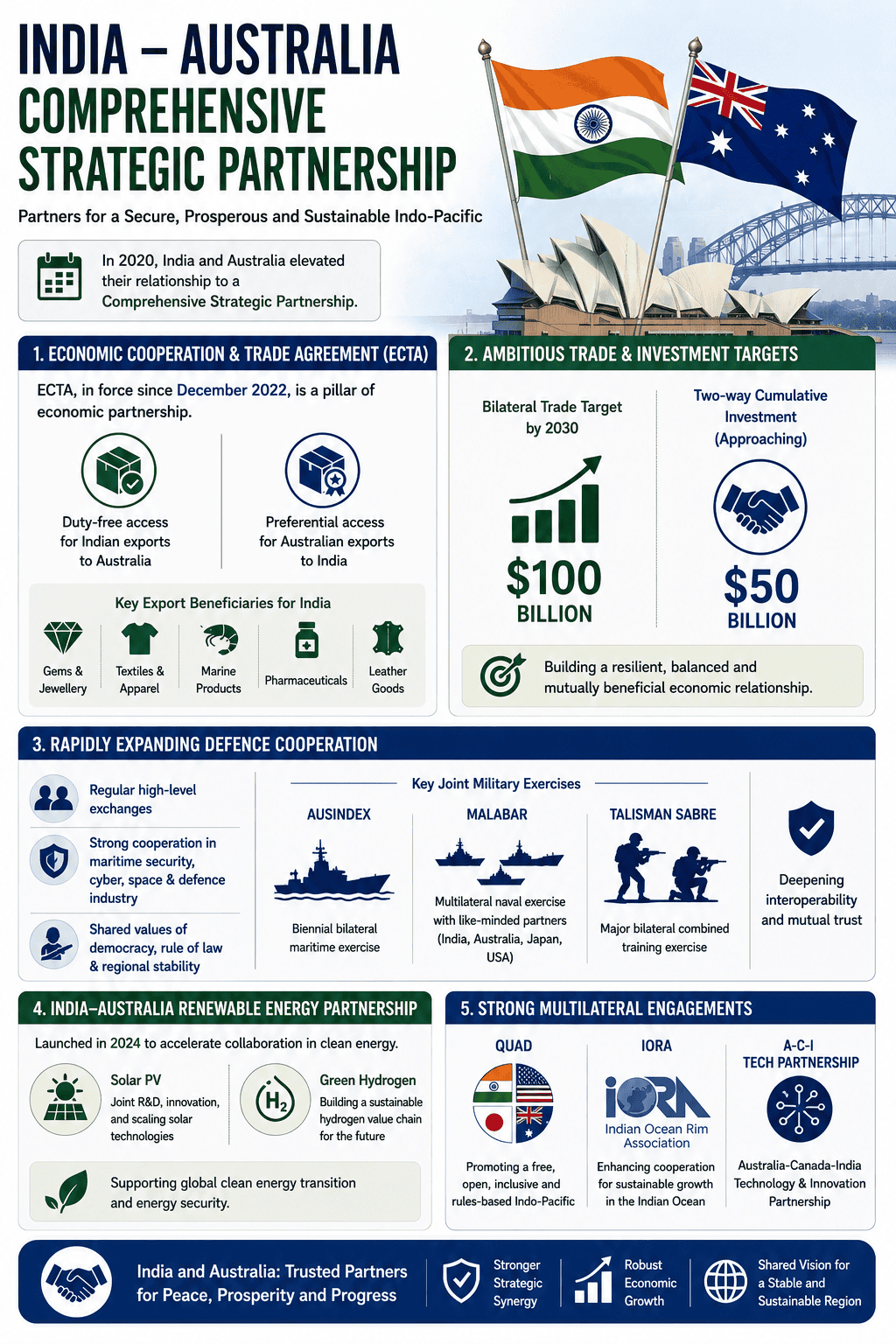
- India and Australia elevated their bilateral relationship to a Comprehensive Strategic Partnership in 2020.
- The Economic Cooperation and Trade Agreement (ECTA), which entered into force in December 2022, provides duty-free access for Indian exports to Australia and preferential access for Australian exports.
- Bilateral trade is targeted to reach $100 billion by 2030, with two-way cumulative investment approaching $50 billion.
- Defence cooperation is rapidly expanding, featuring regular high-level exchanges and joint military exercises such as AUSINDEX, Malabar, and Talisman Sabre.
- The India-Australia Renewable Energy Partnership, launched in 2024, focuses on collaboration in solar PV and green hydrogen.
- Multilateral engagements include the Quad, Indian Ocean Rim Association (IORA), and the Australia-Canada-India Technology and Innovation Partnership.
India-Australia.png
Detailed Insights:
- The Comprehensive Strategic Partnership signifies a deep and broad-based collaboration across various sectors, building on a Strategic Partnership established in 2009.
- The ECTA has significantly benefited Indian sectors like textiles, pharmaceuticals, chemicals, and engineering goods, while facilitating Australian exports of critical minerals and resources.
- Australian investment in India includes projects like AirTrunk's $30 billion plan for digital infrastructure and AI-ready data centers by 2030.
- Indian investment in Australia includes Perdaman Chemicals & Fertilizers' $4.5 billion urea plant in Western Australia, the largest in Australia's fertilizer industry.
- Defence cooperation is exploring opportunities in cyber, AI, and drone technology, leveraging India's expanding shipbuilding capabilities.
- The India-Australia Renewable Energy Partnership is guided by a Solar Taskforce and a Green Hydrogen Task Force at the ministerial level.
- Potential Australian uranium exports are expected to provide a significant boost to India's ambitious civil nuclear program.
- Over 100,000 Indian students are enrolled in Australia, and Australian universities are establishing campuses in India, fostering educational ties.
- Joint research initiatives cover priority areas such as advanced computing, energy, healthcare, space, and defence.
- Sports cooperation is emerging as a new priority, with potential collaboration in sport education, training, and organizing major events like the Brisbane Olympics 2032.
- The Indian diaspora in Australia, exceeding ten lakh, acts as a "living bridge," strengthening people-to-people connections.
- Trilateral cooperation extends to forums like India-Indonesia-Australia and India-France-Australia dialogues.
- The Australia-Canada-India Technology and Innovation Partnership, launched in November 2025, aims to deepen cooperation in critical and emerging technologies.
- The India-Japan-Australia Supply Chain Resilience Initiative plays a crucial role in countering supply chain disruptions and market dominance in critical areas.
- Both nations share a common vision for a free, open, safe, peaceful, and prosperous Indo-Pacific region.
Key Concepts Involved:
- Comprehensive Strategic Partnership: A high-level bilateral relationship indicating deep cooperation across various sectors.
- Economic Cooperation and Trade Agreement (ECTA): A free trade agreement aimed at reducing tariffs and boosting bilateral trade.
- Indo-Pacific: A geopolitical concept referring to the maritime region spanning the Indian and Pacific Oceans, crucial for global trade and security.
- Quad: A strategic dialogue between Australia, India, Japan, and the United States, focused on a free and open Indo-Pacific.

SuperKalam is your personal mentor for UPSC preparation, guiding you at every step of the exam journey.
Download the App


STUDY RESOURCES
CONTACT US
ⓒ Snapstack Technologies Private Limited