GS 3: EconomyGS 3: Science & TechnologyGS 2: GovernancePrelims
Policy is undoing what science built. That's a challenge for Cotton Productivity Mission, Pg11
Policy failures, including seed price controls, crippled India's cotton productivity and biotech innovation, jeopardizing the new Rs 5,659 crore Cotton Productivity Mission's 2031 targets.
Practice MCQs
819 Students attempted
Key Highlights:
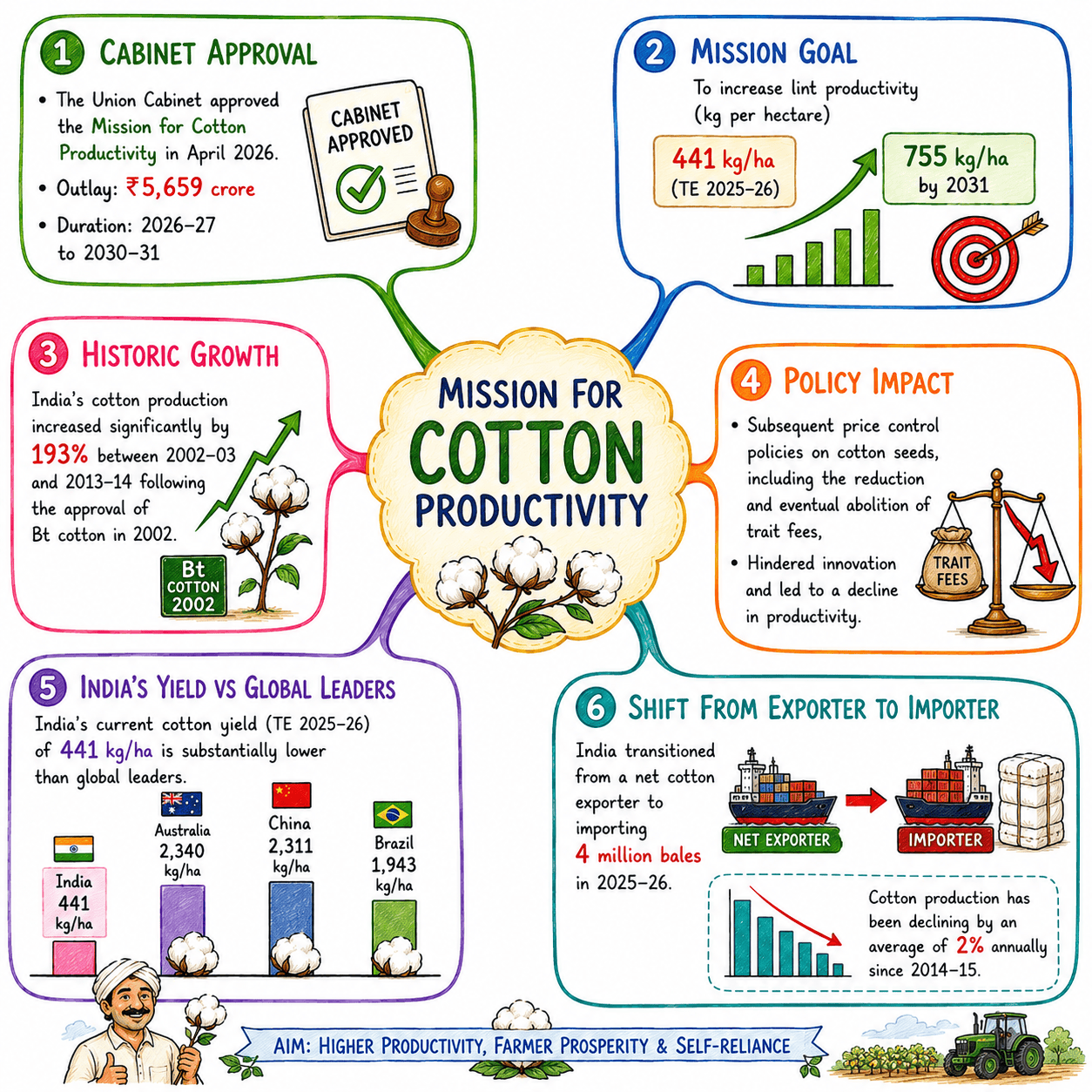
- The Union Cabinet approved the Mission for Cotton Productivity in April 2026 with an outlay of Rs 5,659 crore, running from 2026-27 to 2030-31.
- This mission aims to increase lint productivity from 441 kg per hectare (TE 2025-26) to 755 kg/ha by 2031.
- India's cotton production significantly increased by 193% between 2002-03 and 2013-14 following the approval of Bt cotton in 2002.
- Subsequent price control policies on cotton seeds, including the reduction and eventual abolition of trait fees, hindered innovation and led to a decline in productivity.
- India's current cotton yield of 441 kg/ha is substantially lower than global leaders like Australia (2,340 kg/ha), China (2,311 kg/ha), and Brazil (1,943 kg/ha) (TE 2025-26).
- India transitioned from a net cotton exporter to importing 4 million bales in 2025-26, with production declining by an average of 2% annually since 2014-15.
Cotton.png
Detailed Insights:
- Prime Minister Atal Bihari Vajpayee approved the commercial cultivation of Bt cotton in 2002, envisioning India as a leader in the biotechnology revolution.
- The Genetic Engineering Appraisal Committee (GEAC) initially approved Bt hybrids with the Cry1Ac gene and later Bollgard II (stacked genes) by 2006.
- This technological adoption led to India becoming the largest producer and second-largest exporter of cotton, with yields improving by 88% from 302 kg/ha to 566 kg/ha.
- Andhra Pradesh first imposed a Maximum Retail Price of Rs 750 per packet in 2006, drastically reducing the trait fee from Rs 1,250.
- The central government formalized these controls in 2015 through the Cotton Seed Price Control Order, cutting the trait fee by 74% from Rs 186.95 to Rs 49 per packet.
- By 2020, the trait fee was entirely abolished, making seed innovation commercially unviable for private companies.
- Consequently, Mahyco-Monsanto Biotech (MMB) withdrew advanced technologies like Bollgard II with Roundup Ready Flex (RRF) from GEAC consideration.
- Countries like Brazil and the United States routinely plant advanced multi-gene stacked technologies such as Bollgard 3 ThryvOn with XtendFlex.
- Brazil, where 92% of cotton is rainfed, leverages seed innovation to enable a second crop within the same agricultural year in 60% of its cotton area.
- The estimated accumulated cost of policy failure is 36.3 million bales in lost production by 2026, contributing to India's import dependence.
- The new mission's target of 755 kg/ha by 2031 would still leave India significantly behind current global leaders in productivity.
- The government faces a critical choice: either restore the intellectual property framework for private innovators or substantially fund public sector R&D to fill the technology gap.
Key Concepts Involved:
- Bt Cotton: Genetically modified cotton incorporating genes from Bacillus thuringiensis to confer resistance against bollworm pests.
- Trait Fee: A royalty or licensing fee paid by seed companies to the technology provider for the use of patented genetic traits in seeds.
- Genetic Engineering Appraisal Committee (GEAC): India's apex regulatory body responsible for approving genetically modified organisms for environmental release and commercial cultivation.
- Lint Productivity: The measure of the yield of processed cotton fiber (lint) per unit area of land, typically expressed in kilograms per hectare.

SuperKalam is your personal mentor for UPSC preparation, guiding you at every step of the exam journey.
Download the App


STUDY RESOURCES
CONTACT US
ⓒ Snapstack Technologies Private Limited