GS 2: International RelationsGS 3: EconomyPrelims
Not seeking mediation on border dispute: Nepal FM, Pg1
Nepal's FM rejects third-party mediation on Kalapani-Lipulekh-Limpiyadhura border dispute, advocating diplomatic resolution and boosting digital payment connectivity with India.
Practice MCQs
819 Students attempted
Key Highlights:
- Nepal's Foreign Minister Shisir Khanal affirmed that Nepal is not seeking third-party mediation on the Kalapani-Lipulekh-Limpiyadhura border dispute with India.
- Nepal intends to resolve the dispute through diplomatic processes and by accessing historical documents, potentially from the U.K.
- The border issue gained renewed attention after India announced the Kailash-Manasarovar Yatra for 2026 through the Lipulekh Pass, a territory claimed by Nepal.
- Nepal formally communicated its objection to both India and China regarding the Yatra announcement.
- The new Nepalese government, led by Prime Minister Balendra Shah of the Rastriya Swatantra Party (RSP), aims to shift bilateral relations towards development diplomacy.
- India and Nepal have operationalized peer-to-peer (P2P) cross-border payment transactions, enhancing digital financial connectivity.
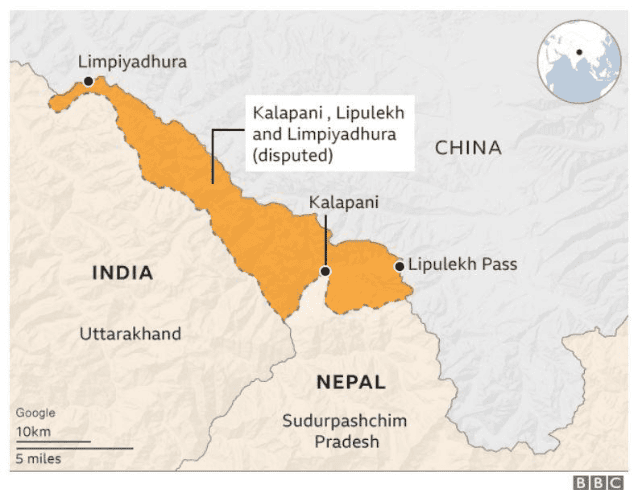
Kalapani region.png
Detailed Insights:
- The Kalapani-Lipulekh-Limpiyadhura dispute originates from differing interpretations of the 1816 Treaty of Sugauli, which designated the Kali River as Nepal's western boundary but lacked a clear definition of its source.
- Nepal claims the Kali River originates at Limpiyadhura, asserting that the entire 372 sq km area, including Kalapani and Lipulekh, falls within its territory.
- India maintains that the Kali River originates near Kalapani in Pithoragarh district, Uttarakhand, and that the disputed areas are part of its territory, citing historical administrative records.
- The Lipulekh Pass holds significant strategic importance as a traditional route for the Kailash-Manasarovar Yatra and its location at the India-China-Nepal tri-junction.
- The dispute escalated in 2020 when India inaugurated a road to Lipulekh, prompting Nepal to issue a new political map incorporating the contested territories.
- Prime Minister Balendra Shah, a former rapper and engineer, leads the Rastriya Swatantra Party (RSP), which came to power in March 2026 following a "Gen Z uprising" in Nepal.
- India has consistently affirmed that border issues with Nepal should be resolved through bilateral mechanisms, rejecting any third-party involvement.
- Nepal's new government seeks to reorient its relationship with India, moving away from past geopolitical friction towards a focus on economic cooperation and shared development.
- The newly launched P2P cross-border payment system links India's Unified Payments Interface (UPI) with Nepal's National Payments Interface (NPI), facilitating easier remittances and financial transactions between citizens.
Key Concepts Involved:
- Treaty of Sugauli (1816): A historical agreement between the British East India Company and Nepal that established Nepal's western boundary along the Kali River.
- Kalapani-Lipulekh-Limpiyadhura: A disputed tri-junction area claimed by both India and Nepal, central to their ongoing border disagreement.
- Bilateral Mechanism: A framework for resolving disputes directly between two sovereign nations without the intervention of external parties.
- Development Diplomacy: A foreign policy approach that prioritizes economic cooperation, trade, and development initiatives to strengthen international relations.

SuperKalam is your personal mentor for UPSC preparation, guiding you at every step of the exam journey.
Download the App


STUDY RESOURCES
CONTACT US
ⓒ Snapstack Technologies Private Limited