GS 2: PolityGS 2: GovernancePrelims
Was a ‘proper debate’ held in Parliament on CEC and ECs appointment law, asks SC, Pg14
Supreme Court questions Parliament on CEC/ECs appointment law debate, citing concerns over executive dominance and eroded judicial oversight.
Practice MCQs
811 Students attempted
Key Highlights:
- The Supreme Court questioned the extent of parliamentary debate on the 2023 judgment regarding the appointment of Election Commissioners (ECs) and the Chief Election Commissioner (CEC).
- The 2023 judgment in Anoop Baranwal versus Union of India had established a selection committee including the Prime Minister, Leader of the Opposition, and the Chief Justice of India.
- The subsequent law, The Chief Election Commissioner and other Election Commissioners (Appointment, Conditions of Service, and Term of Office) Act of 2023, replaced the CJI with a Union Cabinet Minister in the selection committee.
- Concerns were raised in the Supreme Court about the suspension of Opposition MPs during the passing of the 2023 Act, suggesting a lack of proper debate.
Detailed Insights:
- The 2023 Supreme Court judgment aimed to remove the appointment of CEC and ECs from the sole discretion of the executive, ensuring a more impartial selection process.
- The Union government's subsequent law effectively reinstated the executive's dominant role in the appointment process, raising concerns about the independence of the Election Commission.
- The Supreme Court's questioning focuses on whether the "ethos" of its 2023 judgment, promoting impartiality, was adequately considered during the parliamentary process.
- The intervention by advocates highlighted the suspension of Opposition MPs, suggesting that the law was passed without sufficient scrutiny and debate.
Key Concepts Involved:
- Election Commission of India: Constitutional body responsible for conducting free and fair elections.
- Separation of Powers: The division of governmental power among different branches (executive, legislative, judicial) to prevent tyranny.
- Judicial Review: The power of the judiciary to review and invalidate laws that violate the constitution.
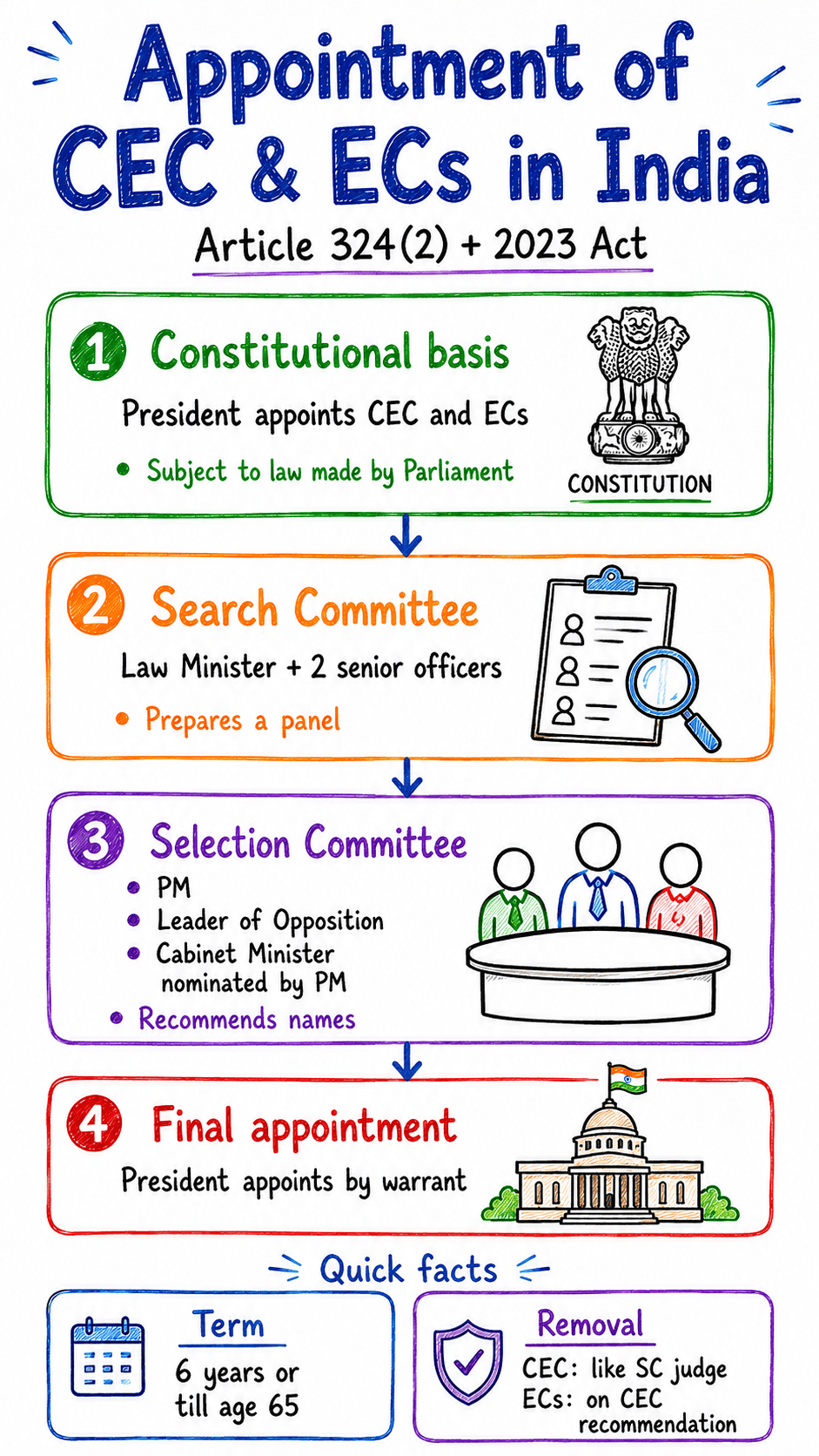
Appointment of CEC & ECs

SuperKalam is your personal mentor for UPSC preparation, guiding you at every step of the exam journey.
Download the App


STUDY RESOURCES
CONTACT US
ⓒ Snapstack Technologies Private Limited