GS 3: EconomyGS 3: Environment & EcologyGS 3: Science & TechnologyGS 2: GovernancePrelims
What is the ethanol advantage?, Pg1
Government re-evaluates E25 ethanol blending target amidst auto industry and consumer concerns over vehicle damage, fuel economy, and rushed transition.
Practice MCQs
819 Students attempted
Key Highlights:
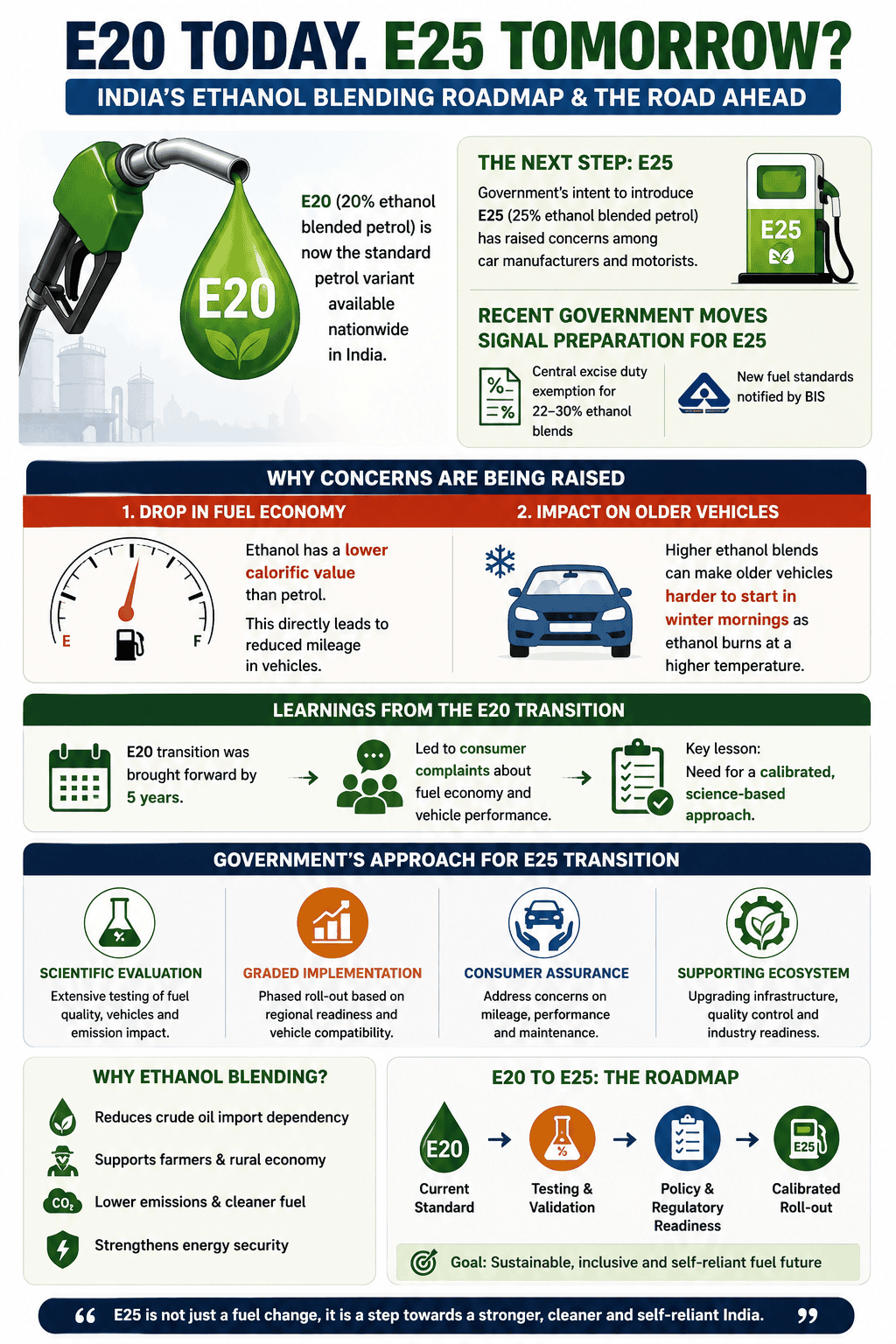
- E20 (20% ethanol blended petrol) is now the standard petrol variant available nationwide in India.
- The government's intent to introduce E25 (25% ethanol blended petrol) has raised concerns among car manufacturers and motorists.
- Recent government decisions, including central excise duty exemption for 22-30% ethanol blends and new fuel standards notified by BIS, signal preparations for E25.
- Concerns primarily revolve around a perceptible drop in fuel economy and potential vehicular part damage in older cars due to higher ethanol content.
- The government plans to address these concerns scientifically and implement the transition to E25 in a calibrated and graded manner.
Ethanol.png
Detailed Insights:
- The rapid advancement of the E20 transition by five years previously led to consumer complaints regarding fuel economy and vehicle performance.
- Ethanol has a lower calorific value than petrol, which directly contributes to reduced mileage in vehicles.
- Higher ethanol blends can make older vehicles harder to start in winter mornings as ethanol burns at a higher temperature.
- Ethanol's hygroscopic nature promotes water uptake, increasing the risk of corrosion and potential damage to internal combustion engine parts, especially in older vehicles.
- Despite challenges, ethanol offers advantages such as lower carbon content, reduced dependence on fossil fuel imports, and a higher octane number.
- Automakers face significant work for E25 readiness, including engine calibration, fuel-system durability, corrosion resistance, material compatibility, and homologation.
- The government maintains that the rollout of higher ethanol-petrol blends will only proceed after proper testing and extensive stakeholder consultations.
Key Concepts Involved:
- E20/E25: Petrol blended with 20% or 25% ethanol, respectively, as a biofuel.
- Calorific Value: The amount of heat energy released when a fuel is completely combusted.
- Octane Number: A measure of a fuel's resistance to knocking or pre-ignition during combustion.
- Hygroscopic Nature: The property of a substance to attract and hold water molecules from the surrounding environment.
- Homologation: The process of certifying a vehicle or component to comply with regulatory standards for safety, environment, and roadworthiness.
- BIS (Bureau of Indian Standards): India's national standards body responsible for developing and maintaining quality standards for various products and services.

SuperKalam is your personal mentor for UPSC preparation, guiding you at every step of the exam journey.
Download the App


STUDY RESOURCES
CONTACT US
ⓒ Snapstack Technologies Private Limited