GS 3: Science & TechnologyGS 3: EconomyGS 3: Environment & EcologyGS 2: GovernancePrelims
‘Prioritise charging infra for electric 3Ws’, Pg13
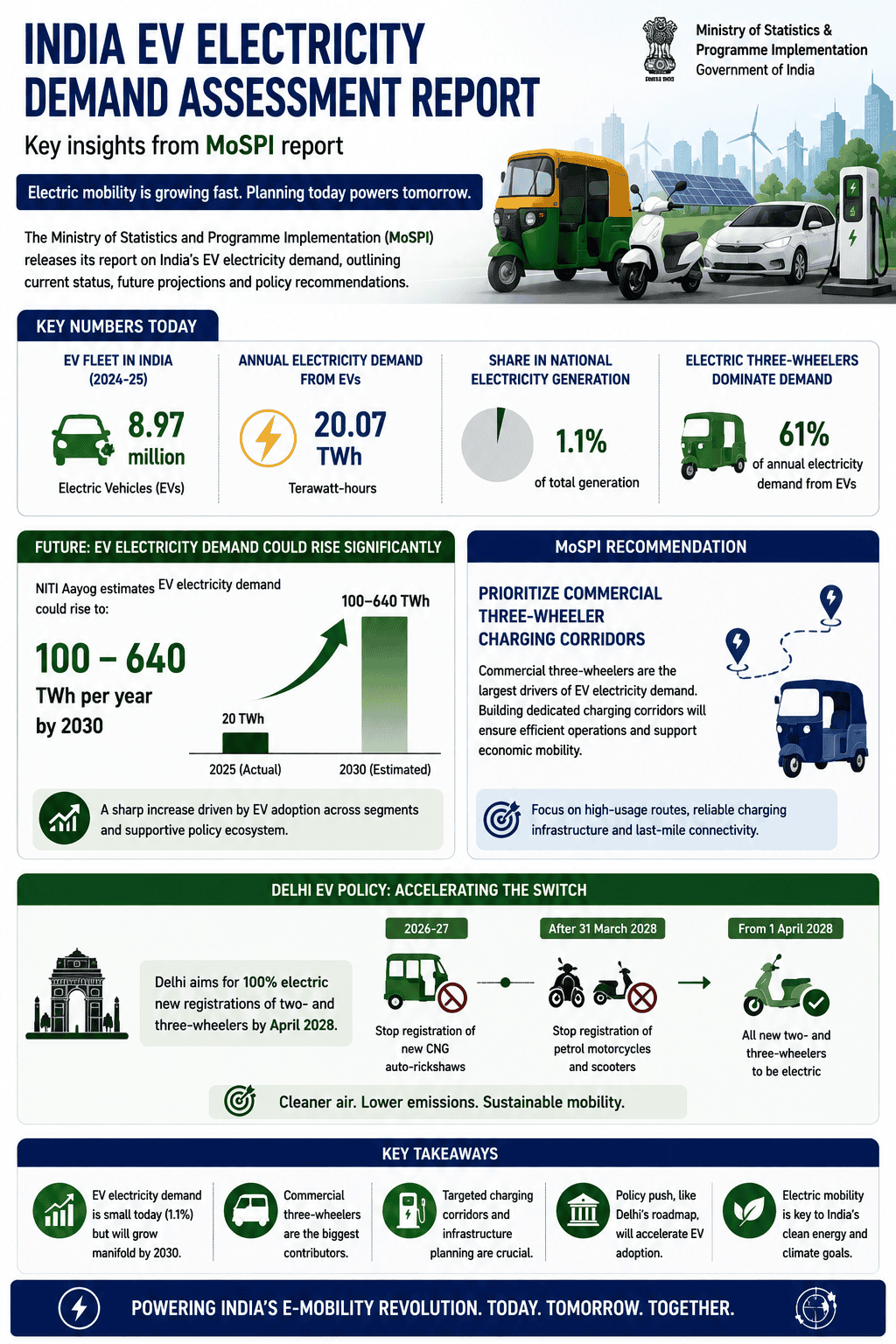
MoSPI report demands priority charging for electric 3-wheelers, consuming 61% of EV electricity, crucial for India's 2030 infrastructure push.
Practice MCQs
819 Students attempted
Key Highlights:
- The Ministry of Statistics and Programme Implementation (MoSPI) report, titled India EV Electricity Demand Assessment Report, recommends prioritizing commercial three-wheeler charging corridors.
- Electric three-wheelers account for 61% of the annual electricity demand from India's 8.97 million Electric Vehicles (EVs).
- The current annual electricity demand from all EVs in India is 20.07 Terawatt-hours (TWh), representing about 1.1% of the national electricity generation.
- The NITI Aayog estimates that EV electricity demand could rise significantly to 100-640 TWh per year by 2030.
- Delhi has announced a policy to stop registration of petrol motorcycles and scooters after March 31, 2028, and new CNG auto-rickshaws in 2026-27, aiming for all new two- and three-wheelers to be electric by April 2028.
EV.png
Detailed Insights:
- Despite electric two-wheelers dominating the EV fleet population, their electricity demand is lower due to shorter annual distances and reduced per-kilometer energy consumption.
- The report emphasizes the need for quantifying category-wise energy consumption for future infrastructure planning due to increasing EV penetration.
- Heavy Motor Electric Vehicles (buses and trucks) constitute only 0.4% of all EVs but account for nearly 22% of the total electricity share due to higher payload and long-distance operations.
- Beyond commercial three-wheeler corridors, the report also suggests prioritizing urban fleet charging stations, bus depots, freight charging hubs, and fast-charging infrastructure for heavy-duty transport.
- Residential charging for two-wheelers is considered more manageable due to lower charging power requirements and reduced annual electricity consumption.
- India's EV population comprises 4.37 million electric two-wheelers and 4.14 million three-wheelers, collectively making up 95% of all EVs.
Key Concepts Involved:
- Ministry of Statistics and Programme Implementation (MoSPI): A ministry responsible for statistical system development, data collection, and analysis in India.
- India EV Electricity Demand Assessment Report: A specific report by MoSPI's Expert Committee on Energy Statistics, assessing electricity consumption patterns of EVs.
- NITI Aayog: A policy think tank of the Government of India, providing directional and policy inputs.
- Electric Vehicles (EVs): Vehicles that are powered by an electric motor, using energy stored in rechargeable batteries.
- Terawatt-hours (TWh): A unit of energy equal to one trillion watt-hours, commonly used to measure large-scale electricity generation and consumption.

SuperKalam is your personal mentor for UPSC preparation, guiding you at every step of the exam journey.
Download the App


STUDY RESOURCES
CONTACT US
ⓒ Snapstack Technologies Private Limited