GS 3: Science & TechnologyPrelims
Oldest quasars found deepen ‘perplexing’ space mystery, Pg2
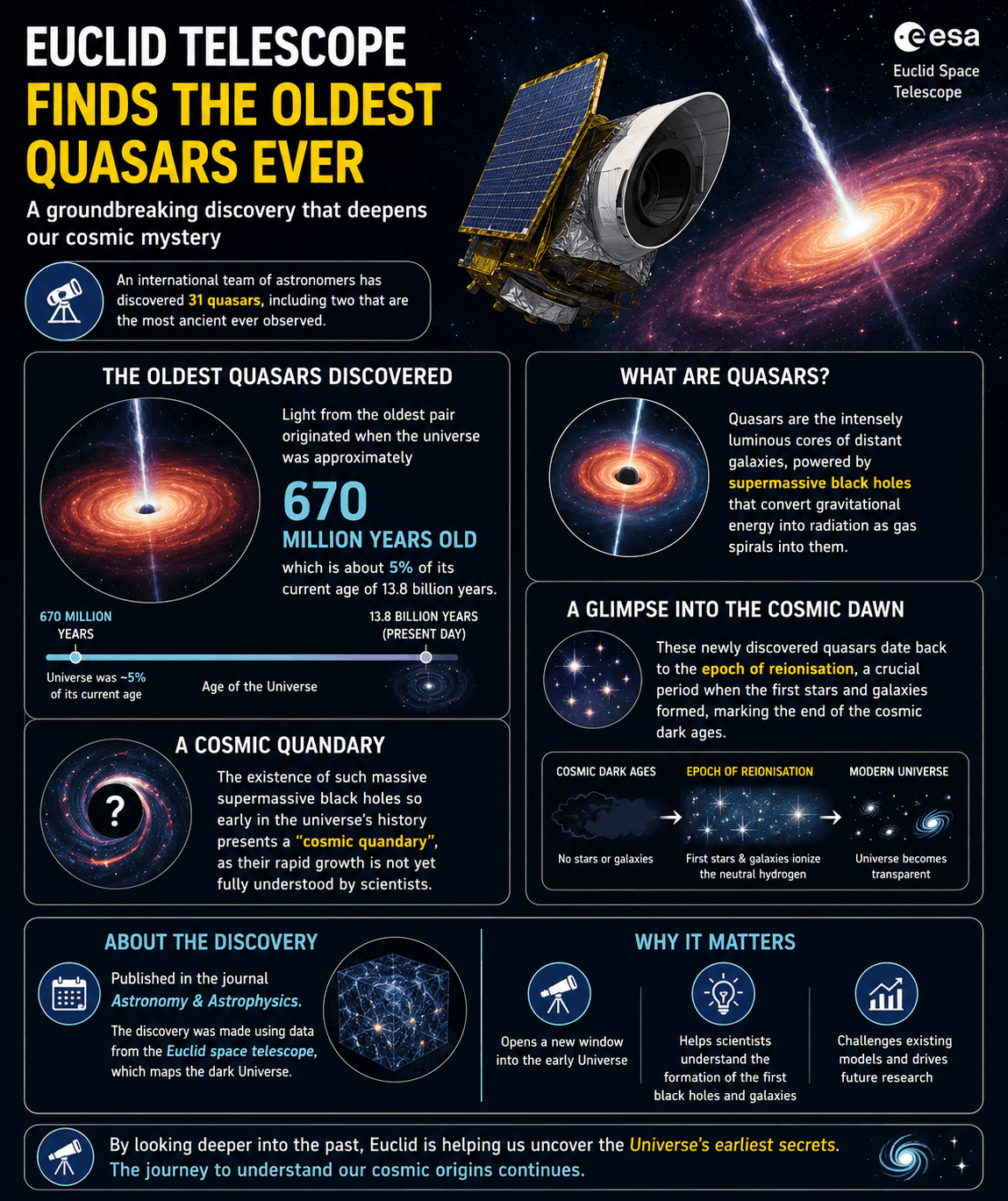
Euclid space telescope uncovers two oldest quasars from universe's infancy, deepening cosmic mystery of supermassive black hole formation.
Practice MCQs
819 Students attempted
Key Highlights:
- The Euclid space telescope has discovered the oldest quasars ever observed, deepening a cosmic mystery.
- An international team of astronomers announced the discovery of 31 quasars, including two that are the most ancient.
- Light from the oldest pair originated when the universe was approximately 670 million years old, which is about five percent of its current age of 13.8 billion years.
- This discovery was published in the journal Astronomy & Astrophysics.
Quasar.png
Detailed Insights:
- Quasars are the intensely luminous cores of distant galaxies, powered by supermassive black holes that convert gravitational energy into radiation as gas spirals into them.
- These newly discovered quasars date back to the epoch of reionisation, a crucial period when the first stars and galaxies formed, marking the end of the cosmic dark ages.
- The existence of such massive supermassive black holes so early in the universe's history presents a "cosmic quandary," as their rapid growth is not yet fully understood by scientists.
- The Euclid space telescope, launched in 2023 by the European Space Agency (ESA), is designed to map the large-scale structure of the universe and study dark energy and dark matter.
- Its advanced capabilities have doubled the number of known ancient quasars in just two years.
- The James Webb Space Telescope is also being utilized to observe these quasars, with scientists planning to analyze its collected data for further insights.
- Researchers aim to compile a "quasar chronicle" to understand the universe's evolution during its first billion years.
Scientific/Technical Concepts Involved:
- Quasar: An extremely luminous active galactic nucleus (AGN) powered by a supermassive black hole, emitting vast amounts of energy across the electromagnetic spectrum.
- Supermassive Black Hole: The largest type of black hole, with masses millions to billions of times that of the Sun, typically found at the center of most large galaxies.
- Epoch of Reionisation: A period in the early universe (approximately 150 million to 1 billion years after the Big Bang) when neutral hydrogen atoms were reionized by the intense radiation from the first stars, galaxies, and quasars.
- Euclid space telescope: An European Space Agency (ESA) mission launched in 2023, designed to create a 3D map of the universe and investigate the nature of dark energy and dark matter.
- James Webb Space Telescope: A large infrared observatory, a collaboration between NASA, ESA, and the Canadian Space Agency, designed to observe the early universe, galaxy formation, and exoplanets.

SuperKalam is your personal mentor for UPSC preparation, guiding you at every step of the exam journey.
Download the App


STUDY RESOURCES
CONTACT US
ⓒ Snapstack Technologies Private Limited