GS 3: EconomyGS 1: Indian SocietyPrelims
Understanding inequality in India’s growth story, Pg6
Study reveals rising consumption inequality in India, driven by urban-rural divide and non-food expenditure disparities, challenging official narratives.
Practice MCQs
804 Students attempted
Key Highlights:
- The Household Consumer Expenditure Survey (HCES) 2023-24 estimates India's overall consumption expenditure inequality at a Gini index of 0.29.
- Urban areas exhibit higher inequality than rural areas, particularly in non-food expenditure.
- The top 10% of the urban population contributes 27% of total non-food expenditure.
- The mean MPCE of the top urban decile is six times that of the bottom urban decile and nine times that of the bottom rural decile.
Detailed Insights:
- India's consumption boom is primarily driven by non-food expenditure, which also exhibits higher inequality compared to food expenditure in both urban and rural sectors.
- There is a substantial gap between urban and rural sectors in MPCE, with urban non-food MPCE being approximately 1.5 times higher than the national average, while rural MPCE is lower.
- Within urban India, within-decile and between-decile inequalities account for about 33% and 67% of food expenditure inequality, respectively, and about 10% and 90% of non-food expenditure inequality.
- The richest 5% in rural areas have a per-capita consumption expenditure six times higher than the poorest 5%, while in urban areas, it is nine times higher, indicating greater inequality in urban areas.
- Traditional inequality measures may underestimate the true extent of inequality due to the under-representation of the super-rich in NSS surveys.
- Class-based analysis reveals that urban owners, managers, and professionals have disproportionately benefited since the 1980s, while urban informal workers, rural small farmers, and agricultural laborers have lagged behind.
- A significant portion of the population engages in debt-led consumption, highlighting the complexities of inequality in India.
Key Concepts Involved:
- Gini Index: A measure of statistical dispersion intended to represent the income or wealth distribution of a nation's residents, and is the most commonly used measure of inequality.
- MPCE (Monthly Per Capita Expenditure): An estimate of the average expenditure incurred by a person in a household during a month.
- NSSO (National Sample Survey Organisation): An organization of the Ministry of Statistics and Programme Implementation, Government of India, for conducting socio-economic surveys.
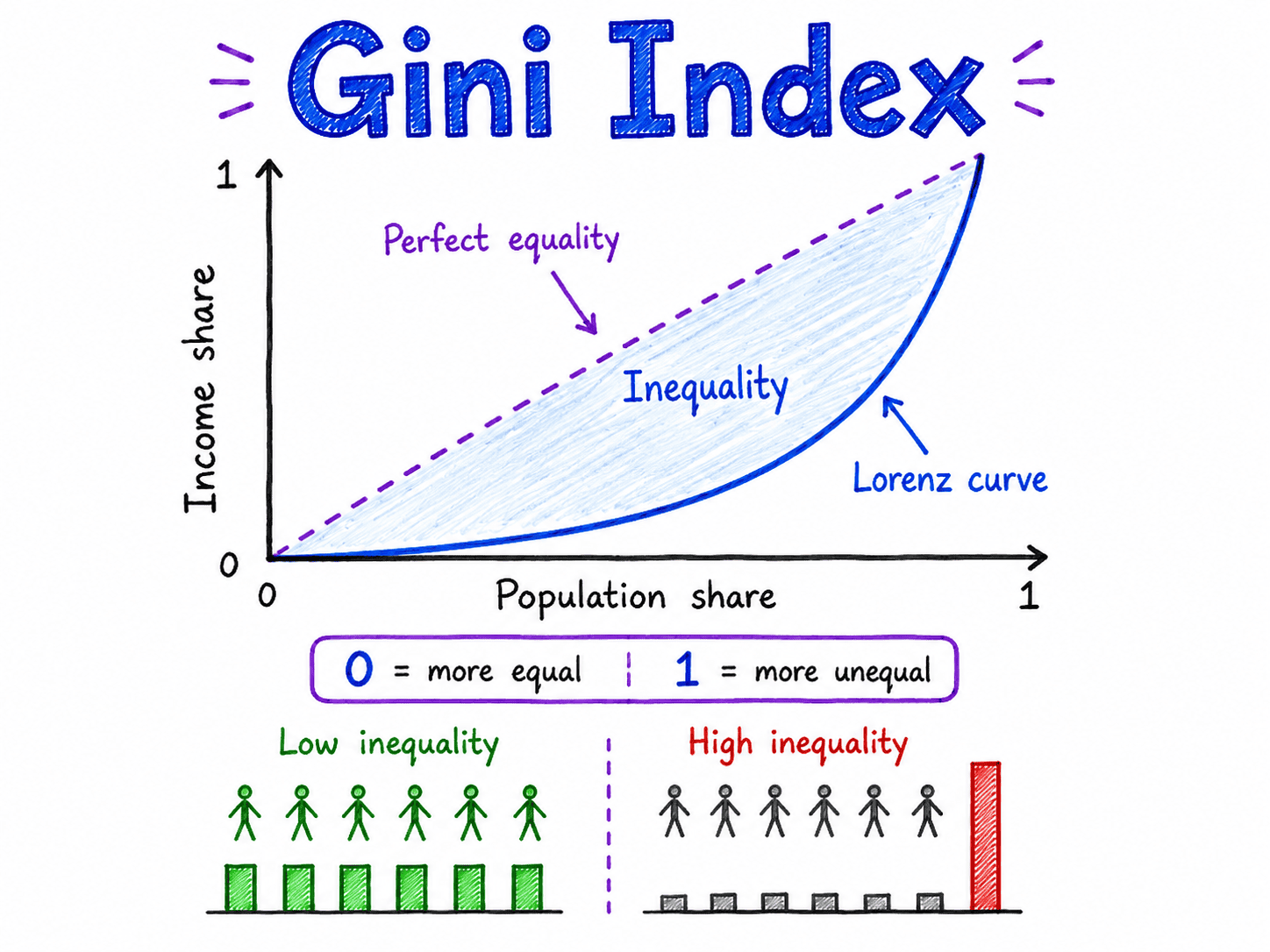
Gini Index

SuperKalam is your personal mentor for UPSC preparation, guiding you at every step of the exam journey.
Download the App


STUDY RESOURCES
CONTACT US
ⓒ Snapstack Technologies Private Limited