GS 2: PolityGS 2: GovernancePrelims
CJI’s role in CEC, EC appointments was temporary, pending new law: SC, Pg10
Supreme Court reviews petitions challenging CEC and EC appointment law, questioning executive's control over Election Commission appointments after Anoop Baranwal case.
Practice MCQs
804 Students attempted
Key Highlights:
- The Supreme Court addressed petitions challenging the 2023 Act regarding the appointment of the Chief Election Commissioner (CEC) and Election Commissioners (ECs).
- Petitioners argue the 2023 law gives the political executive excessive control over CEC and EC appointments.
- The 2023 Act replaced the CJI in the appointment committee with a Union Cabinet Minister.
- The court clarified that the CJI's involvement was temporary, pending parliamentary legislation.
Detailed Insights:
- The 2023 Act was enacted to countermand a March 2023 Supreme Court judgment that mandated a committee including the Prime Minister, Leader of the Opposition, and the CJI for CEC and EC appointments.
- Prior to the March 2023 judgment, the President, acting on the Prime Minister's advice, appointed the CEC and ECs.
- Petitioners argue that the Constitution framers intended to prevent the executive branch from having exclusive control over Election Commission appointments to ensure its independence.
- The Supreme Court questioned whether Parliament is obligated to enact laws in a specific manner, acknowledging Parliament's power to legislate on the appointment process.
- The Anoop Baranwal v. Union of India case highlighted the need to end government monopoly over appointments to maintain the Election Commission's neutrality.
Key Concepts Involved:
- Chief Election Commissioner (CEC): The head of the Election Commission of India, responsible for overseeing and conducting elections.
- Election Commissioners (ECs): Members of the Election Commission who assist the CEC in managing the electoral process.
- Article 324(2): A constitutional provision that deals with the composition of the Election Commission.
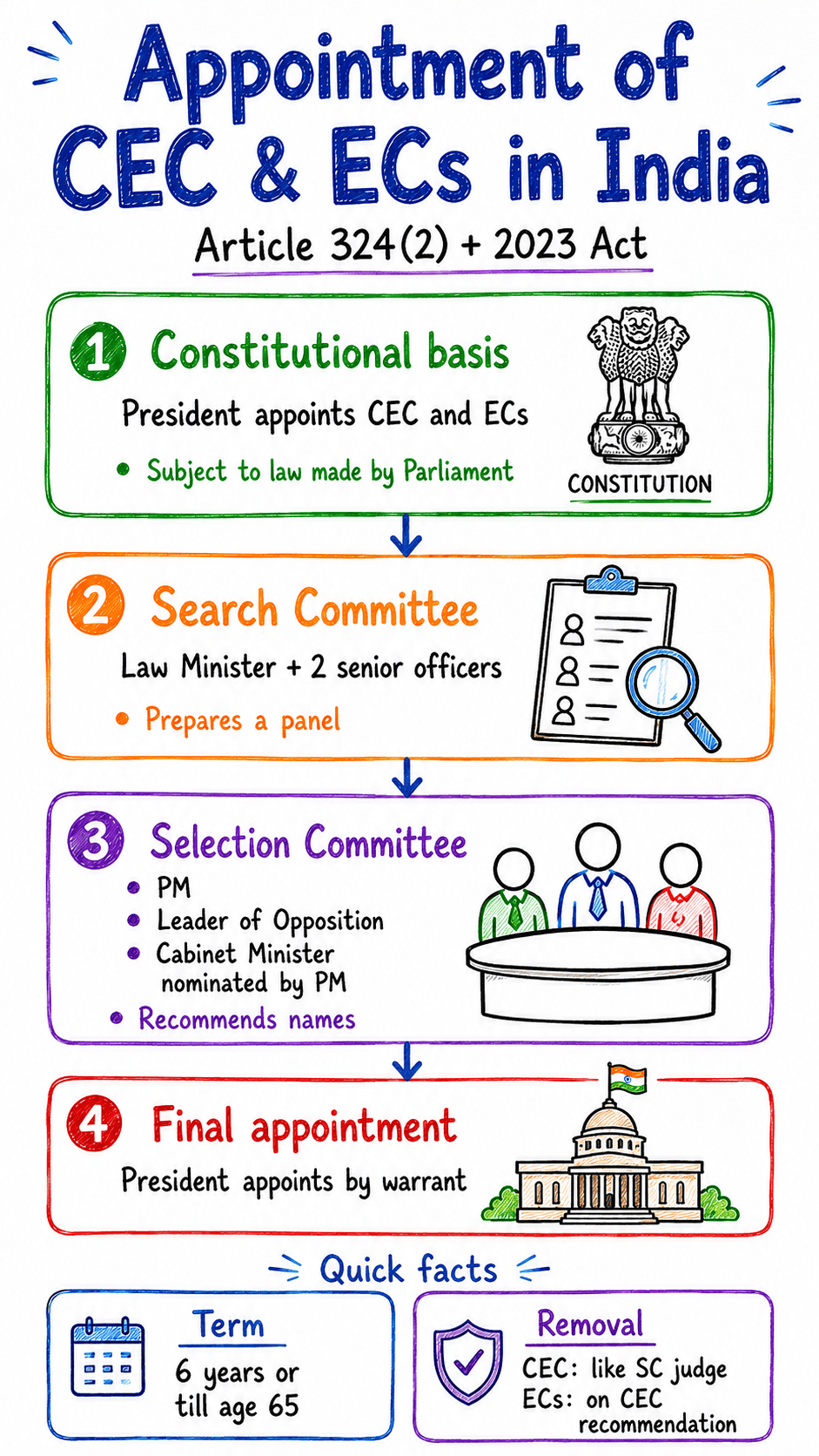
Appointment of CEC & ECs

SuperKalam is your personal mentor for UPSC preparation, guiding you at every step of the exam journey.
Download the App


STUDY RESOURCES
CONTACT US
ⓒ Snapstack Technologies Private Limited