GS 2: International RelationsGS 3: EconomyGS 2: PolityPrelims
Rubio fails to win India back for Washington, Pg10
US Secretary Rubio fails to mend fractured India-US ties, as Trump's 'America First' policies, trade tariffs, and Quad neglect deepen strategic mistrust.
Practice MCQs
804 Students attempted
Key Highlights:
- U.S.-India bilateral ties have significantly deteriorated since the second half of 2025, impacting a partnership once deemed crucial for the 21st century.
- Key factors for the decline include U.S. President Donald Trump's claims on the May 2025 India-Pakistan ceasefire and 50% tariffs on Indian exports.
- U.S. Secretary of State Marco Rubio's visit to India from May 23-26, 2026, failed to repair the strained relationship or make progress on a trade deal.
- India perceives a strategic betrayal due to growing U.S.-Pakistan strategic partnership post-Operation Sindoor and neglect of the Quad.
- The "America First" policy under President Trump is seen as prioritizing U.S. interests over repairing the strategic partnership with India.
US-India.png
Detailed Insights:
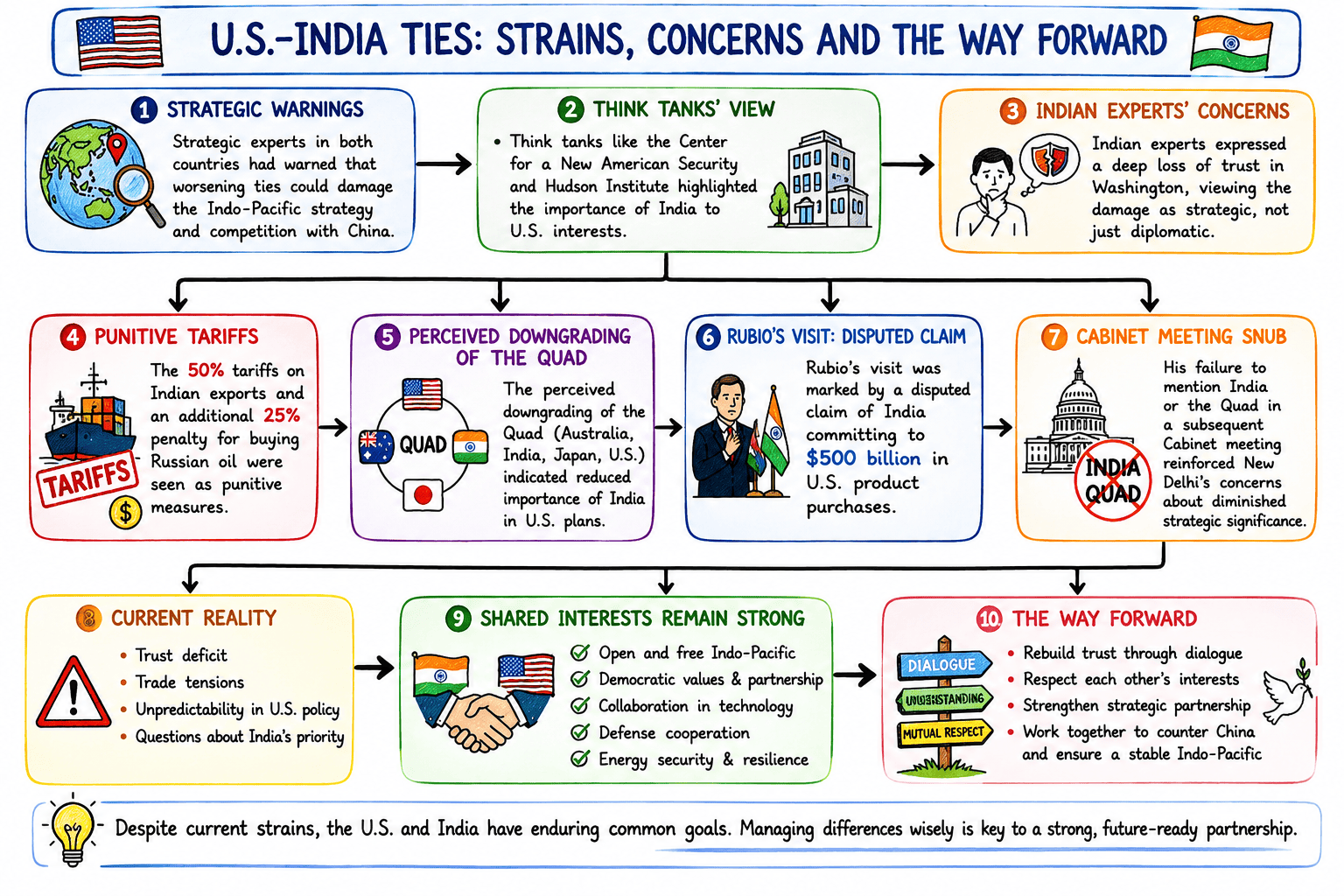
- Strategic experts in both countries had warned that worsening ties could damage the Indo-Pacific strategy and competition with China.
- Think tanks like the Center for a New American Security and Hudson Institute highlighted the importance of India to U.S. interests.
- Indian experts expressed a deep loss of trust in Washington, viewing the damage as strategic, not just diplomatic.
- The 50% tariffs on Indian exports and an additional 25% penalty for buying Russian oil were seen as punitive measures.
- The perceived downgrading of the Quad (Australia, India, Japan, U.S.) indicated reduced importance of India in U.S. plans.
- Rubio's visit was marked by a disputed claim of India committing to $500 billion in U.S. product purchases.
- His failure to mention India or the Quad in a subsequent Cabinet meeting reinforced New Delhi's concerns about diminished strategic significance.
- Despite current strains, shared interests in an open Indo-Pacific, democratic partnership, and collaboration in technology, defense, and energy security remain.
Key Concepts Involved:
- Indo-Pacific Strategy: A geopolitical framework emphasizing a free, open, and inclusive region, often seen as a counter to China's growing influence.
- Quad (Quadrilateral Security Dialogue): An informal strategic forum comprising the United States, Japan, Australia, and India, aimed at promoting regional security and cooperation.
- America First: A nationalist foreign policy doctrine prioritizing U.S. domestic interests and bilateral agreements over multilateralism and international commitments.
- Tariffs: Taxes imposed by a government on imported goods and services, often used to protect domestic industries or as a tool in trade negotiations.

SuperKalam is your personal mentor for UPSC preparation, guiding you at every step of the exam journey.
Download the App


STUDY RESOURCES
CONTACT US
ⓒ Snapstack Technologies Private Limited