GS 3: Science & TechnologyGS 3: EconomyGS 2: GovernancePrelims
Skyroot co-founder: India's aerospace industry is taking a private turn with ISRO's help, Pg13
Skyroot Aerospace targets August for India's historic first private orbital rocket launch, Vikram-I, boosting the nation's $44 billion space economy with ISRO collaboration.
Practice MCQs
804 Students attempted
Key Highlights:
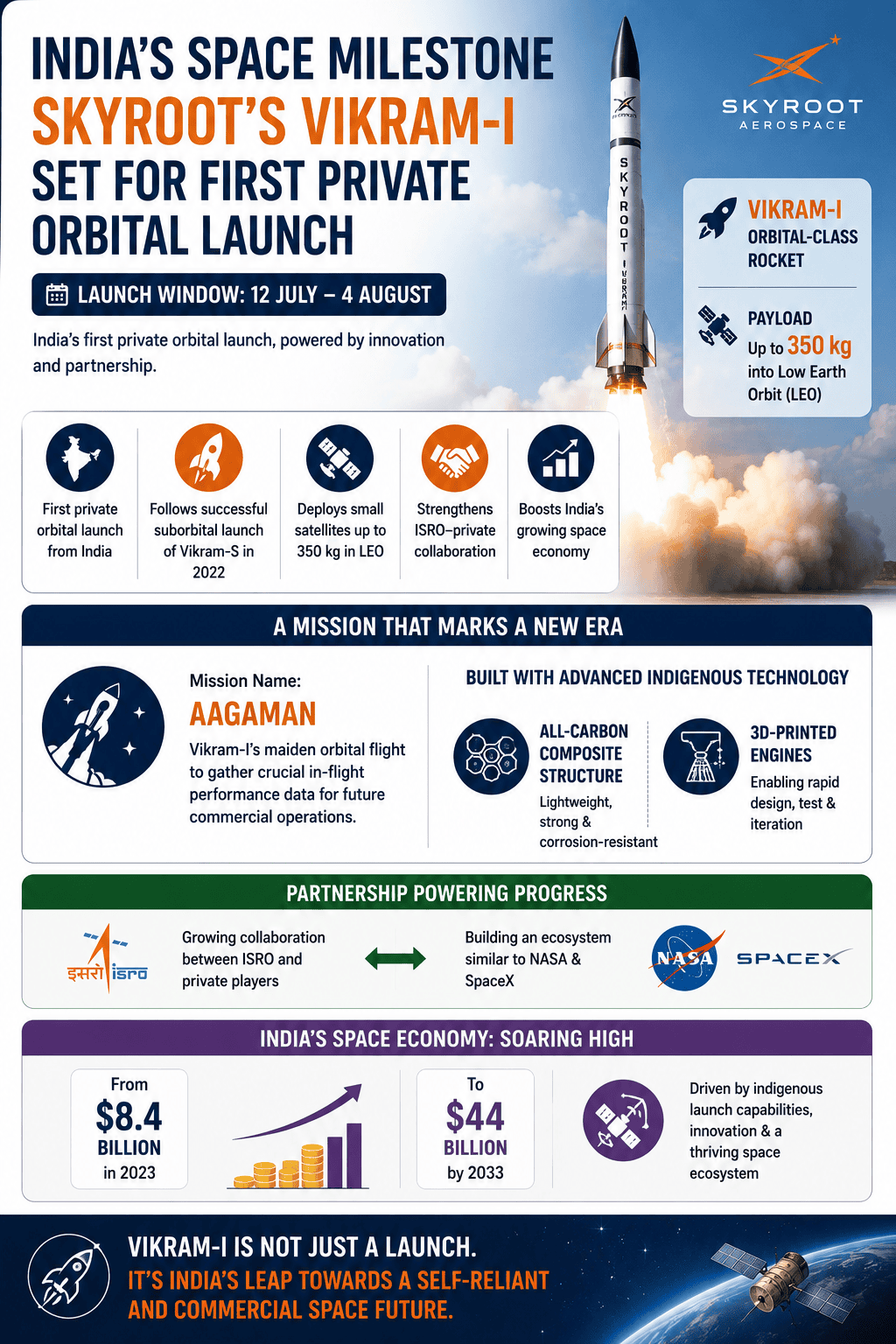
- Skyroot Aerospace, a private Indian company, is preparing to launch its orbital-class rocket, Vikram-I, between July 12 and August 4.
- This mission will mark India's first private orbital launch, following Skyroot's successful suborbital launch of Vikram-S in 2022.
- Vikram-I is designed to deploy small satellites weighing up to 350 kg into Low Earth Orbit (LEO).
- The launch highlights the growing collaboration between ISRO and private players, fostering an ecosystem similar to NASA and SpaceX.
- India's space economy is projected to grow significantly from $8.4 billion to $44 billion by 2033, driven by indigenous launch capabilities.
Skyroot.png
Detailed Insights:
- The Vikram-I mission, named "Aagaman", aims to gather crucial in-flight performance data for future commercial operations.
- Skyroot Aerospace developed Vikram-I using an all-carbon composite structure and 3D-printed engines, showcasing advanced indigenous technology.
- Recent government reforms have opened the space sector, enabling private companies to design, develop, and manufacture rockets within India.
- Achieving reliable and frequent orbital launch capabilities is a strategic advantage currently held by only a few nations globally.
- Increased private sector involvement is expected to alleviate the bottleneck for satellite operators, who often face extended waiting periods for launch opportunities.
- ISRO is exploring deeper partnerships, potentially integrating private startups as development partners for national missions like space stations and new satellites.
Key Concepts Involved:
- Low Earth Orbit (LEO): An orbit around Earth at an altitude typically between 160 km and 2,000 km, commonly used for satellite constellations.
- Suborbital Launch: A flight that reaches space but does not achieve the necessary velocity to enter a stable orbit around the Earth.
- Orbital Launch: A flight that achieves sufficient velocity to enter and maintain a stable orbit around the Earth, allowing a spacecraft to remain in space.
- Space Economy: The sum of all public and private sector activities and the value they generate in the exploration, research, and utilization of space.
Previous12/12

SuperKalam is your personal mentor for UPSC preparation, guiding you at every step of the exam journey.
Download the App


STUDY RESOURCES
CONTACT US
ⓒ Snapstack Technologies Private Limited