GS 3: Science & TechnologyPrelims
Planet shows star’s death does not have to doom its worlds, Pg12
Webb telescope unveils atmosphere with hydrocarbons on Jupiter-sized exoplanet WD 1856 b orbiting a white dwarf, proving planetary survival post-stellar death.
Practice MCQs
804 Students attempted
Key Highlights:
- The James Webb Space Telescope (JWST) has detected an atmosphere around WD 1856 b, a Jupiter-sized exoplanet orbiting a white dwarf star.
- This marks the first time an atmosphere has been confirmed on a planet orbiting a dead star.
- The atmosphere of WD 1856 b contains hydrocarbons, such as methane, and aerosol clouds.
- The planet was found to be significantly hotter than expected, likely due to tidal heating.
- The discovery suggests that planets can retain their atmospheres and potentially sustain conditions for life even after their host stars die.
WD1856.png
Detailed Insights:
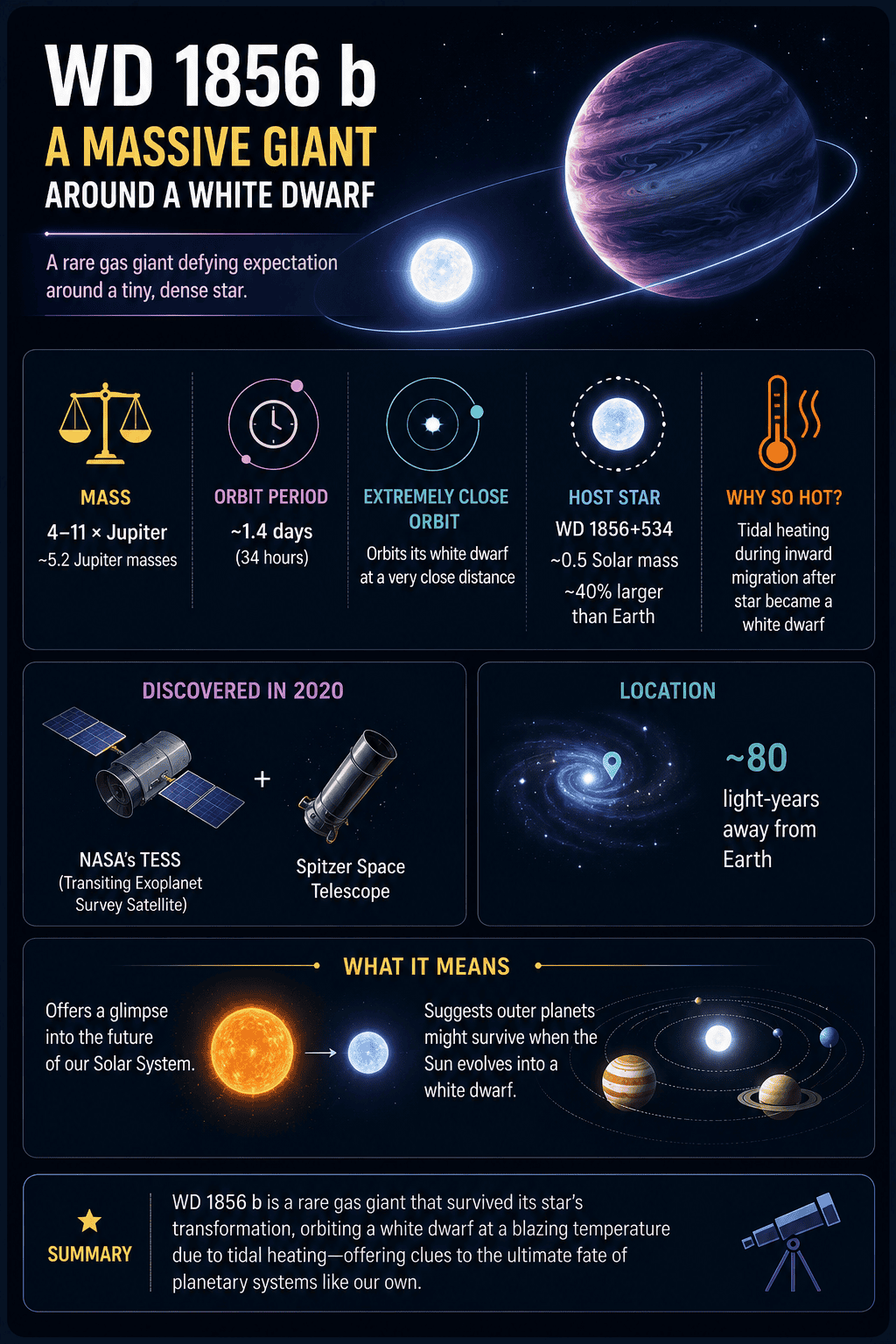
- WD 1856 b is a gas giant with a mass estimated to be between four and eleven times that of Jupiter, or approximately 5.2 Jupiter masses.
- It orbits its host white dwarf star, WD 1856+534, at an extremely close distance, completing an orbit in about 1.4 days (34 hours).
- The white dwarf star, WD 1856+534, is roughly half the mass of our Sun but only about 40% larger than Earth in radius.
- The planet's unexpected warmth is attributed to tidal heating, a process that occurred during its inward migration after the star evolved into a white dwarf.
- WD 1856 b was initially discovered in 2020 using data from NASA's Transiting Exoplanet Survey Satellite (TESS) and the Spitzer Space Telescope.
- This planetary system is located approximately 80 light-years away from Earth.
- The findings offer a glimpse into the potential future of our own Solar System, suggesting that outer planets might survive the Sun's eventual transformation into a white dwarf.
Scientific/Technical Concepts Involved:
- White Dwarf: The dense, Earth-sized remnant core of a star like our Sun after it has exhausted its nuclear fuel and shed its outer layers.
- Exoplanet: Any planet that orbits a star outside of our Solar System.
- James Webb Space Telescope (JWST): A powerful infrared space observatory designed to detect and characterize the atmospheres of distant exoplanets.
- Tidal Heating: The process where orbital and rotational energy is converted into heat within a celestial body due to varying gravitational forces from its primary, especially in eccentric orbits.

SuperKalam is your personal mentor for UPSC preparation, guiding you at every step of the exam journey.
Download the App


STUDY RESOURCES
CONTACT US
ⓒ Snapstack Technologies Private Limited