GS 2: International RelationsGS 3: EconomyPrelims
Trump tariff saga goes on, India must find way, Pg12
Trump administration proposes new tariffs on 60 nations, including India, under Section 301, citing forced labor concerns, escalating global trade tensions.
Practice MCQs
797 Students attempted
Key Highlights:
- The US Trade Representative (USTR) proposed new tariffs under Section 301 against 60 countries, covering 99.4% of US imports.
- India is among the nations facing a proposed 12.5% tariff due to alleged failure to enforce forced labor import prohibitions.
- These actions follow a US Supreme Court ruling in February 2026 against tariffs imposed under the International Emergency Economic Powers Act (IEEPA), with existing Section 122 tariffs set to expire on July 24.
- A separate Section 301 investigation, initiated in March 2026, targets 16 economies, including India and China, for structural excess capacity in manufacturing sectors.
- The Indian government is engaging with the US on these issues while working towards finalizing a framework trade agreement announced earlier this year.
Detailed Insights:
- The USTR's shift to Section 301 provides a more robust legal basis for imposing tariffs after the Supreme Court determined that the IEEPA did not authorize the President to levy tariffs.
- The Trump administration had previously utilized IEEPA and subsequently Section 122 for imposing tariffs, with Section 122 being a temporary measure limited to 150 days for addressing balance-of-payments issues.
- The emphasis on forced labor aligns with a growing international focus, as the US prohibits such imports under Section 307 of the Tariff Act of 1930, and the EU has also implemented similar regulations.
- The investigation into structural excess capacity aims to counter situations where government support leads to overproduction, thereby distorting global trade and affecting US manufacturing competitiveness.
- The ongoing India-US trade negotiations are progressing towards an interim agreement, with discussions encompassing market access, non-tariff barriers, and trade facilitation as part of a broader Bilateral Trade Agreement (BTA).
- India's strategy involves diplomatic engagement and pursuing a comprehensive trade deal to secure greater market access and protect its economic interests amidst evolving US trade policies.
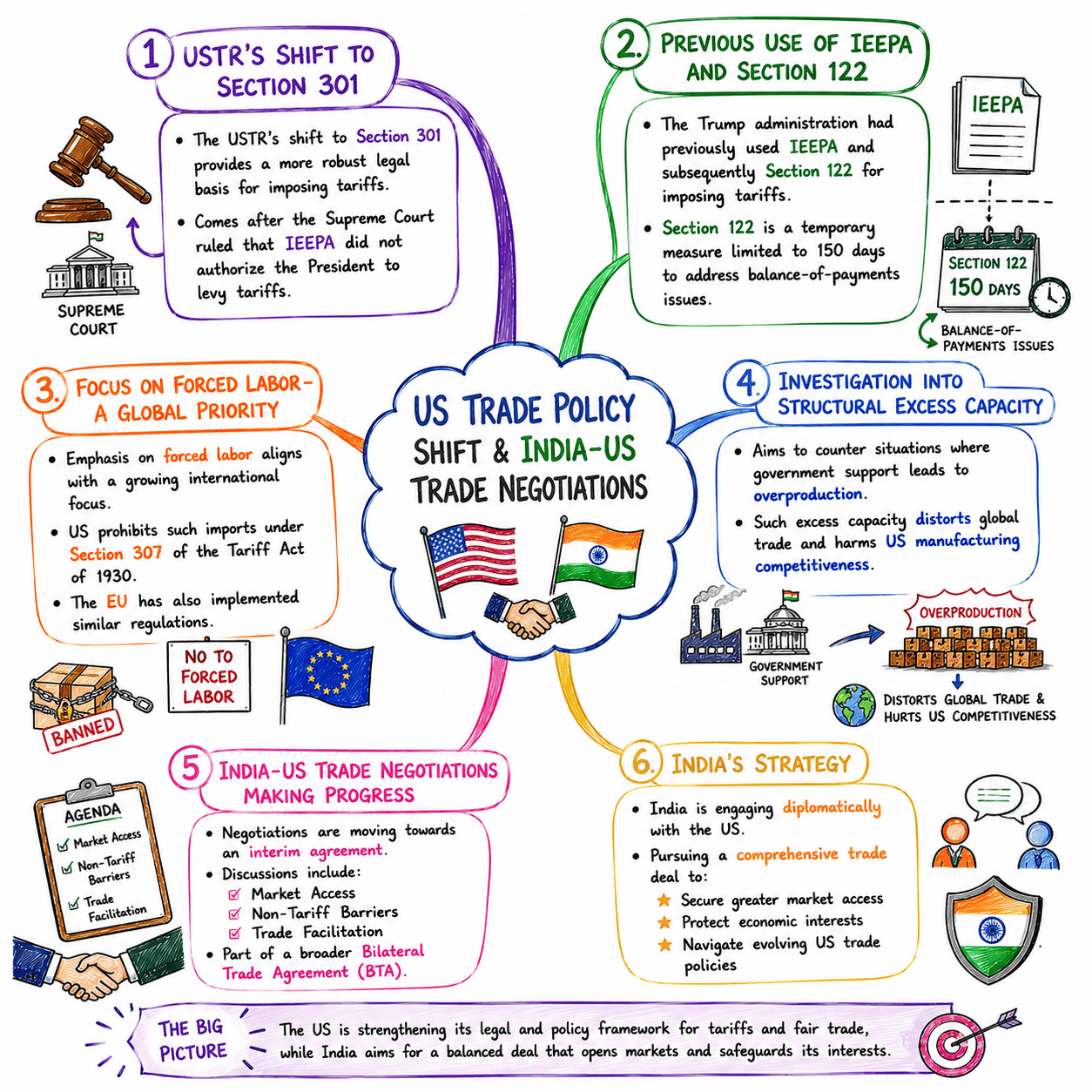
India-USA.png
Key Concepts Involved:
- Section 301 of US Trade Act, 1974: Authorizes the USTR to investigate and take action against foreign government practices deemed unfair or discriminatory that burden US commerce.
- International Emergency Economic Powers Act (IEEPA): A US law granting the President authority to regulate international economic activity during a declared national emergency, but not for imposing tariffs.
- Section 122 of Trade Act, 1974: Grants the President temporary authority (up to 150 days) to impose import surcharges or quotas to address serious balance-of-payments deficits.
- Forced Labor Import Prohibition: US law (Section 307 of Tariff Act of 1930) that bans the importation of goods produced wholly or partly by forced labor.
- Structural Excess Capacity: Production capability that exceeds domestic and global demand, often sustained by government interventions, leading to overproduction and trade imbalances.
- Framework Agreement: A preliminary agreement between countries that outlines principles and areas for future, more detailed trade negotiations.

SuperKalam is your personal mentor for UPSC preparation, guiding you at every step of the exam journey.
Download the App


STUDY RESOURCES
CONTACT US
ⓒ Snapstack Technologies Private Limited