GS 3: EconomyGS 3: Environment & EcologyGS 2: GovernancePrelims
Funding India’s climate future, a trillion-dollar question, Pg8
India needs $10.1 trillion for 2070 net-zero, demanding urgent RBI action, green finance, and a robust climate taxonomy to bridge the massive funding gap.
Practice MCQs
797 Students attempted
Key Highlights:
- India requires $2.5 trillion by 2030 to meet its Nationally Determined Contributions (NDCs).
- The estimated cost for India to achieve net-zero emissions by 2070 is $10.1 trillion.
- The Reserve Bank of India (RBI) issued Climate Finance and Management of Climate Change Risks Directions in 2025, integrating climate risks into banking practices.
- The Union Budget 2024-25 announced the development of a Climate Finance Taxonomy for India.
- India has issued $55.9 billion in green, social, sustainability, and sustainability-linked debt by 2024, with green debt accounting for 83%.
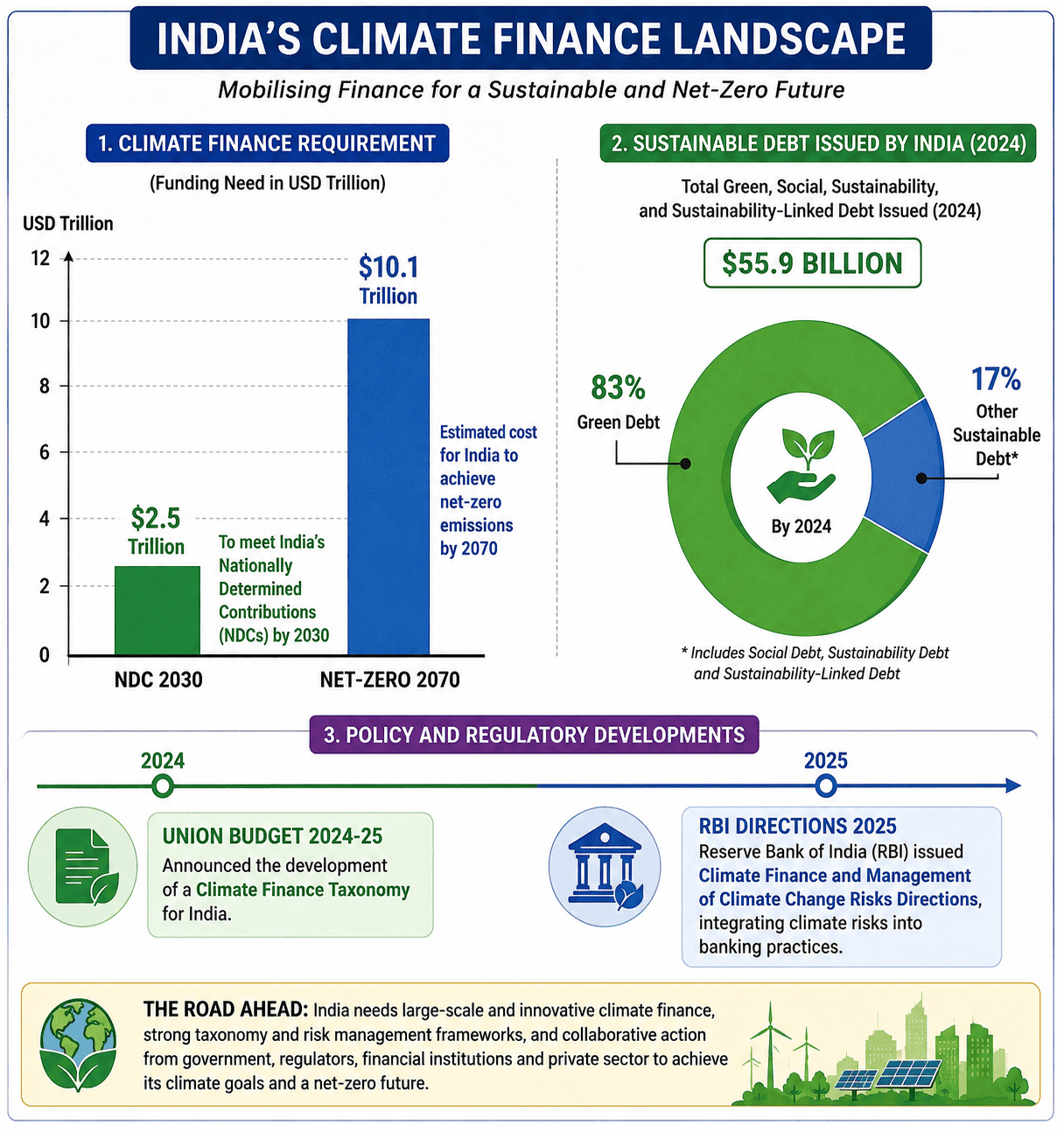
Climate Finance
Detailed Insights:
- Decarbonizing sectors like steel, cement, power, and road transport requires an additional $467 billion by 2030, or 1.3% of GDP annually.
- The international community's commitment of $100 billion annually (Paris Agreement) and $300 billion by 2035 (Baku NCQG) is considered insufficient for developing economies.
- The RBI has included eligible green activities under Priority Sector Lending (PSL) and recognized investments in sovereign green bonds.
- Proposed RBI measures include accepting sovereign green bonds as collateral and implementing differentiated capital requirements based on climate risk.
- A comprehensive Climate Finance Taxonomy is essential for credible verification of green investments, accurate PSL classifications, and preventing greenwashing.
- Blended finance, which strategically uses public funds to de-risk private investment, is an underused instrument with significant potential to mobilize capital.
- State-level climate adaptation finance faces challenges due to limited borrowing capacity and institutional infrastructure at the state level.
- Key actions include finalizing the Climate Finance Taxonomy, RBI mandating green finance, establishing a State Climate Finance Facility, and scaling sovereign green bond issuances.
Key Concepts Involved:
- Nationally Determined Contributions (NDCs): Climate action targets set by countries under the Paris Agreement to reduce emissions and adapt to climate change.
- Net-zero emissions: Achieving a balance between the amount of greenhouse gas emissions produced and the amount removed from the atmosphere.
- Priority Sector Lending (PSL): Mandated lending by banks to specific sectors deemed important for the economy, as directed by the central bank.
- Climate Finance Taxonomy: A classification system that defines which economic activities can be considered environmentally sustainable or "green."
- Blended Finance: The strategic use of public or philanthropic development finance to mobilize additional private capital for sustainable development.

SuperKalam is your personal mentor for UPSC preparation, guiding you at every step of the exam journey.
Download the App


STUDY RESOURCES
CONTACT US
ⓒ Snapstack Technologies Private Limited