GS 2: PolityGS 2: GovernancePrelims
Did the PM’s broadcast violate MCC?, Pg10
PM's broadcast under scrutiny: Did it violate Model Code of Conduct guidelines during elections, raising questions on impartiality?
Practice MCQs
790 Students attempted
Key Highlights:
- The Model Code of Conduct (MCC), initially drafted by the Kerala government in 1960, guides political parties during elections.
- The Election Commission (EC) formalized the MCC in 1968, revising it in 1974 and adding a section on the "party in power" in 1979.
- Prime Minister Narendra Modi's April 18 address has sparked debate regarding potential violations of the MCC.
- The Supreme Court has recognized the EC's broad powers under Article 324 to act where Parliament hasn't legislated.
- Section 123(3) of the Representation of the People Act, 1951 prohibits appeals to voters based on religion, race, caste, community, or language.
- A petition before the Supreme Court argues that using Doordarshan and Sansad TV for a partisan broadcast violates Section 123(7) of the Representation of the People Act, 1951.
Detailed Insights:
- The MCC evolved over time, with key milestones including formalization by the EC and enforcement by T.N. Seshan from 1991.
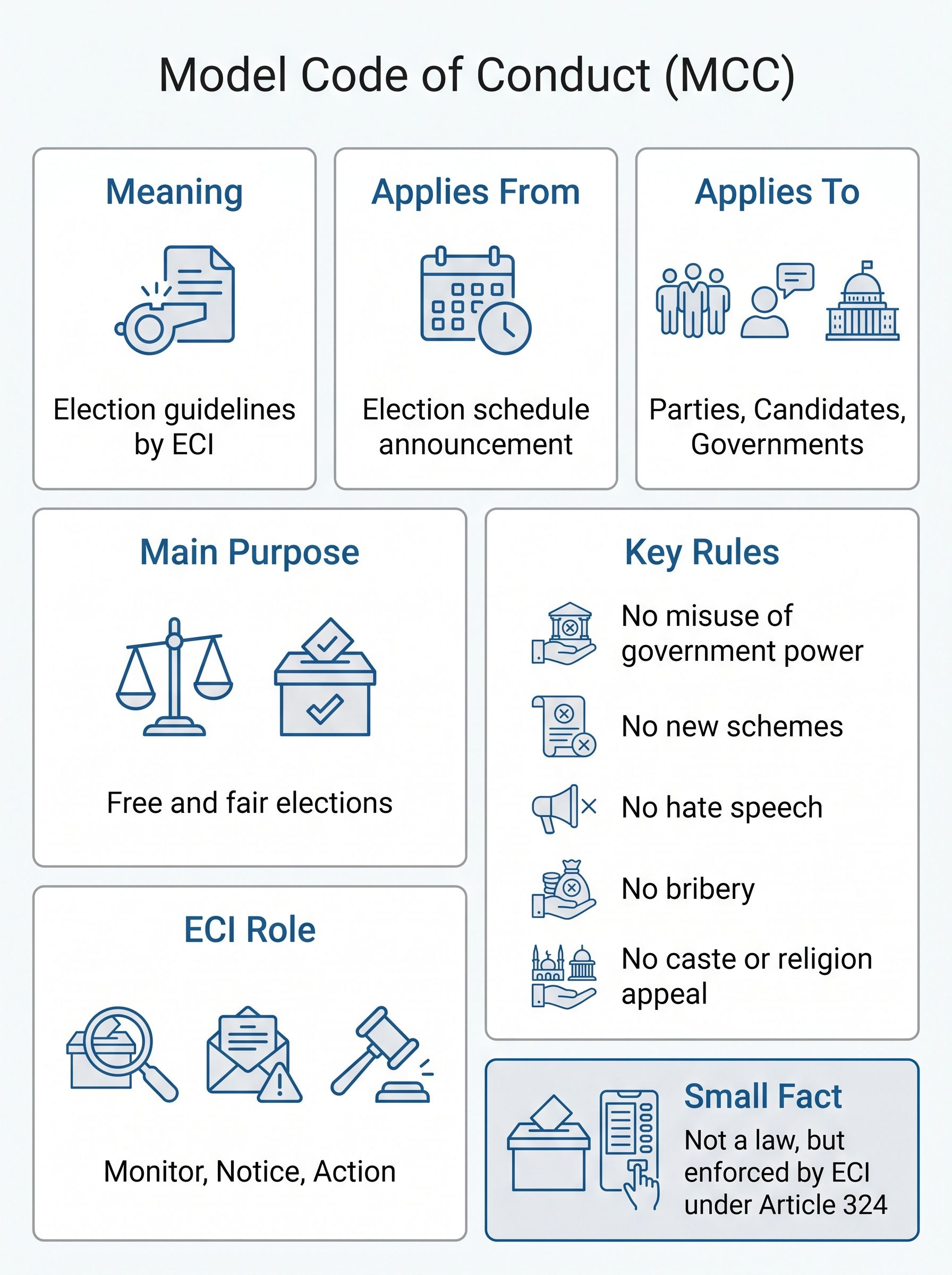
- Clauses 1(a), 1(b), and 4 of Part VII of the MCC restrict the ruling party from combining official duties with campaigning and misusing public media.
- Section 123(3) was enacted to counter sectarian appeals prevalent in Indian politics at the time, focusing on religion, race, caste, community and language.
- The petition before the Supreme Court argues that the use of public broadcasters and the Prime Minister's Office (PMO) for partisan broadcasts falls under the prohibition of obtaining assistance from government servants for electoral prospects as per Section 123(7).
- The MCC is designed to be flexible and address situations where the statute may not provide immediate recourse.
- The Election Commission's decision to remain silent on the broadcast is a choice not to use the MCC, which is specifically designed for situations where the statute's reach is limited.
Key Concepts Involved:
- Model Code of Conduct (MCC): A set of guidelines for political parties and candidates during elections to ensure free and fair elections.
- Article 324: A constitutional provision granting the Election Commission broad powers to oversee and conduct elections.
- Section 123 of the Representation of the People Act, 1951: Defines corrupt practices in elections, including appealing to voters on the grounds of religion, race, caste, community, or language.
MCC

SuperKalam is your personal mentor for UPSC preparation, guiding you at every step of the exam journey.
Download the App


STUDY RESOURCES
CONTACT US
ⓒ Snapstack Technologies Private Limited