GS 3: EconomyGS 2: International Relations
Urea, DAP prices rise amid Iranwar tensions, supply concerns, pg12
The escalating conflict between the U.S.-Israel alliance and Iran has sent global fertilizer prices soaring, with experts warning that Urea and DAP could breach the $1,000 per tonne mark. The disruption coincides with India’s upcoming sowing season, threatening to inflate input costs for farmers and increase the government's subsidy burden.
Practice MCQs
775 Students attempted
Key Highlights:
- Price Surge: Following the commencement of military action against Iran, urea prices jumped from $492 to $530 per tonne almost immediately, while DAP (Di-Ammonium Phosphate) is projected to hit $1,000 per tonne.
- Feedstock Crisis: The rise in crude oil and Liquefied Natural Gas (LNG) prices—a key feedstock for urea production—is the primary driver behind the cost escalation.
- Import Dependency: India's urea imports surged by 85.3% to 8 million tonnes (April-December 2025-26) to meet a 3.8% increase in domestic demand, as local production fell by 3%.
- Geopolitical Duration: Statements from U.S. President Donald Trump suggesting the conflict could last over a month have fueled fears of a prolonged supply chain disruption.
Detailed Insights:
- Input Cost Inflation: As India prepares for its next sowing season, the reliance on high-cost imported fertilizers and LNG puts severe stress on the agricultural sector. If urea breaches the $1,000 mark, it would mirror the record highs seen during the early 2022 global energy crisis.
- Geographical Concentration: Fertilizer prices are highly sensitive to geopolitics because raw materials are concentrated in a few regions—Morocco holds 70% of phosphate reserves, while Canada and Belarus dominate potash production. Any shift in West Asian stability further tightens these already concentrated markets.
- Supply-Demand Mismatch: The Fertiliser Association of India (FAI) data indicates a widening gap between local output (22.44 mt) and total sales (31.16 mt), leaving the country increasingly vulnerable to volatile international "spot" prices rather than stable long-term contracts.
- Impact on Subsidy: Since the Indian government heavily subsidizes fertilizers to protect farmers from price volatility, the spike to $1,000 per tonne will lead to a massive, unplanned increase in the national fertilizer subsidy bill for the 2026 fiscal year.
Key Concepts Involved:
- Urea and DAP: Two of the most widely used chemical fertilizers in India. Urea provides nitrogen, while DAP provides both nitrogen and phosphorus to crops.
- Feedstock (LNG): Natural gas is the essential raw material (feedstock) used to produce ammonia, which is then converted into urea.
- FOB and CFR: Shipping terms used in international trade; FOB (Free on Board) means the price at the seller's port, while CFR (Cost and Freight) includes the cost of moving the goods to the buyer's destination port.
- Sowing Season: The period of the year when seeds are planted in the ground; in India, this typically refers to the start of the Kharif or Rabi cycles.
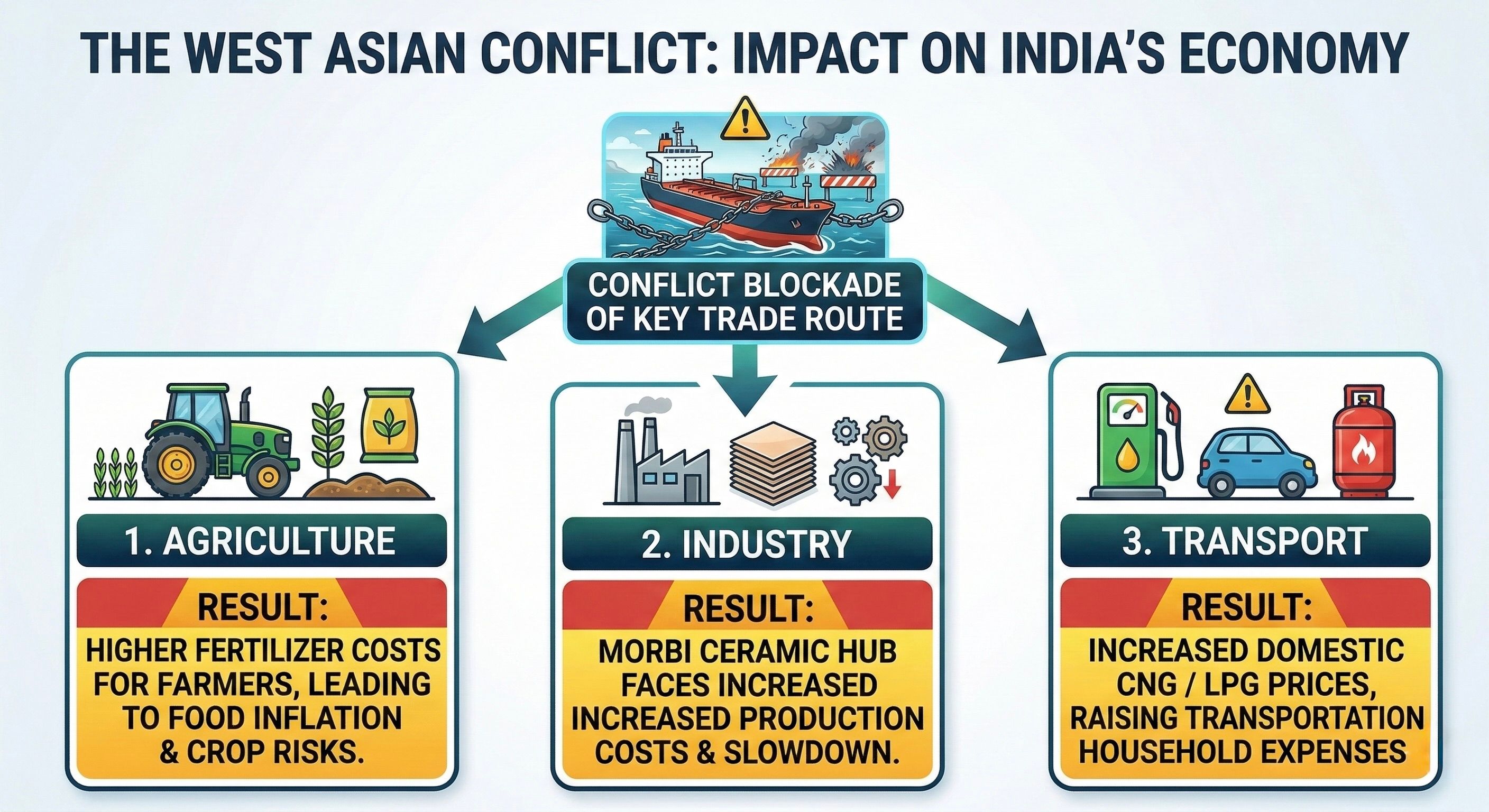
The West Asian Conflict: Impact on Indian Economy
Previous10/10

SuperKalam is your personal mentor for UPSC preparation, guiding you at every step of the exam journey.
Download the App


STUDY RESOURCES
CONTACT US
ⓒ Snapstack Technologies Private Limited