GS 3: Environment & EcologyPrelims
Climate risks must prompt international legal reforms, pg8
Escalating climate crisis necessitates a fundamental renegotiation of international legal principles, including statehood criteria, maritime boundaries, and permanent sovereignty over natural resources, to address unprecedented risks like sea-level rise and climate-induced migration.
Practice MCQs
775 Students attempted
Key Highlights:
- Legal Paradigm Shift: The severity of climate change is moving beyond biophysical impacts, forcing a rethink of foundational international law concepts like Permanent Sovereignty over Natural Resources (PSNR) and the requirements for statehood.
- Threat to Statehood: Rising sea levels (SLR) challenge the 1933 Montevideo Convention criteria, as small island states face the potential loss of physical territory, leading to debates over the continuity of statehood.
- Maritime Zone Instability: SLR threatens to "unsettle" legal baselines, which would technically shift territorial seas and Exclusive Economic Zones (EEZ) unless states adopt "permanent" rather than "ambulatory" baselines.
- Climate Refugees Gap: Current international law, specifically the 1951 Refugee Convention, does not recognize or protect people displaced by climate change, necessitating a new legal regime or protocol under the UNFCCC.
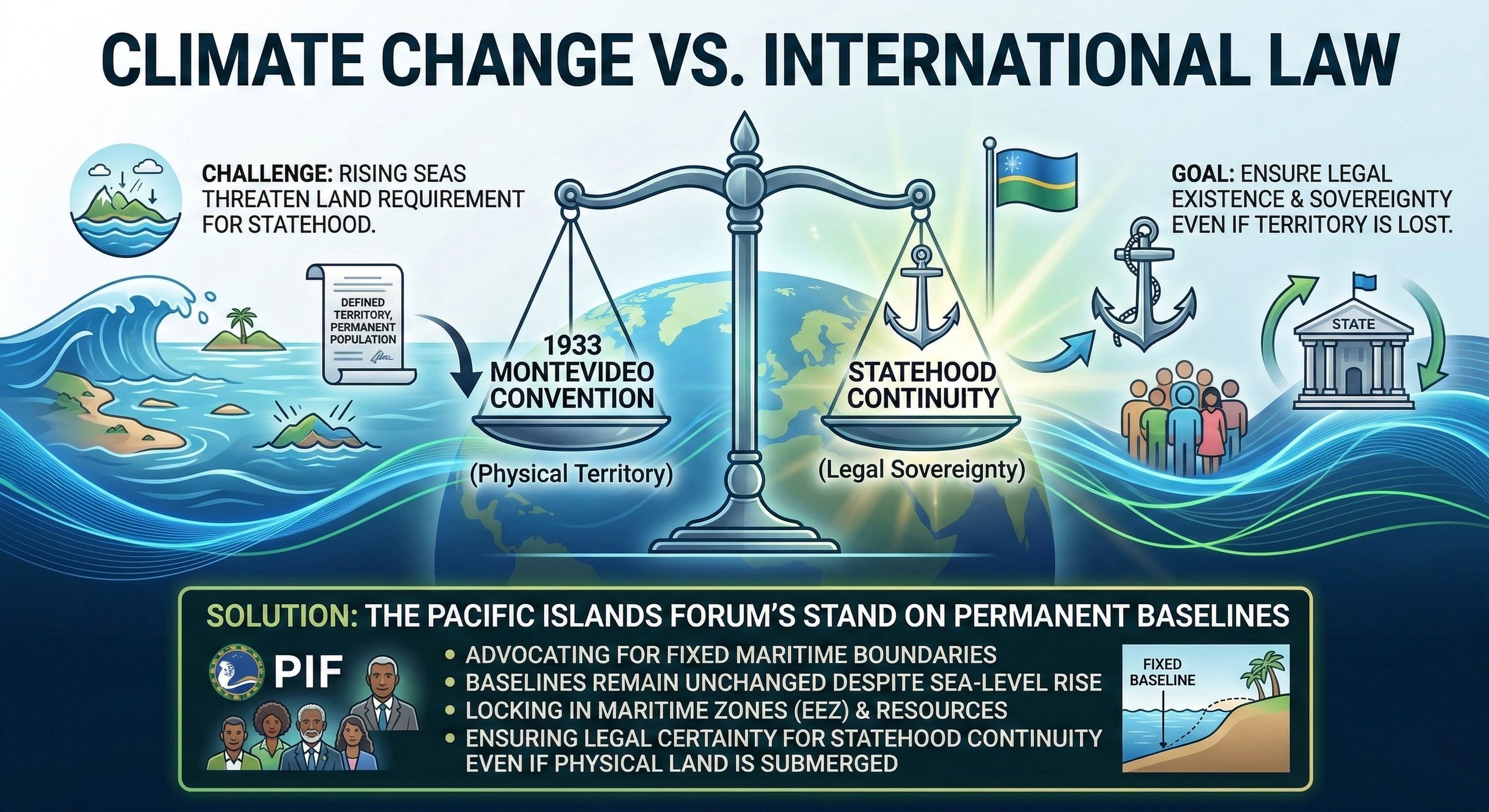
Climate Change vs. International Law
Detailed Insights:
- Sovereignty vs. Phasing Out Fossil Fuels: Under PSNR, states have the right to extract their own resources. However, the push for a Fossil-Fuel Non-Proliferation Treaty to meet the 1.5 C goal creates a tension between national economic independence and global survival.
- Statehood Continuity: While customary law presumes state continuity, the International Court of Justice (ICJ) and scholars like James Crawford argue that losing territory doesn't automatically mean losing statehood. The Pacific Islands Forum (PIF) is already declaring their statehood as permanent regardless of SLR.
- Maritime Legal Dilemma: States are currently split between two interpretations of UNCLOS: keeping baselines fixed (permanent) to protect maritime rights, or allowing them to move with the tide (ambulatory), which could lead to significant loss of maritime territory for coastal nations.
- Need for a New Protocol: Experts suggest a specific Protocol to the UNFCCC for "climate refugees" to ensure legal protection and resettlement, as they currently lack the status of "refugees" defined by persecution.
Key Concepts Involved:
- Permanent Sovereignty over Natural Resources (PSNR): The principle that every state has the right to exercise full authority over its natural wealth and resources.
- Montevideo Convention (1933): The treaty that defined the standard legal requirements for statehood: a permanent population, defined territory, government, and capacity to enter relations.
- Ambulatory Baseline: A legal concept where the maritime boundary (baseline) of a country shifts automatically as the coastline changes due to natural processes like erosion or sea-level rise.
- UNCLOS (United Nations Convention on the Law of the Sea): The international agreement that establishes a legal framework for all marine and maritime activities.

SuperKalam is your personal mentor for UPSC preparation, guiding you at every step of the exam journey.
Download the App


STUDY RESOURCES
CONTACT US
ⓒ Snapstack Technologies Private Limited