GS 3: Science & TechnologyPrelims
Rescue op launched to save NASA telescope that's falling back to Earth, Pg2
Three-armed Link spacecraft launches to save NASA's Swift Observatory from crashing to Earth by October, boosting its orbit after solar storm impact.
Practice MCQs
797 Students attempted
Key Highlights:
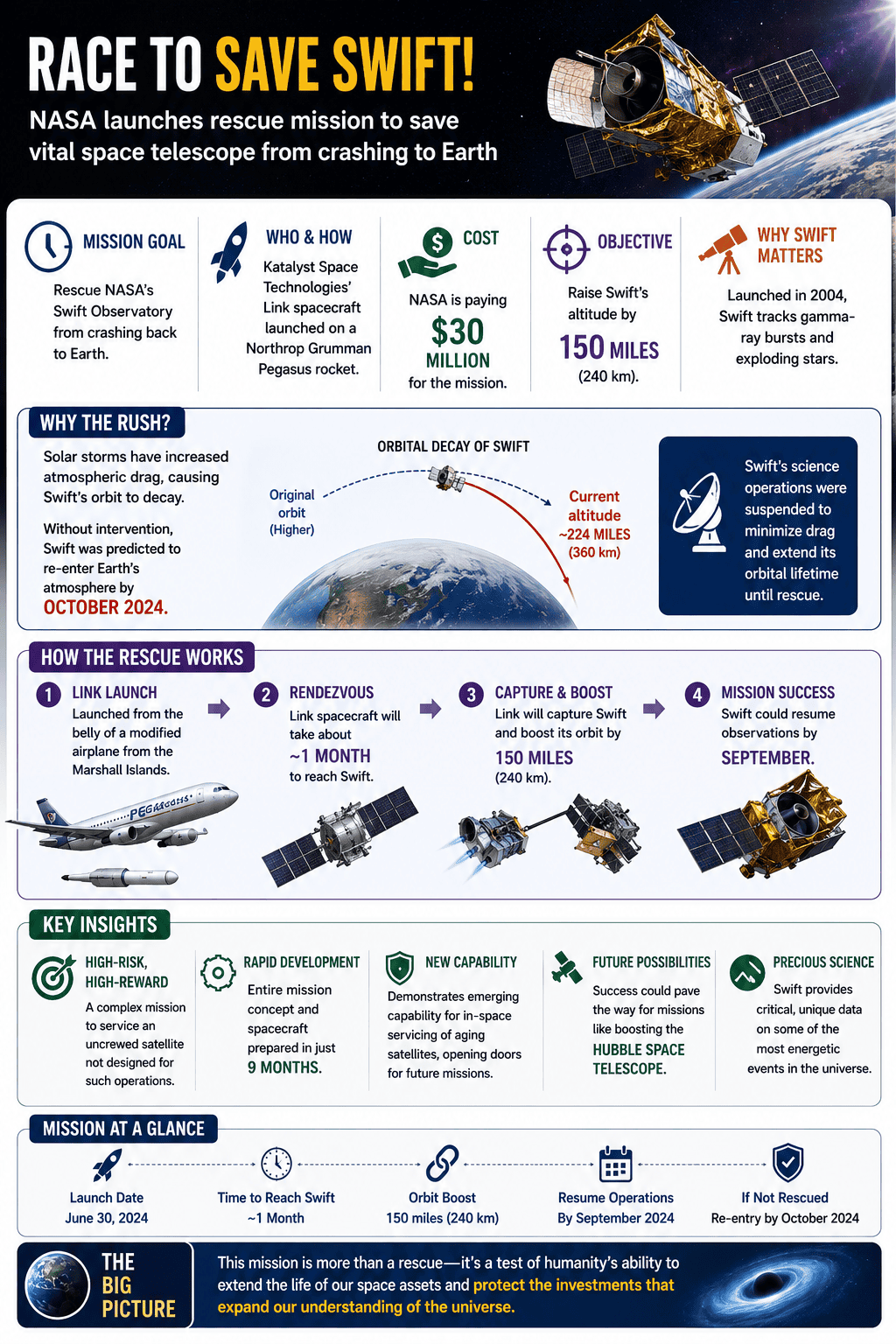
- A rescue mission was launched for NASA's Swift Observatory, which is at risk of crashing back to Earth due to orbital decay caused by solar storms.
- Katalyst Space Technologies' Link spacecraft was launched on a Northrop Grumman Pegasus rocket from the Marshall Islands to capture and boost the telescope's orbit.
- NASA is paying $30 million for the mission, which aims to raise Swift's altitude by 150 miles (240 kilometers).
- The Swift Observatory, launched in 2004, is crucial for tracking gamma-ray bursts and exploding stars.
- The mission was rapidly developed in nine months, with Swift predicted to re-enter Earth's atmosphere by October without intervention.
SWIFT.png
Detailed Insights:
- The Link spacecraft was launched from the belly of a modified airplane, a method chosen for its speed and ability to reach Swift's specific orbital inclination.
- Swift's current altitude is approximately 224 miles (360 kilometers), having decayed from its original orbit due to increased atmospheric drag.
- The rescue operation is expected to take about a month for Link to reach Swift, with the telescope potentially resuming observations by September.
- This mission is considered high-risk, high-reward, demonstrating a new capability for in-space servicing of uncrewed satellites not originally designed for such operations.
- The success of this mission could pave the way for similar operations, such as potentially boosting the Hubble Space Telescope, which is also experiencing orbital decay.
- Swift's science operations were suspended to minimize drag and extend its orbital lifetime, allowing time for the rescue mission.
Scientific/Technical Concepts Involved:
- Orbital decay: The gradual decrease in the altitude of a satellite's orbit, primarily due to atmospheric drag.
- Atmospheric drag: Resistance experienced by a satellite from collisions with gas molecules in Earth's upper atmosphere, causing it to slow down and lose altitude.
- Solar storms: Eruptions on the Sun that can increase the density of Earth's upper atmosphere, leading to enhanced atmospheric drag on satellites.
- Gamma-ray bursts: The most powerful explosions in the universe, which the Swift Observatory is designed to detect and study.

SuperKalam is your personal mentor for UPSC preparation, guiding you at every step of the exam journey.
Download the App


STUDY RESOURCES
CONTACT US
ⓒ Snapstack Technologies Private Limited