GS 2: International RelationsGS 3: Internal SecurityPrelims
‘No revival of Indus treaty if Pak. does not end terror’, Pg10
India puts Indus Waters Treaty on hold, demanding Pakistan "credibly and irrevocably" stop cross-border terrorism for its revival.
Practice MCQs
797 Students attempted
Key Highlights:
- India declared that the Indus Waters Treaty (IWT) will remain in abeyance until Pakistan credibly and irrevocably ceases support for cross-border terrorism.
- The decision to put the treaty in abeyance was taken by the Cabinet Committee on Security following the Pahalgam terror attack on April 22, 2025.
- The Pahalgam terror attack resulted in 26 civilian deaths and led to India's Operation Sindoor targeting terror infrastructure in Pakistan.
- Pakistan's Foreign Minister and Deputy Prime Minister Ishaq Dar recently advocated for the restoration of the IWT at an international conference.
- The External Affairs Ministry spokesperson Randhir Jaiswal reiterated India's stance, emphasizing Prime Minister Narendra Modi's statement that "water and blood cannot flow together."
IWT.png
Detailed Insights:
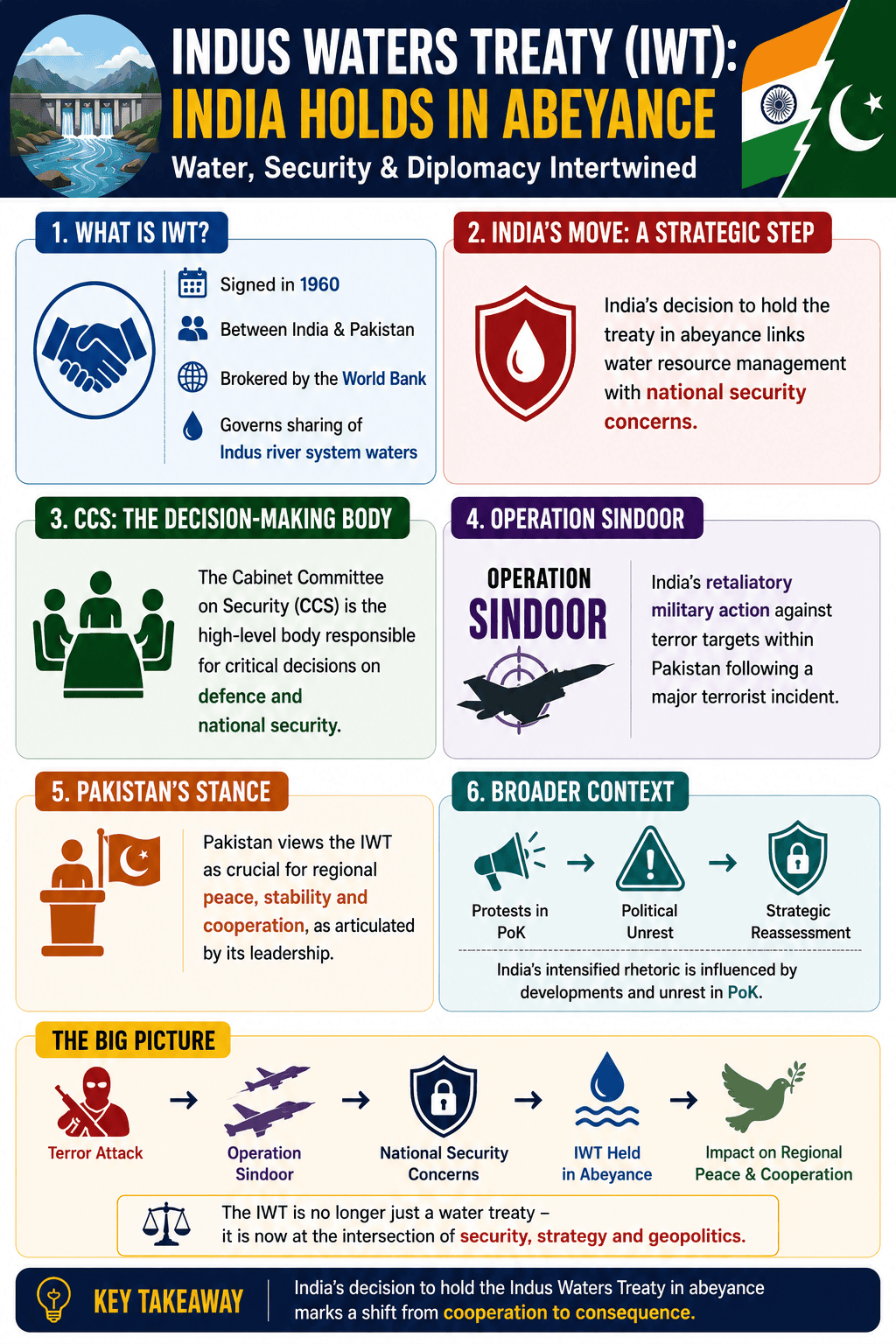
- The Indus Waters Treaty (IWT), signed in 1960, is a water-sharing agreement between India and Pakistan, brokered by the World Bank.
- India's move to hold the treaty in abeyance is a significant diplomatic and strategic step linking water resource management to national security concerns.
- The Cabinet Committee on Security (CCS) is a high-level Indian government body responsible for critical decisions concerning defense and national security.
- Operation Sindoor represents India's retaliatory military action against terror targets within Pakistan following a major terrorist incident.
- Pakistan views the IWT as crucial for regional peace, stability, and cooperation, as articulated by its leadership.
- India's intensified rhetoric against Pakistan is also influenced by recent protests and developments in Pakistan Occupied Kashmir (PoK).
Key Concepts Involved:
- Indus Waters Treaty (IWT): A bilateral water-distribution treaty between India and Pakistan, signed in 1960, governing the six rivers of the Indus system.
- Cross-border terrorism: Terrorist activities originating from the territory of one state and targeting another, often with alleged state or non-state actor support.
- Cabinet Committee on Security (CCS): A powerful committee of the Indian Cabinet that takes decisions on matters related to defense expenditure, national security, and foreign policy.
- External Affairs Ministry (EAM): The government ministry responsible for the conduct of India's foreign relations and diplomatic representation abroad.

SuperKalam is your personal mentor for UPSC preparation, guiding you at every step of the exam journey.
Download the App


STUDY RESOURCES
CONTACT US
ⓒ Snapstack Technologies Private Limited