GS 2: PolityGS 2: GovernancePrelims
Ladakh to have customised self-governance framework, Pg10
MHA proposes 'sui generis' self-governance model for Ladakh under Article 371, establishing UT-level elected body amidst ongoing Statehood and Sixth Schedule demands.
Practice MCQs
797 Students attempted
Key Highlights:
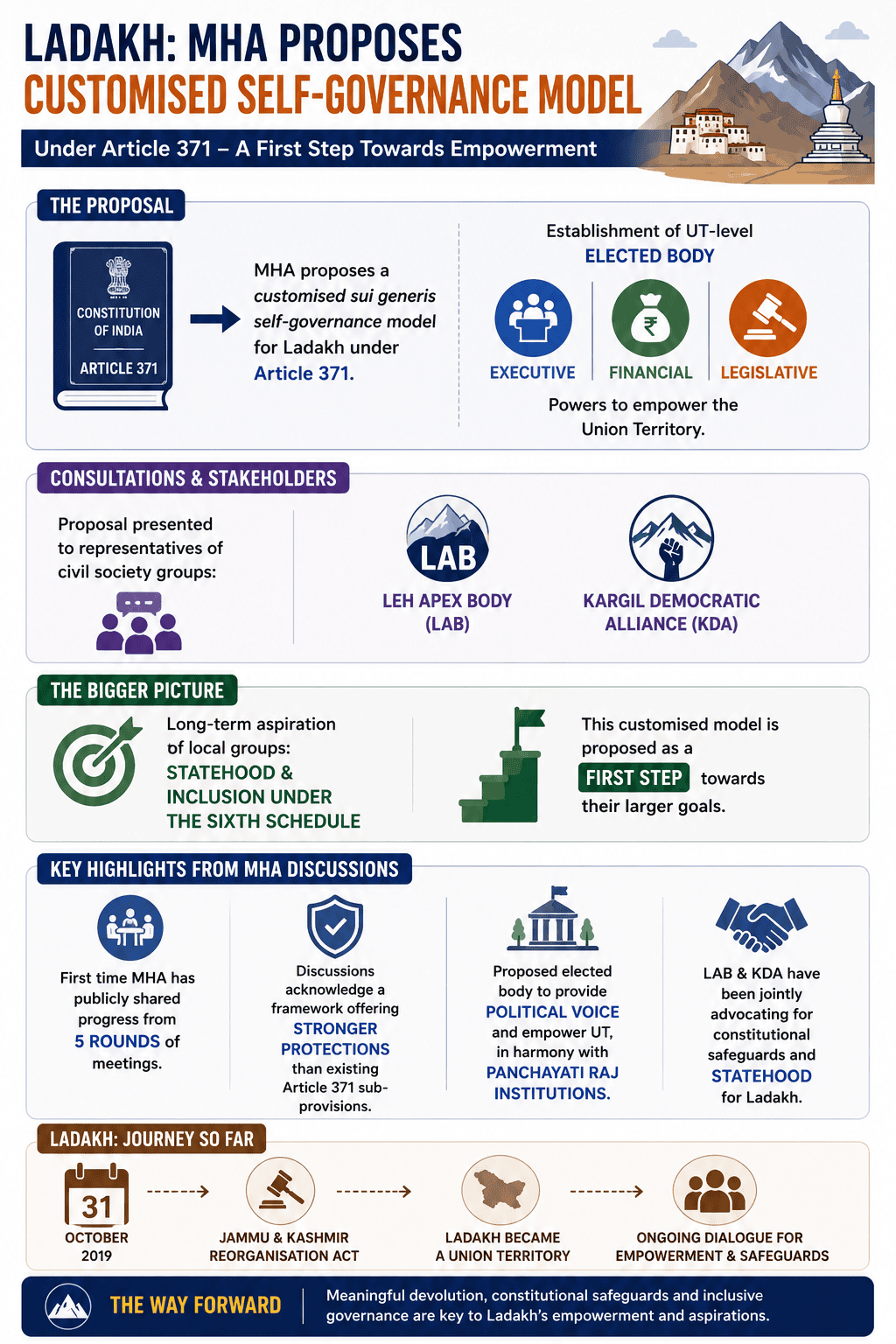
- The Ministry of Home Affairs (MHA) has proposed a customized sui generis self-governance model for the Union Territory of Ladakh under Article 371 of the Constitution.
- This framework includes establishing a Union Territory (UT)-level elected body endowed with executive, financial, and legislative powers.
- The proposal was presented to leaders of the Leh Apex Body (LAB) and the Kargil Democratic Alliance (KDA), who represent civil society groups in Ladakh.
- While the long-term aspiration of local groups remains Statehood and inclusion under the Sixth Schedule, this customized model is presented as a first step.
- Ladakh became a Union Territory on October 31, 2019, following the Jammu and Kashmir Reorganisation Act.
Ladakh.png
Detailed Insights:
- The proposed elected body aims to provide a political voice and empower the UT, working in harmony with Panchayati Raj Institutions.
- This marks the first time the MHA has publicly detailed progress from five rounds of meetings with Ladakh's representatives.
- The discussions acknowledged the possibility of a framework offering stronger protection than existing Article 371 sub-provisions.
- The LAB and KDA have been jointly advocating for constitutional safeguards and statehood for Ladakh since its formation as a UT.
- The MHA's draft proposal will cover the powers and functions of this new elected body, including its relationship with local self-governance structures.
- The agreement to establish an elected body with legislative, executive, and financial powers is considered a significant breakthrough in addressing local demands.
Key Concepts Involved:
- Article 371: Provides special provisions for certain states to address their unique socio-economic, cultural, and historical contexts, ensuring regional interests and equitable development.
- Sixth Schedule: Governs the administration of tribal areas in Assam, Meghalaya, Tripura, and Mizoram, establishing Autonomous District Councils with legislative, executive, and financial powers to protect tribal identity and self-governance.
- Panchayati Raj Institutions (PRIs): Local self-government bodies in rural India, established by the 73rd Constitutional Amendment Act of 1992, forming a three-tier system for grassroots administration and development.
- Sui Generis Model: A Latin term meaning "of its own kind" or "unique," referring to a tailor-made system designed to address specific needs and situations that do not fit existing legal frameworks.

SuperKalam is your personal mentor for UPSC preparation, guiding you at every step of the exam journey.
Download the App


STUDY RESOURCES
CONTACT US
ⓒ Snapstack Technologies Private Limited