GS 3: Environment & EcologyGS 2: GovernancePrelims
Govt's plan to revive struggling tiger reserves, Pg4
Centre unveils new roadmap to revive struggling tiger reserves, addressing uneven population growth and human-wildlife conflict across 58 sites.
Practice MCQs
797 Students attempted
Key Highlights:
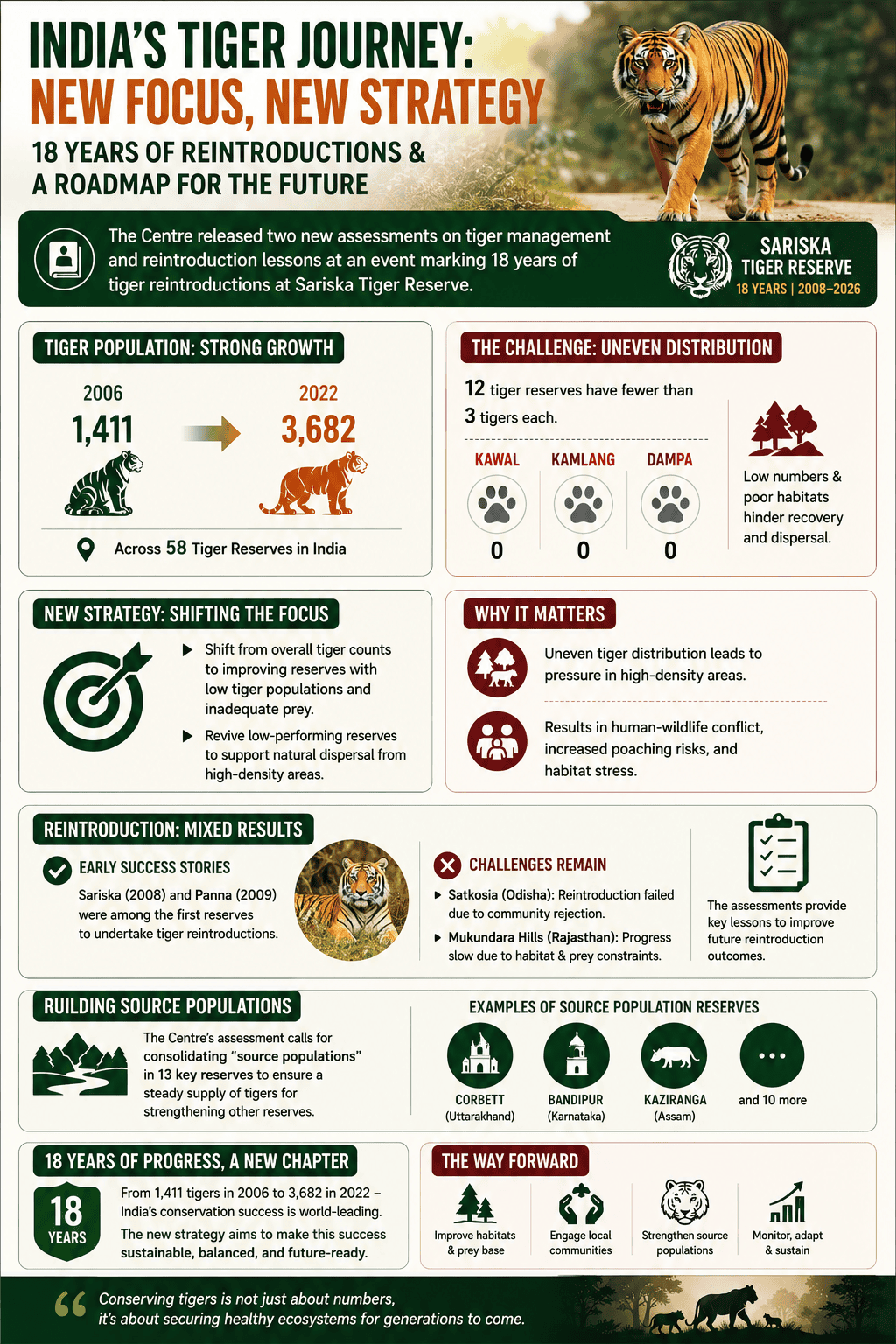
- The Centre released two new assessments on tiger management and reintroduction lessons during an event marking 18 years of tiger reintroductions at Sariska Tiger Reserve.
- India's tiger population increased from 1,411 in 2006 to 3,682 in 2022 across 58 Tiger Reserves.
- Despite overall growth, 12 tiger reserves have fewer than three tigers, with Kawal, Kamlang, and Dampa having zero tigers.
- The new strategy focuses on reviving reserves with low tiger numbers and poor habitats to aid dispersal from high-density areas.
- Sariska (2008) and Panna (2009) were among the first reserves to undertake tiger reintroductions.
Tiger Reserve.png
Detailed Insights:
- The assessments aim to shift focus from overall tiger counts to improving reserves with low tiger populations and inadequate prey availability.
- Uneven tiger distribution leads to pressure in high-density areas, causing human-wildlife conflict and increased poaching risks.
- Reintroduction efforts have seen mixed success, with failures noted in Satkosia (Odisha) due to community rejection and slow progress in Mukundara Hills (Rajasthan).
- The Centre's assessment calls for consolidating "source populations" in 13 reserves like Corbett, Bandipur, and Kaziranga.
- Priority interventions, including reintroductions, are suggested for at least 25 reserves where fewer than five tigers remain.
- A well-connected landscape of forests is crucial for establishing a metapopulation, facilitating genetic exchange and reducing extinction risk.
- Long-term tiger recovery depends on the interplay of prey abundance, habitat quality, and natural colonization by tigers.
Key Concepts Involved:
- Tiger Reintroduction: The process of releasing captive-bred or wild-caught tigers into an area where they previously existed but were extirpated.
- Source Populations: Tiger habitats with high numbers, good prey availability, and successful breeding, from which tigers can disperse.
- Sink Populations: Areas with low or no breeding tigers, often lacking connectivity to healthier forests, and where tiger populations are not self-sustaining.
- Metapopulation: A group of spatially separated populations of the same species which interact at some level, typically through dispersal.

SuperKalam is your personal mentor for UPSC preparation, guiding you at every step of the exam journey.
Download the App


STUDY RESOURCES
CONTACT US
ⓒ Snapstack Technologies Private Limited