GS 2: International RelationsPrelims
Nepal raises Lipulekh issue; India says no ‘historical’ record, Pg1
Nepal raises concerns with India and China regarding Kailash Manasarovar Yatra through Lipulekh, claiming territorial sovereignty; India refutes claims.
Practice MCQs
782 Students attempted
Key Highlights:
- Nepal raised concerns with India and China regarding the Kailash Manasarovar Yatra through the Kalapani-Limpiyadhura-Lipulekh region.
- Nepal reiterated its claim that the Kalapani-Limpiyadhura-Lipulekh region is part of its sovereign territory.
- The Ministry of External Affairs (MEA) of India stated that Nepal's claims on Lipulekh Pass are not based on historical facts.
- The MEA announced that the next Kailash Yatra would occur in coordination with China in June-August.
Detailed Insights:
- The Lipulekh issue has been a point of contention between India and Nepal, particularly since India inaugurated a road through the disputed territory in 2020.
- Nepal's new Prime Minister, Balendra Shah, has been following a restrictive diplomatic protocol since taking office in March, creating uncertainties around meetings with foreign envoys.
- The Kailash Manasarovar Yatra is a pilgrimage of great significance for Hindus, Buddhists, and Jains, and the route through Lipulekh Pass is considered one of the access points.
- India claims the area as part of Uttarakhand, while Nepal asserts its claim based on the Treaty of Sugauli signed in 1816.
Key Concepts Involved:
- Treaty of Sugauli: A treaty signed between the East India Company and the Kingdom of Nepal in 1816, which defined the boundary between British India and Nepal.
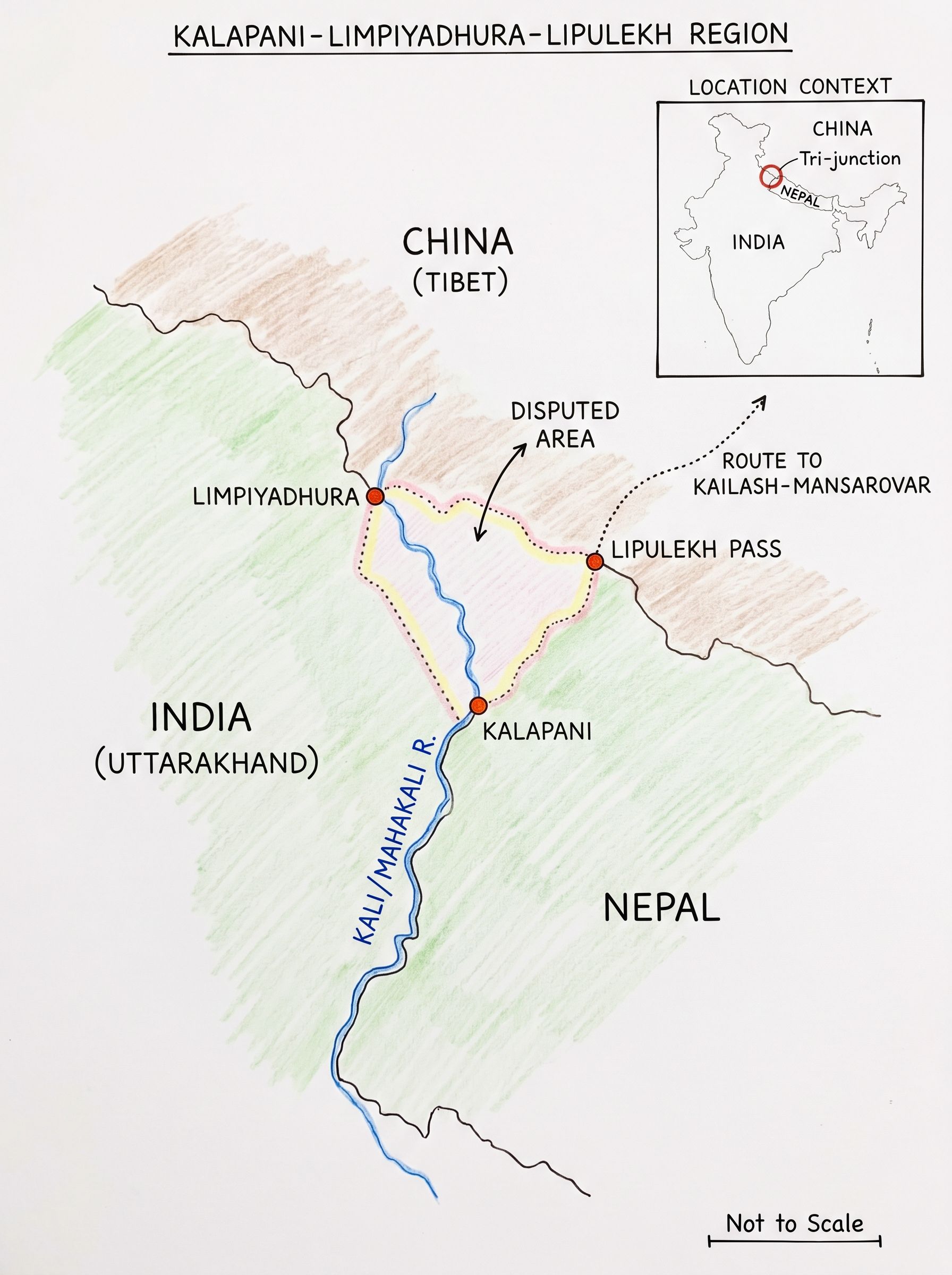
Kalapani Region

SuperKalam is your personal mentor for UPSC preparation, guiding you at every step of the exam journey.
Download the App


STUDY RESOURCES
CONTACT US
ⓒ Snapstack Technologies Private Limited