GS 3: Internal SecurityPrelims
Naxalism’s Decline and the Road to “Naxal-Mukt Bharat”, Pg 11.
India has witnessed a significant decline in Left Wing Extremism (LWE) incidents between 2010 and 2024. The government’s multi-pronged approach—combining development, governance reforms, and security measures—has led to a sharp fall in violence and affected districts.
Practice MCQs
811 Students attempted
Key Highlights:
- Civilian deaths due to Left Wing Extremism fell from 480 (2004–2013) to 152 (2014–2024).
- Affected districts reduced from 126 (2014) to 81 (2024); only 30 remain “severely affected.”
- The government’s “Naxal-Mukt Bharat” strategy integrates security operations with developmental outreach and governance presence.
- Security operations have been complemented by the Aspirational District Programme, road and telecom connectivity, and financial inclusion measures.
- Data shows fewer attacks on economic infrastructure (down from 360 in 2015 to 125 in 2024), indicating waning rebel capabilities.
- Poverty alone does not explain LWE persistence; factors like governance deficits, local neglect, and political manipulation remain central.
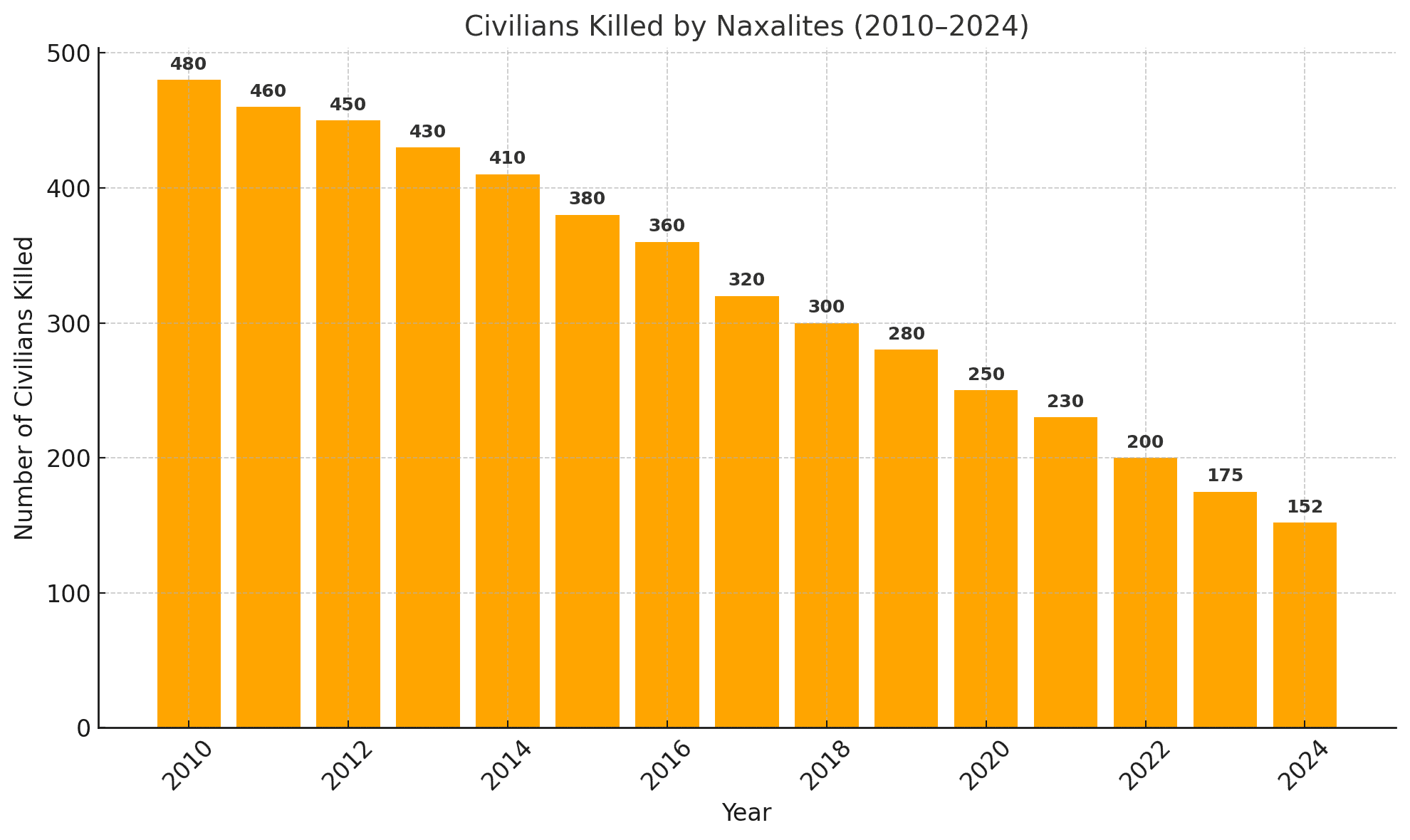
the number of civilians killed by Naxalites (2010–2024).png
Detailed Insights:
- Reassessing the Poverty Narrative: Studies by the National Bureau of Economic Research and University of North Carolina find no strong correlation between poverty/unemployment and extremism. Rather, state accessibility and governance vacuum are stronger predictors.
- Governance and Trust Deficit: Naxalism thrives where the state is perceived as distant, exploitative, or absent. Ensuring accountability, transparency, and institutional presence are critical to reversing alienation.
- Comprehensive Strategy: The Centre has adopted a “Whole-of-Government” approach involving security, development, and administrative legitimacy. The Central Armed Police Forces now operate jointly with local administrations for lasting stability.
- Socio-political Symbolism: Naxalism often capitalized on identity-based grievances—land rights, caste inequality, and resource control. Government initiatives like Skill India, Eklavya Schools, and Livelihood Missions target these underlying vulnerabilities.
- Decline and Vigilance: Despite decline in violence, experts warn against complacency; sustainable peace requires institutional reform, grassroots governance, and continued development engagement.
- Moral Lesson: India’s civilizational ethos of non-violence and inclusion, drawn from the teachings of Buddha and Gandhi, must guide its final push toward ending Left Wing Extremism through dialogue and democratic integration.
Scientific/Technical Concepts Involved:
- Multidimensional Poverty Index (MPI): Composite measure including health, education, and living standards—used to assess deprivation beyond income poverty.
- Aspirational Districts Programme: NITI Aayog initiative targeting governance and socio-economic outcomes in backward regions, many of which overlap with LWE zones.

SuperKalam is your personal mentor for UPSC preparation, guiding you at every step of the exam journey.
Download the App


STUDY RESOURCES
CONTACT US
ⓒ Snapstack Technologies Private Limited