GS 3: EconomyGS 2: International RelationsPrelims
FPIs Invest ₹6.9 Trillion in Indian Debt Market Despite Outflows from Equities, Pg 13.
In 2025, foreign portfolio investors (FPIs) have made substantial investments in India’s debt market—₹69,073 crore ($7.8 billion)—even as they pulled out capital from equities, reflecting a growing global preference for Indian fixed-income assets amid economic stability and monetary reforms.
Practice MCQs
811 Students attempted
Key Highlights:
- FPIs invested ₹1,52,775 crore ($17.26 billion) in debt instruments in 2024; in 2025, debt inflows stand at ₹69,073 crore ($7.8 billion) so far.
- Outflows from equities totaled ₹1.39 lakh crore, indicating shifting global investment sentiment.
- About ₹65,278 crore of 2025 debt inflows came through the Fully Accessible Route (FAR), with the rest via Voluntary Retention Route (VRR).
- The RBI and SEBI have liberalized norms under FAR to attract long-term foreign participation in government securities (G-secs).
- Inclusion of Indian G-secs in the JP Morgan Emerging Market Bond Index (EMBI) and similar global indices has increased foreign appetite for rupee debt.
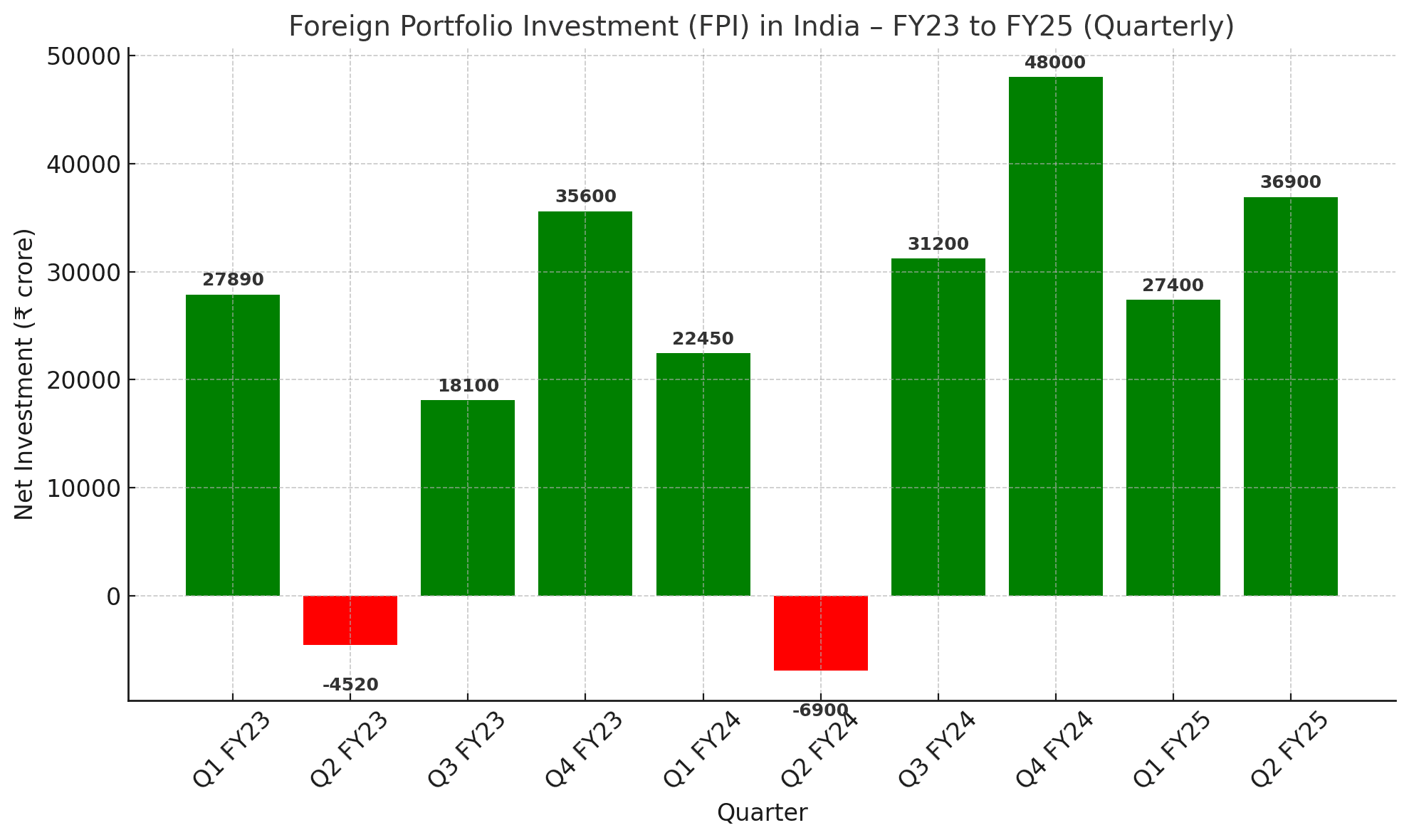
Foreign Portfolio Investment (FPI) in India.png
Detailed Insights:
- Policy Reforms Driving Inflows:
- FAR allows unrestricted foreign access to specific G-secs (5-year, 10-year, and 30-year) without investment caps.
- The move aligns with India’s goal to internationalize the rupee and deepen domestic bond markets.
- Domestic Economic Strength:
- India’s stable macroeconomic indicators—moderate inflation, fiscal consolidation, and steady growth—make it attractive for fixed-income investors seeking stability.
- Structural reforms and resilient domestic demand have strengthened India’s global investment profile.
- Global Context:
- In an environment of global uncertainty, rising US interest rates, and geopolitical tensions, FPIs are diversifying into Indian bonds for higher yields and currency stability.
- India’s inclusion in global bond indices from 2025 is expected to channel institutional flows of over $25 billion into Indian debt over the next few years.
- Market Implications:
- Increased debt inflows stabilize the rupee and strengthen forex reserves.
- However, outflows from equities highlight continued caution over valuation concerns and global monetary tightening.
- Analysts suggest that FPIs now see India as a long-term anchor for debt investment, while equities remain driven by short-term risk perception.
Scientific/Technical Concepts Involved:
- Foreign Portfolio Investment (FPI): Cross-border investment in financial assets (equity, bonds) that does not involve management control.
- Fully Accessible Route (FAR): RBI framework allowing foreign investors full access to specified government securities without investment limits.
- Voluntary Retention Route (VRR): Allows FPIs to invest in debt with a minimum retention period, promoting stability of capital inflows.
- Bond Index Inclusion: The addition of a country’s sovereign debt to global bond indices attracts automatic institutional investments through index-tracking funds.

SuperKalam is your personal mentor for UPSC preparation, guiding you at every step of the exam journey.
Download the App


STUDY RESOURCES
CONTACT US
ⓒ Snapstack Technologies Private Limited