GS 3: Environment & EcologyGS 2: GovernanceGS 3: EconomyGS 1: Indian GeographyGS 1: Indian Society
In Chhattisgarh's Hasdeo forests, ministry's green nod for coal mining in Kente block, Pg9
Environment Ministry grants controversial clearance for Kente coal block in Chhattisgarh's Hasdeo forests, risking massive deforestation, biodiversity loss, and tribal displacement.
Practice MCQs
790 Students attempted
Key Highlights:
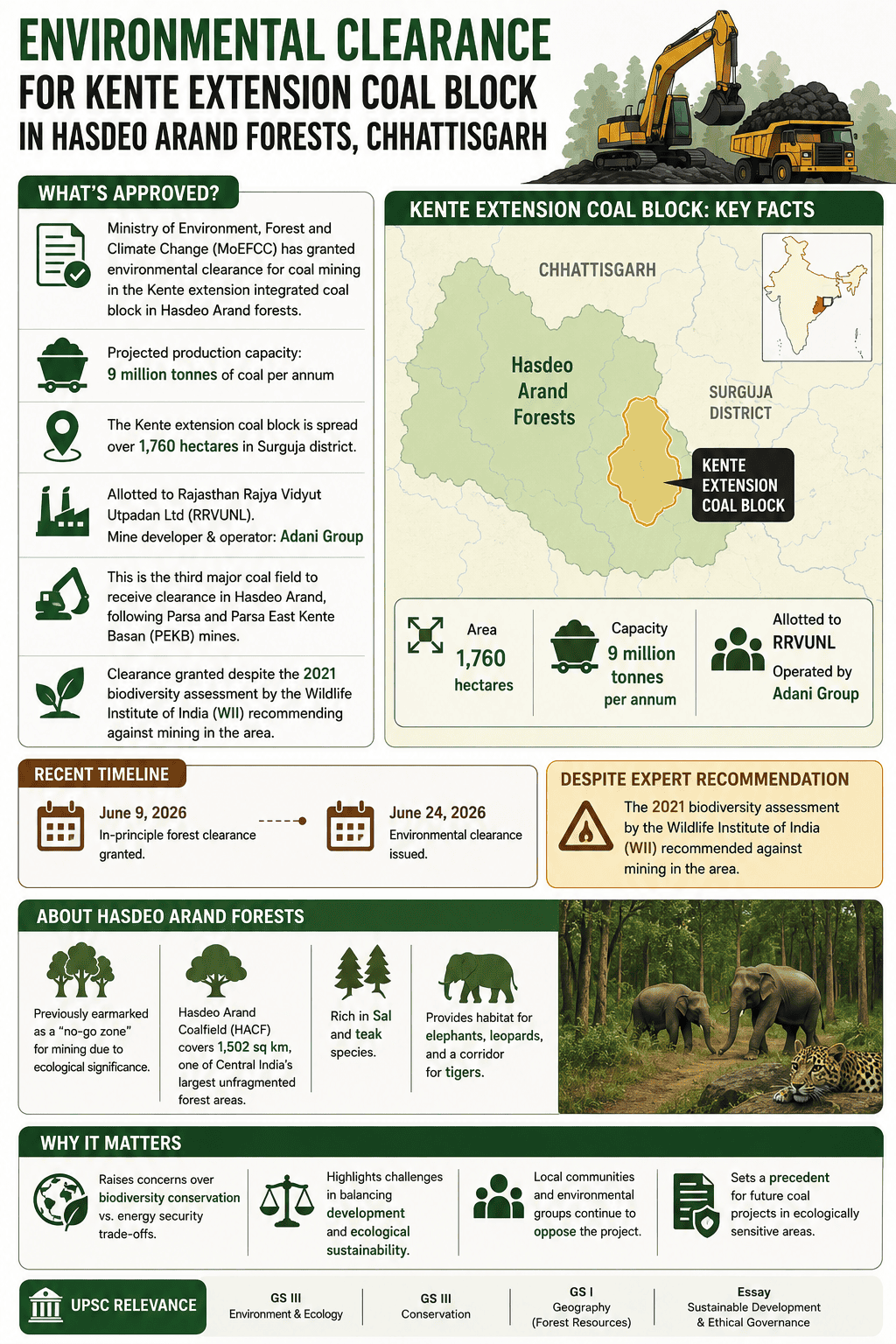
- The Ministry of Environment, Forest and Climate Change has granted environmental clearance for coal mining in the Kente extension integrated coal block in Chhattisgarh's Hasdeo Arand forests.
- The project has a projected production capacity of 9 million tonnes of coal per annum.
- The Kente extension coal block is spread over 1,760 hectares in Surguja district and was allotted to Rajasthan Rajya Vidyut Utpadan Ltd, with the Adani Group as the mine developer and operator.
- This is the third major coal field to receive clearance in Hasdeo Arand, following Parsa and Parsa East Kente Basan (PEKB) mines.
- The clearance was granted despite a 2021 biodiversity assessment by the Wildlife Institute of India (WII) recommending against mining in the area.
Hasdeo.png
Detailed Insights:
- The environmental clearance was issued on June 24, shortly after the in-principle forest clearance was granted on June 9.
- Hasdeo Arand forests were previously earmarked as a "no-go zone" for mining due to their ecological significance.
- The Hasdeo Arand Coalfield (HACF), covering 1,502 sq km, is one of Central India's largest unfragmented forest areas.
- These forests are rich in Sal and teak species and provide habitat for elephants, leopards, and a corridor for tigers.
- The Indian Council of Forestry Research and Education (ICFRE), in consultation with WII, had recommended strict environmental safeguards for the Kente extension project.
- The project involves the diversion of 1,742.6 hectares of forest land and the felling of approximately 4.48 lakh trees in phases.
- The project will affect 56 families in villages like Kente, Basan, Chakeri, and Parogia, who are to be rehabilitated.
- The Hasdeo-Arand forests are considered "Central India’s green lungs" and are a catchment for the Hasdeo river, a tributary of the Mahanadi.
Key Concepts Involved:
- Environmental Clearance (EC): A statutory approval required for certain projects that may have significant environmental impacts.
- Forest Clearance (FC): Permission granted by the government for the diversion of forest land for non-forest purposes.
- No-Go Zone: Ecologically sensitive areas identified by the government where industrial activities, particularly mining, are restricted or prohibited.
- Biodiversity Assessment: A scientific study to evaluate the variety of life forms, their habitats, and ecosystems in a specific region.

SuperKalam is your personal mentor for UPSC preparation, guiding you at every step of the exam journey.
Download the App


STUDY RESOURCES
CONTACT US
ⓒ Snapstack Technologies Private Limited