GS 2: International RelationsGS 3: Science & TechnologyGS 2: GovernanceGS 3: EconomyPrelims
Don't bet on an AI trickle-down, Pg11
US weaponizes AI access, creating a strategic gap; India must accelerate domestic chip fabrication and secure compute guarantees to avoid technological dependence.
Practice MCQs
790 Students attempted
Key Highlights:
- The article argues against the "trickle-down" effect of Artificial Intelligence (AI) capabilities, stating that advanced AI is being weaponized and controlled by leading nations.
- The United States has implemented policies to restrict access to advanced AI models and chips, exemplified by the temporary cut-off of Anthropic's models to users outside the US.
- The G7 nations are reportedly reserving frontier AI models for "trusted partners," making access a privilege controlled by Washington.
- India faces a strategic challenge, being rationed by the US for advanced AI while being courted by China for open-weight models, risking dependence on both.
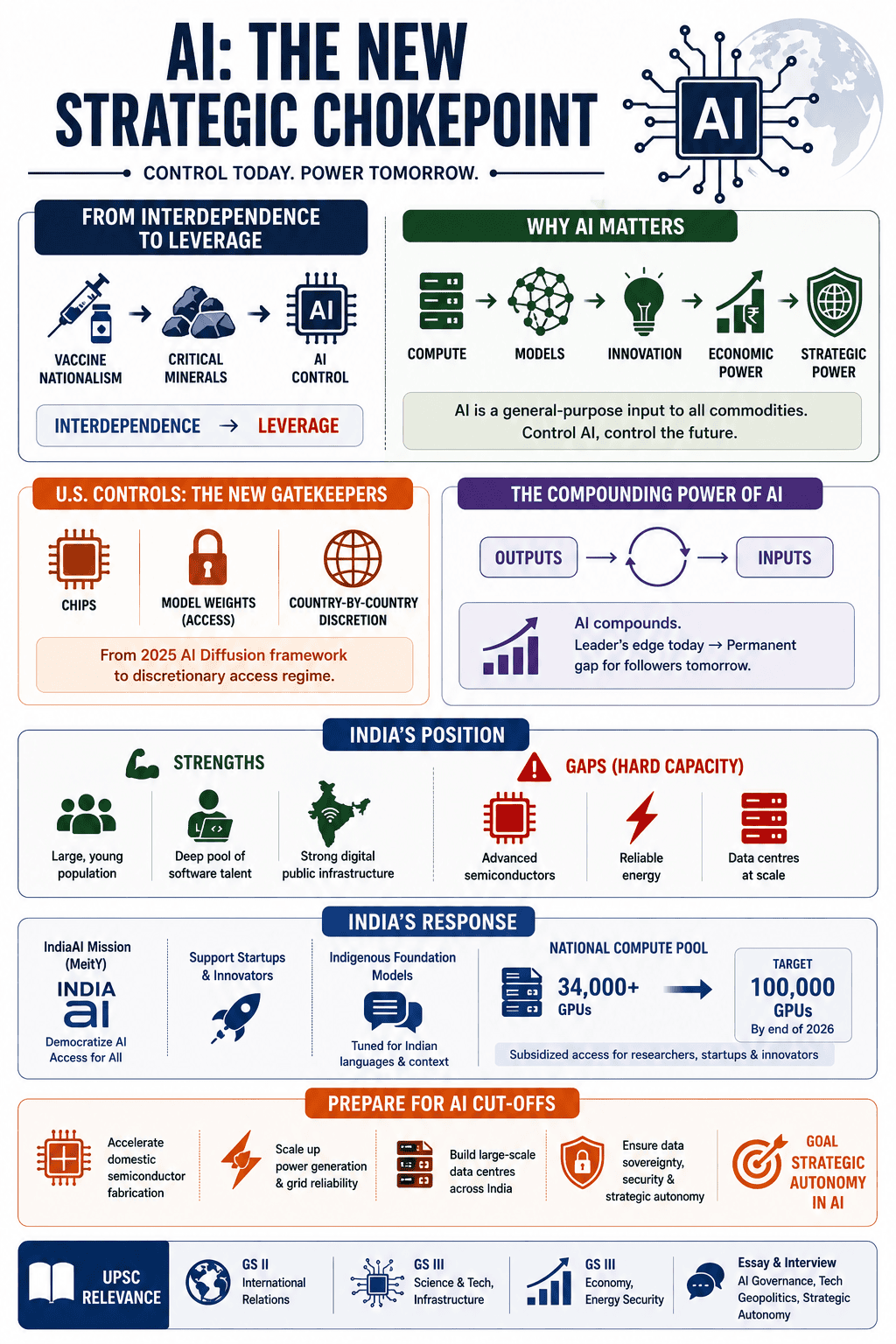
- India has launched the IndiaAI Mission with an outlay of over ₹10,372 crore to build indigenous AI capabilities, including a national compute pool with tens of thousands of Graphics Processing Units (GPUs).
AI Control.png
Detailed Insights:
- The article draws parallels between AI control and past instances of vaccine nationalism and controls over critical minerals, highlighting the conversion of interdependence into leverage.
- AI is considered a general-purpose input to all other commodities, making its control highly consequential for modern statecraft.
- The US policy, initially outlined in a conceptual 2025 AI Diffusion framework, aimed to tier access to AI model weights and chips, which has since evolved into a discretionary country-by-country regime.
- The compounding nature of AI, where outputs feed back as inputs, means that a leader's edge can harden into a permanent structural gap for followers.
- India possesses a significant demographic advantage with a large, young population and a deep pool of software talent, but lacks hard capacity in advanced semiconductors, reliable energy, and data centers.
- The IndiaAI Mission, implemented by the Ministry of Electronics and Information Technology (MeitY), aims to democratize AI access, support startups, and develop indigenous foundational models tuned for Indian languages.
- India's national compute pool has expanded to over 34,000 GPUs, with a target of 100,000 by the end of 2026, offering subsidized access to researchers and startups.
- The article emphasizes the need for India to prepare for potential AI cut-offs by accelerating domestic fabrication, power generation, and data center buildout to ensure data sovereignty and strategic autonomy.
Key Concepts Involved:
- Weaponization of AI: The strategic use of AI capabilities by nations to gain geopolitical and economic leverage, including restricting access to advanced technology.
- General-Purpose Technology: A technology that has the potential to affect an entire economy and society, leading to widespread innovation and productivity gains across multiple sectors.
- Data Sovereignty: The principle that data is subject to the laws and governance structures of the nation in which it is collected or stored, implying national control over data.

SuperKalam is your personal mentor for UPSC preparation, guiding you at every step of the exam journey.
Download the App


STUDY RESOURCES
CONTACT US
ⓒ Snapstack Technologies Private Limited