GS 3: Environment & EcologyGS 2: PolityGS 2: GovernancePrelims
Top court appoints high-powered panel to review Aravalli definition report, Pg3
Supreme Court appoints high-powered panel under ICFRE DG Kanchan Devi to independently review controversial Aravalli definition report, ensuring impartial ecological protection against unregulated mining.
Practice MCQs
782 Students attempted
Key Highlights:
- The Supreme Court has constituted a High-Powered Committee (HPC) under Kanchan Devi, Director General of the Indian Council of Forestry Research and Education (ICFRE), to review the definition of the Aravalli hills.
- The HPC is tasked with providing a fair, impartial, and independent opinion to resolve critical ambiguities in a previous report on the Aravalli definition.
- The committee is mandated to submit its comprehensive report by August 31.
- The previous report, submitted in October 2025 by a panel chaired by the Environment Secretary, faced criticism for potentially excluding 90% of Aravalli hills by proposing a 100-meter height threshold.
- The Forest Survey of India (FSI) had warned against this threshold, and the Central Empowered Committee (CEC) had raised objections, which were reportedly overlooked.
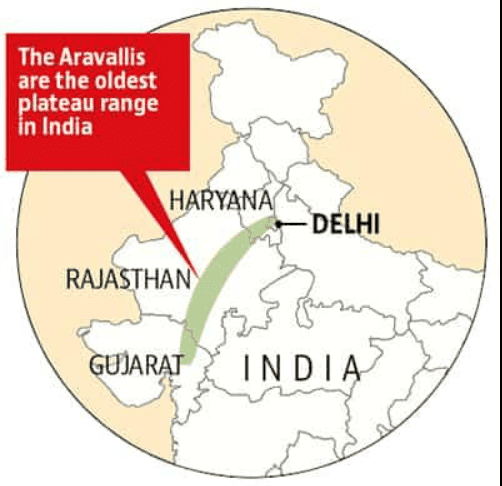
Aravalli.png
Detailed Insights:
- The Supreme Court's intervention stems from concerns over a controversial definition of the Aravalli hills that could significantly reduce their protected area, potentially facilitating unregulated mining.
- The previous report's definition, which considered only landforms 100 meters or more in elevation and within 500 meters of other hills, was criticized for its narrow scope.
- The amicus curiae in the Aravalli definition case had informed the court that the October 2025 report suppressed the views of the FSI.
- On December 29, the Supreme Court put the implementation of the Environment Ministry's report on hold, emphasizing the need for an independent expert review.
- The HPC will specifically address whether the 500-meter gap and 100-meter elevation criteria create a structural paradox and if the assertion that only 1,048 of Rajasthan's 12,081 hills meet the threshold is scientifically accurate.
- The Aravalli Range is ecologically crucial, acting as a natural barrier against the Thar Desert's eastward expansion, aiding groundwater recharge, and moderating climate.
- The HPC comprises experts from various fields, including former DGs of Forest Survey of India and Geological Survey of India, and former officials from the Environment Ministry.
Key Concepts Involved:
- High-Powered Committee (HPC): A specialized committee formed by a high authority, often the Supreme Court, to investigate complex issues and provide expert recommendations.
- Indian Council of Forestry Research and Education (ICFRE): An autonomous body under the Ministry of Environment, Forest and Climate Change, responsible for forestry research, education, and extension.
- Forest Survey of India (FSI): A national organization under the Ministry of Environment, Forest and Climate Change, responsible for assessing and monitoring India's forest resources.
- Central Empowered Committee (CEC): A body established by the Supreme Court to monitor compliance with its orders on environment, forest, and wildlife matters and submit independent reports.
- Amicus Curiae: A Latin term meaning "friend of the court," referring to an impartial advisor, often a legal professional, appointed by the court to assist in complex legal matters.

SuperKalam is your personal mentor for UPSC preparation, guiding you at every step of the exam journey.
Download the App


STUDY RESOURCES
CONTACT US
ⓒ Snapstack Technologies Private Limited